Chen Collection, Lower Volume
Radical: Death (dǎi)
Kangxi Strokes: 12
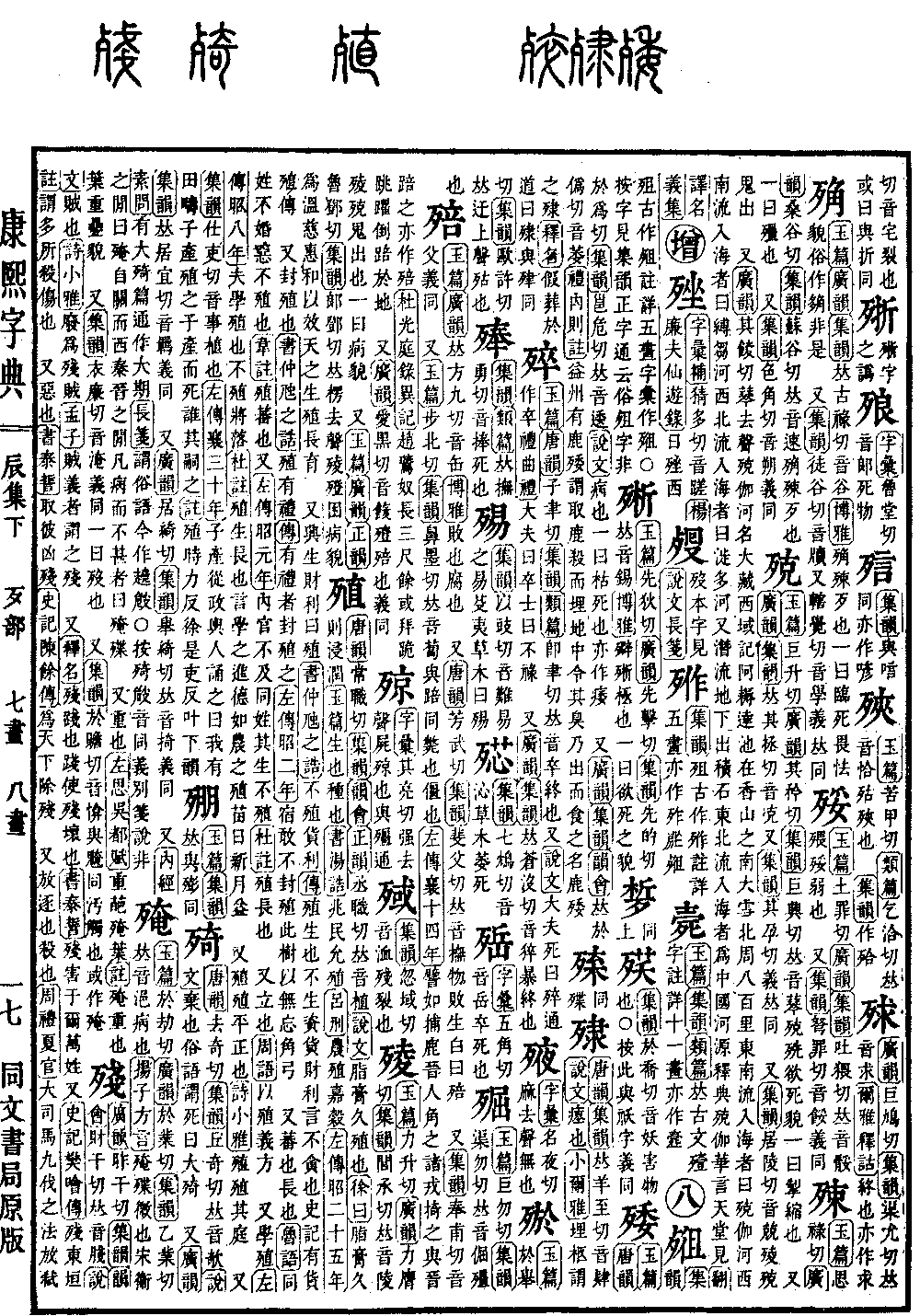
Page 581, Entry 01
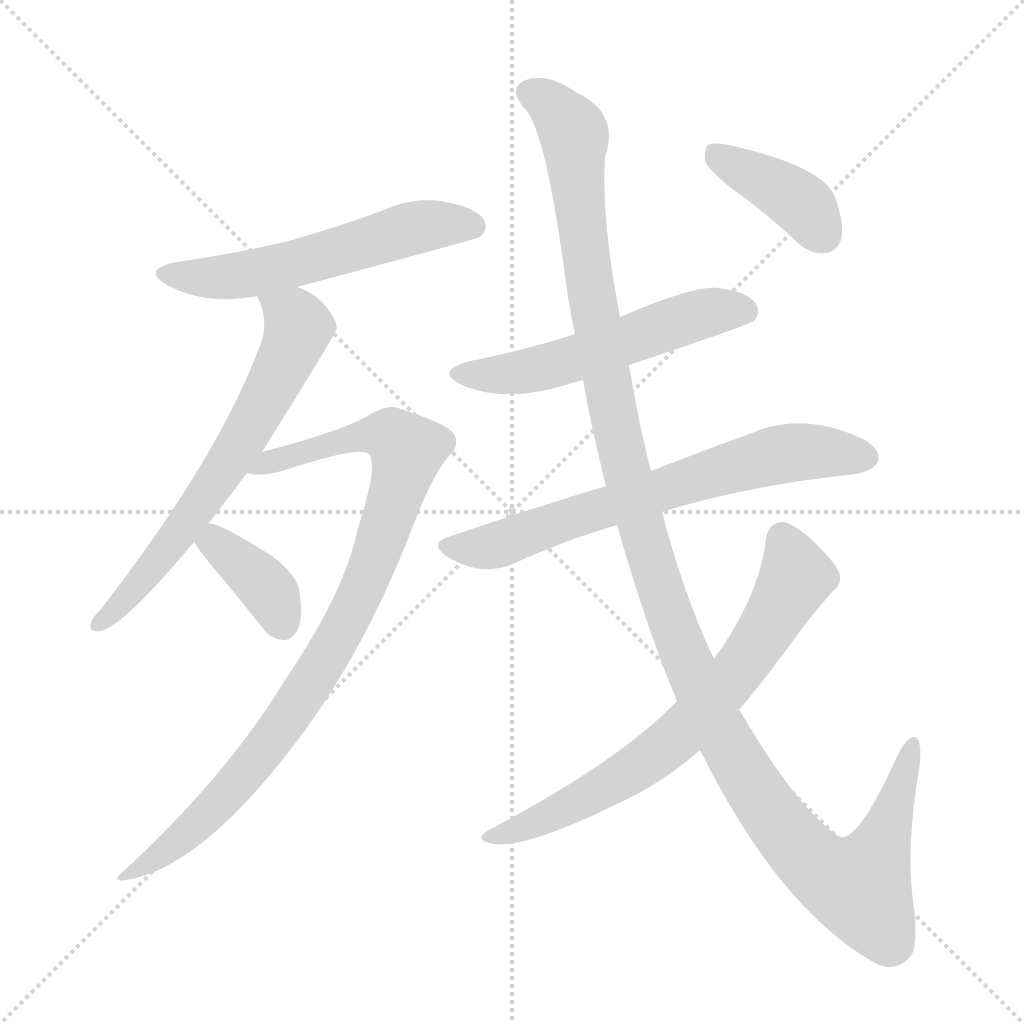
Pronounced cán.
Shuowen Jiezi (Explanation of Writing): To injure or destroy.
Book of Odes (Shijing), Lesser Odes: To become a thief who causes injury and destruction.
Mencius: Those who injure justice and righteousness are called cán.
Also, Explaining Names (Shiming): Cán means to trample. To trample something so that it becomes broken or destroyed.
Book of Documents (Shangshu), Oath at Tai: To harm and destroy your myriad people.
Also, Records of the Grand Historian (Shiji), Biography of Fan Kuai: To capture and break the city of Dongyuan. Commentary: Refers to killing and wounding many people.
Also, ferocious or cruel.
Book of Documents (Shangshu), Oath at Tai: Eliminate those cruel and violent people.
Records of the Grand Historian (Shiji), Biography of Chen Yu: To eliminate the cruel and violent for the sake of the world.
Also, to banish or slaughter.
Rites of Zhou (Zhouli), Summer Officials, Great Minister of War: Among the nine rules of military expeditions, if a ruler is banished or killed, the state is exterminated.
Fangyan (Dialectology): Means to kill. In the regions of Jin, Wei, and north of Henei, killing is called cán. Pronounced lǐn. Or read as luò gǎn.
Also, leftovers of food.
Du Fu: Remaining wine and cold side dishes.
Also, a name for a method of cooking meat.
Zhang Xie, Seven Stimuli: Cooking the lips of an orangutan, the residual meat of a zebu, and the white tusks of an elephant. Commentary: Zebu is a type of ox. Residual white is likely another name for a type of boiled meat.
Cui Yin, Treatise on Gamblers: Boiled residual meat of a sheep.
Also, incomplete or fragmented.
Liu Xin, Memorial to the Academicians of the Taichang: To persist in one's own biases and strictly defend incomplete texts. Commentary: Shigu says: To persist in one's own prejudices and obstinately cling to incomplete texts.
Also, forced interpretations are called zùicán.
Wang Chong, Balanced Discourses (Lunheng): A cartload of chaotic and fragmentary books cannot make a principle. A box full of jade dust cannot make a treasure.
Also, malicious cursing is called cánmà.
Fangyan: In the southern Chu region, malicious cursing is called qián.
Also, greedy and cruel officials are called cánlì.
Book of the Later Han (Hou Hanshu), Annals of Emperor Ming: Greedy and violent officials act recklessly and without restraint.
Also, Five Cán, name of a constellation.
Records of the Grand Historian (Shiji), Treatise on the Celestial Offices: The Five Cán star appears in the fields of the due east; its shape resembles the Planet Mercury (Chenxing).
Orthodox Meaning: Five Cán is also called Five Peaks.
Book of the Former Han (Qian Hanshu), Treatise on Arts and Letters: Contains Twenty-one Volumes of Miscellaneous Changes of the Five Cán Stars.
Also, interchangeable with the character jiān.
Book of Changes (Yijing), Bì Hexagram: A bundle of silk is light and sparse. Commentary: Citing the Zixia interpretation of the Book of Changes, it says a bundle of silk is sparse and thin.
Also, Records of Wei (Weizhi): The people of Chenhan called the people of Lelang "A-Cán." Easterners calling us "A" implies that the people of Lelang were originally the remnants of their people.
Also, kuàicán, name of a fish.
Pi Rixiu: One can clearly count the kuàicán fish.
Also, Biographies of Eminent Monks (Gaoseng Zhuan): Chan Master Mingzan was lazy by nature and ate leftovers, so he was nicknamed Lazy Cán.
Also, Rhyme Supplement (Yunbu): Rhymes with the character cái xiān; read like qián.
Ban Biao, Northern Expedition Rhapsody: With body and head separated, yet not awakened; still counting merits while shirking blame. Why does the master explain this indiscriminately? Who says the earth's veins can give birth to harm?
Also, Brush Talks from Dream Brook (Mengxi Bitan): Wang Shengmei studied philology and inferred that the semantic indicator is on the right side. All characters have the category indicator on the left (radical) and the meaning indicator on the right (phonetic). For example, in the wood category, the left side uses the wood radical. The so-called right-side meaning characters, such as jiān, mean sparse or small. Water that is sparse is called shallow (qiǎn), metal that is small is called money (qián), death that is evil and small is called residual (cán), and shells that are small are called cheap (jiàn). These all use jiān to denote meaning. Note: The meaning of cán originally combines both large and small aspects, so it is temporarily noted here.
Research verification: Cui Yin, Treatise on Gamblers, "huò yáng cán." Corrected according to the original text; "huò" replaced "huò."