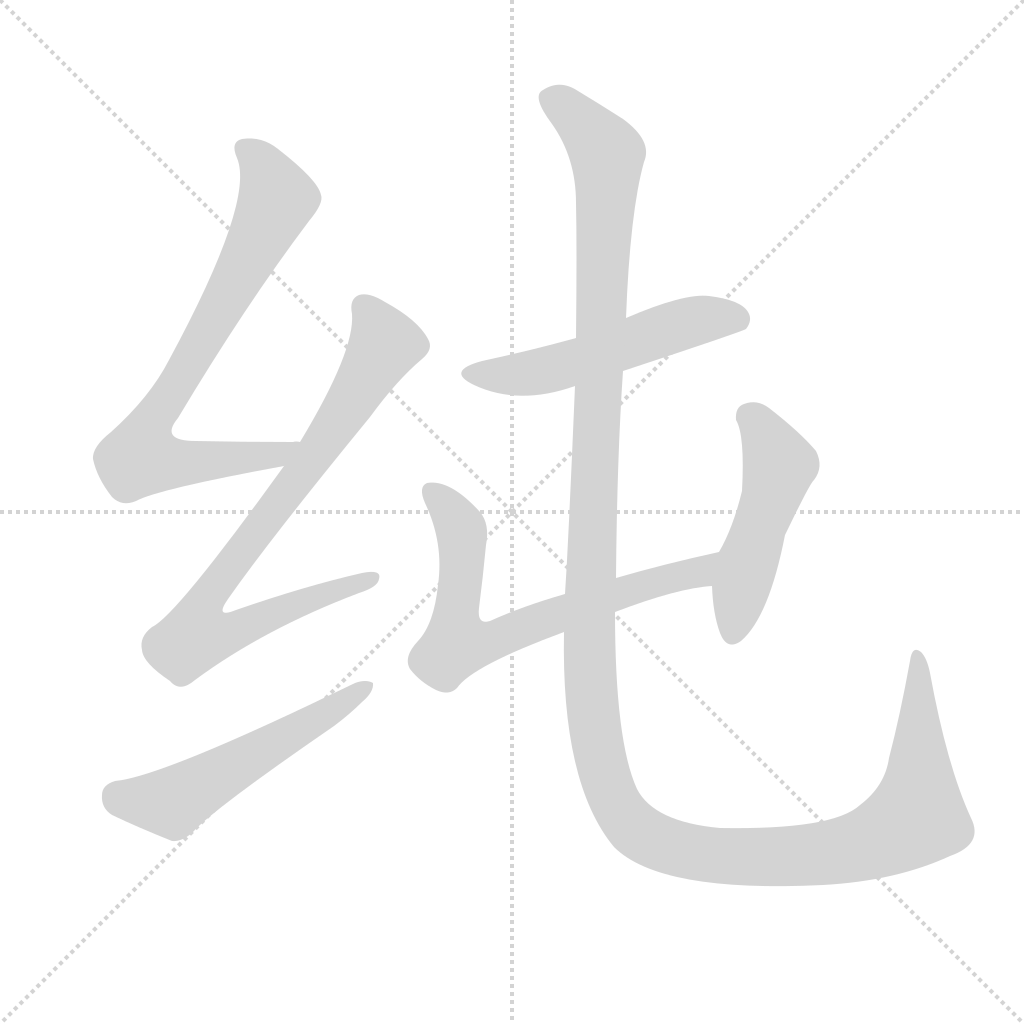
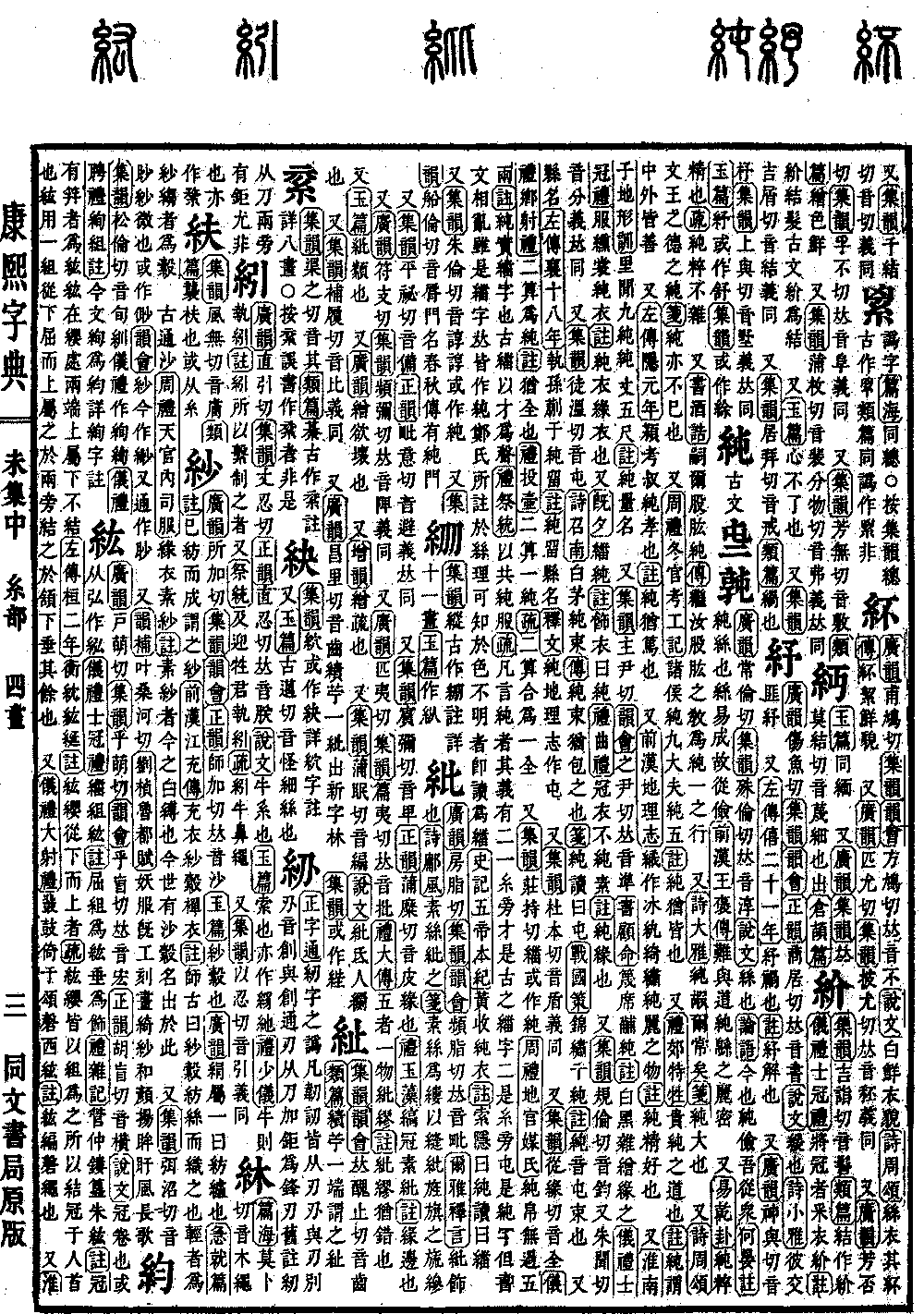
Wei Collection, Middle Volume
Radical: Silk (mì)
Kangxi Strokes: 10
Page 917, Entry 02
Ancient script. Pronounced chun (level tone).
Shuowen Jiezi (Explanation of Simple and Compound Characters): Silk.
Analects (Lunyu): Now, being simple and frugal, I follow the multitude. He Yan notes: The term means silk. Silk is easily made, hence it follows the principle of frugality.
History of the Former Han (Qian Hanshu), Biography of Wang Bao: It is difficult to speak of the beauty and density of silk and cotton.
Also, Book of Changes (Yijing), Qian Hexagram: Pure and unadulterated, refined. Commentary: Pure and unadulterated, not mixed.
Also, Book of Documents (Shujing), Announcement on Wine: Continue your core duties with simplicity. Commentary: Continue the teachings of your core assistants and practice simple and singular conduct.
Also, Book of Odes (Shijing), Greater Odes: Great blessings are yours constantly. Commentary: The term means great.
Also, Book of Odes (Shijing), Odes of Zhou: The virtue of King Wen is pure. Commentary: The term also means ceaseless.
Also, Rites of Zhou (Zhouli), Winter Bureau of Artificers: Feudal lords practice a standard of nine, grand masters a standard of five. Commentary: The term means all.
Also, Book of Rites (Liji), Suburban Sacrificial Offering: The way of valuing purity. Commentary: Pure means that both inside and outside are good.
Also, Zuo Tradition (Zuozhuan), First Year of Duke Yin: Ying Kaoshu, purely filial. Commentary: The term means sincere.
Also, History of the Former Han (Qian Hanshu), Treatise on Geography: Weaving ice-like gauze, patterned silk, and pure, beautiful items. Commentary: The term means refined and excellent.
Also, Huainanzi, Treatise on Terrain: Between villages, nine measures, a measure being five feet. Commentary: The term is a unit of measurement.
Also, Pronounced zhun (rising tone).
Book of Documents (Shujing), The Testamentary Charge: A bamboo mat with black and white embroidered borders. Commentary: Silk fabric with black and white patterns used as a border.
Book of Etiquette and Ceremonial (Yili), The Ceremony of Capping for Scholars: Wearing light red skirts and bordered garments. Commentary: A bordered garment is one with a decorative edge.
Also, The Day After Death: Black borders. Commentary: Adorning a garment is called a border.
Book of Rites (Liji), Summary of the Rules of Propriety: Do not wear white borders on ceremonial clothing. Commentary: The term means border.
Also, Pronounced jun (level tone).
Also, Pronounced zhun (falling tone). Same meaning as above.
Also, Pronounced tun (level tone).
Book of Odes (Shijing), Odes of Shao: Bound with white cogon grass. Commentary: Bound together, meaning to wrap it. Commentary: Pronounced as tun.
Strategies of the Warring States (Zhanguo Ce): One thousand bundles of silk and embroidery. Commentary: Pronounced tun, meaning to bundle.
Also, name of a district. Zuo Tradition (Zuozhuan), Eighteenth Year of Duke Xiang: Arrested Sun Kuai at Chunliu. Commentary: Chunliu is the name of a district. Explication of Text: The Geography Treatise records it as Tun.
Also, Pronounced dun (level tone). Same meaning as above.
Also, Pronounced quan (level tone).
Book of Etiquette and Ceremonial (Yili), Ceremony of Archery for Local Communities: Two tallies make one unit. Commentary: It means complete or whole.
Book of Rites (Liji), Pitch-pot: Two tallies make one unit. Commentary: Two tallies combined make one whole.
Also, Pronounced zhuang (level tone). The character for black silk (zi) is sometimes written as this.
Rites of Zhou (Zhouli), Earth Office, Officer of Matchmaking: Pure silk must not exceed five liang. Commentary: The term refers to black silk. In ancient times, the character for black silk was phonetic.
Book of Rites (Liji), Principles of Sacrifice: To provide for the pure robes. Commentary: Whenever the term is used, it has two meanings: first, with the silk radical and the phonetic component for black silk (zi), it is the ancient character for black silk; second, with the silk radical and the phonetic component for tun, it is the character for pure (chun). However, since the texts are often confused, even when it is the character for black silk, it is written as pure. Where Zheng Xuan’s commentary concerns the texture of silk, it is understandable, but where the color is unclear, it is read as black silk (zi).
Records of the Grand Historian (Shiji), Annals of the Five Emperors: Yellow robes of black silk. Commentary: The Souyin notes: Read as black silk (zi).
Also, Pronounced zhun (level tone). The word for repetitive (zhun) is sometimes written as this.
Also, Pronounced chun (level tone). Name of a gate. The Spring and Autumn Tradition (Chunqiu Zhuan) mentions the Chun Gate.