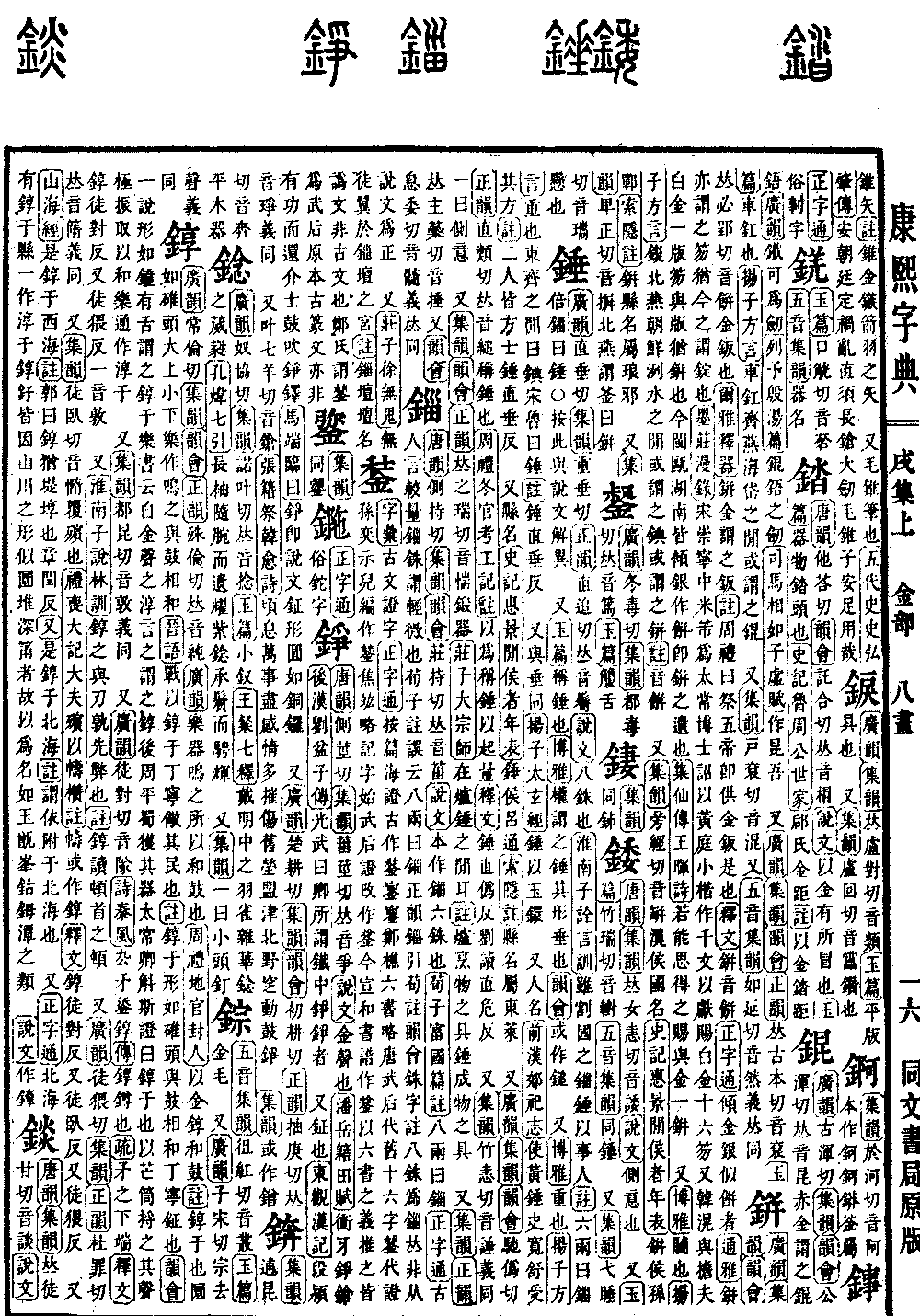
Xu Collection, Upper Volume
Radical: Metal (jīn)
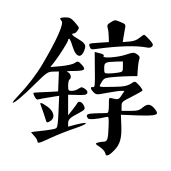
Character: Chun
Kangxi Stroke Count: 16
Page 1310, Entry 20
Pronounced chun.
Broad Rimes (Guangyun): Used for musical instruments; a percussion instrument used to harmonize with drums.
Rites of Zhou (Zhouli), Office of the Earth, Drum Master: Use the metal chun to harmonize with drums.
Commentary: This refers to the chunyu. It is round like a pestle head, wide at the top and narrow at the bottom. When music begins, it is sounded to harmonize with the drums.
Discourses of the States (Jinyu): Fight with the chunyu and the dingning to alert the people.
Commentary: The chunyu is shaped like a pestle head and harmonizes with the drums. The dingning is a gong.
Collection of Rimes (Yunhui): One theory states it is shaped like a bell with a tongue, called a chunyu.
Book of Music (Yueshu) states: Derived from the pure (chun) sound of metal, it is called a chun. After the Northern Zhou dynasty pacified Shu, they captured this instrument. The Minister of Ceremonial Affairs, Husi Zheng, said: This is a chunyu. When played with a reed tube, its sound is extremely resonant; it is used to harmonize music. It is commonly written as chunyu.
Pronounced dun. Same meaning.
Pronounced dui.
Book of Odes (Shijing), Odes of Qin: With sharp spears and metal butts.
Commentary: Chun refers to the butt (zun) of a spear.
Sub-commentary: The lower end of a spear.
Explanation of Texts (Shiwen): Chun, pronounced dui. Also pronounced dun.
Huainanzi, Forest of Sayings: Between the butt and the blade, which wears out first?
Commentary: Chun is read like the dun in dunshou (bowing to the ground).
Pronounced du. Same meaning.
Pronounced duo. To cover.
Book of Rites (Liji), Records of Mourning: The great officer uses a cover (dao) for the burial frame.
Note: Dao is sometimes written as chun.
Explanation of Texts (Shiwen): Chun, pronounced dui. Also pronounced duo. Also pronounced du.
Classic of Mountains and Seas (Shanhaijing): This is located at the chun (border/mound) of the Western Sea.
Commentary: Guo Pu says: Chun is like a dike or mound.
Classic of Mountains and Seas (Shanhaijing): This is located at the chun of the Northern Sea.
Commentary: This means it is situated, or attached to, the Northern Sea.
Authentic Dictionary (Zhengzitong): The Northern Sea has Chunyu County. It is also written as chunyu. The names chun and chunyu all arise because the mountains and rivers resemble round mounds or deep cylinders, such as the Jade Steamer Peak or the Cobalt Pool.
Shuowen Jiezi writes it as the variant form.
Textual Research: In Rites of Zhou, Office of the Earth, Fengren, the text has been corrected to Drum Master according to the original text.