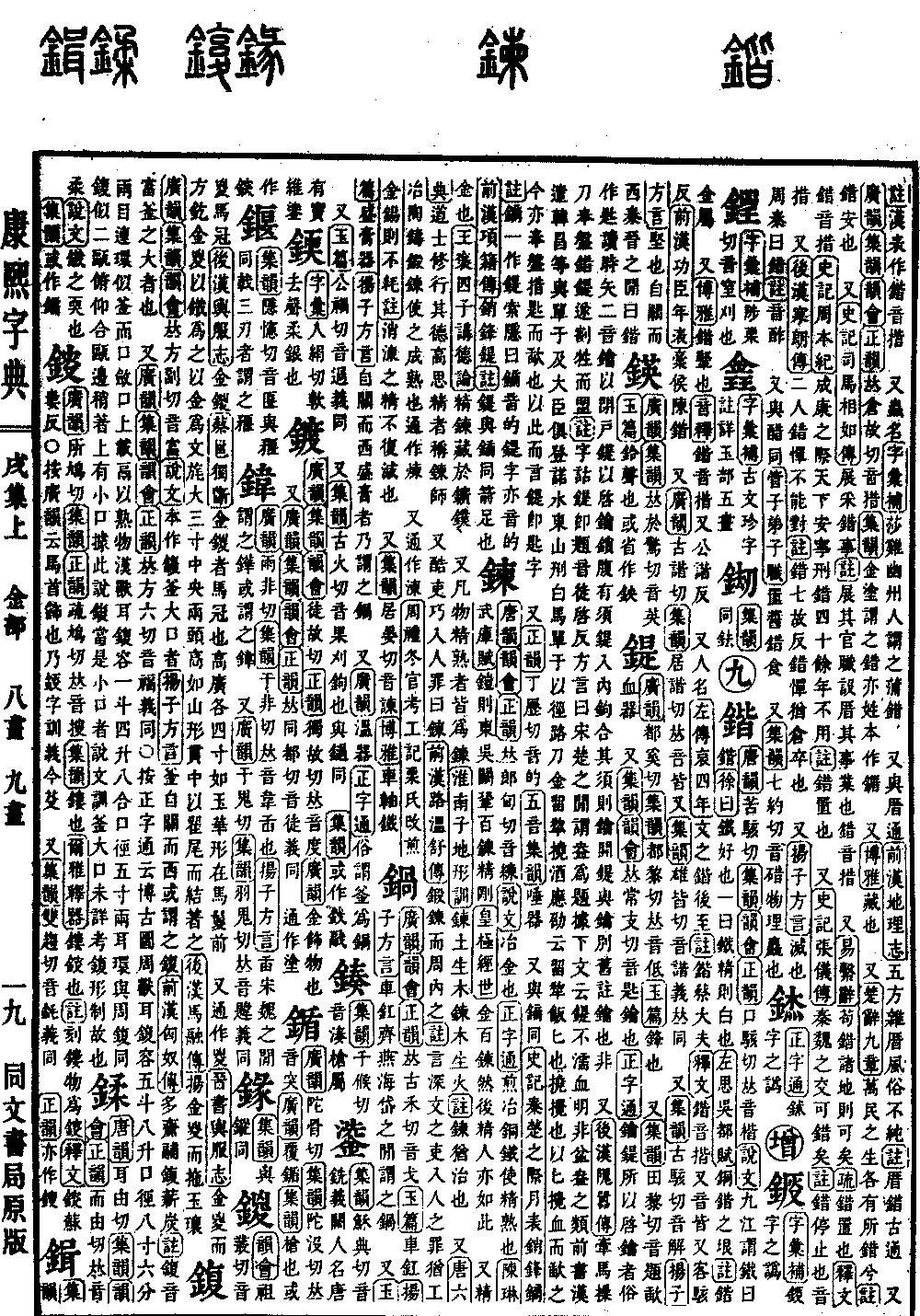
Xu Collection, Upper Volume
Radical: Metal (jīn)
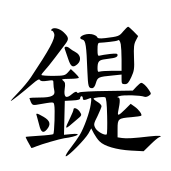
Character: 鍉
Kangxi Stroke Count: 17
Page 1313, Entry 08
Broad Rimes (Guangyun): Pronounced dī
Collected Rimes (Jiyun): Pronounced dī
Jade Chapters (Yupian): Sharp edge of a blade.
Also according to Collected Rimes (Jiyun): Pronounced tí. A vessel used for smearing blood during a blood covenant.
Also according to Collected Rimes (Jiyun) and Rhyme Collection (Yunhui): Pronounced chí. A key.
Correct Meaning Thoroughly Comprehended (Zhengzitong): A key is used to open a lock; it is commonly written as 匙 and pronounced with the sounds shí or shǐ. A lock is used to close a door, and a key is used to open a lock. Inside the lock cylinder there are springs; when the key is inserted, it engages the springs, and the lock opens. A key is different from a lock; older commentaries identifying it as a lock are incorrect.
Also in Biography of Wei Xiao in the History of the Later Han (Hou Hanshu): Leading horses and holding knives, holding a platter and placing a key upon it, thereupon slaughtering livestock to form an alliance.
Commentary: In the Exegesis of Characters (Zigu), it states: The character 鍉 is the same as tí, pronounced túqǐ. Local dialects state: Between the regions of Song and Chu, basins and bowls are called tí. Based on the following passage stating that the key is not stained with blood, it is clearly not a basin or bowl. The previous record states that the Han dynasty sent Han Chang and others, together with the Chanyu and his ministers, to ascend the eastern mountain of the Nuo River. They slaughtered a white horse, and the Chanyu used a jinglu knife and a metal liuli to stir the wine. Ying Shao said: Liuli is a rice spoon. Nao means to stir. One uses a spoon to stir blood in order to smear it for a blood oath; currently, one also holds a platter and places a spoon upon it to smear the blood. From this perspective, the character 鍉 is the same as the character for spoon.
Also in Correct Rhymes (Zhengyun): Pronounced dí.
Five Sounds Collected Rimes (Wuyin Jiyun): A spittoon.
Also the same as the character for arrowhead.
In Monthly Tables of the Time Between the Qin and Chu Dynasties in Records of the Grand Historian (Shiji): Destroying weapons and arrowheads.
Commentary: The character for arrowhead is also written as 鍉. The Search for Mysteries (Suoyin) says: The character for arrowhead is pronounced dí, and the character 鍉 is also pronounced dí.
In Biography of Xiang Ji in the History of the Former Han (Qian Hanshu): Destroying weapons and arrowheads.
Commentary: 鍉 is the same as the character for arrowhead. It refers to the tip of an arrow.