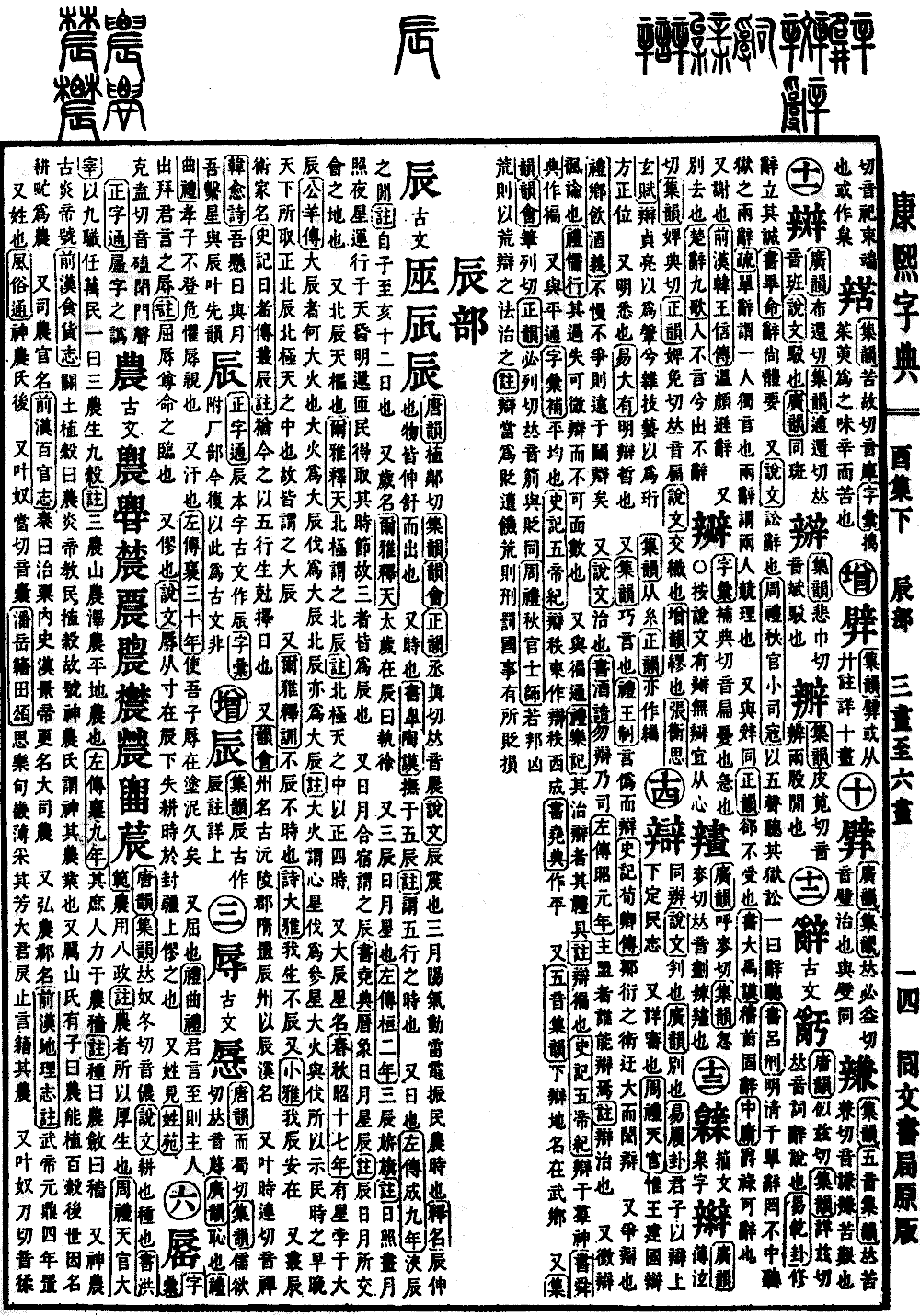
You Collection, Lower Volume
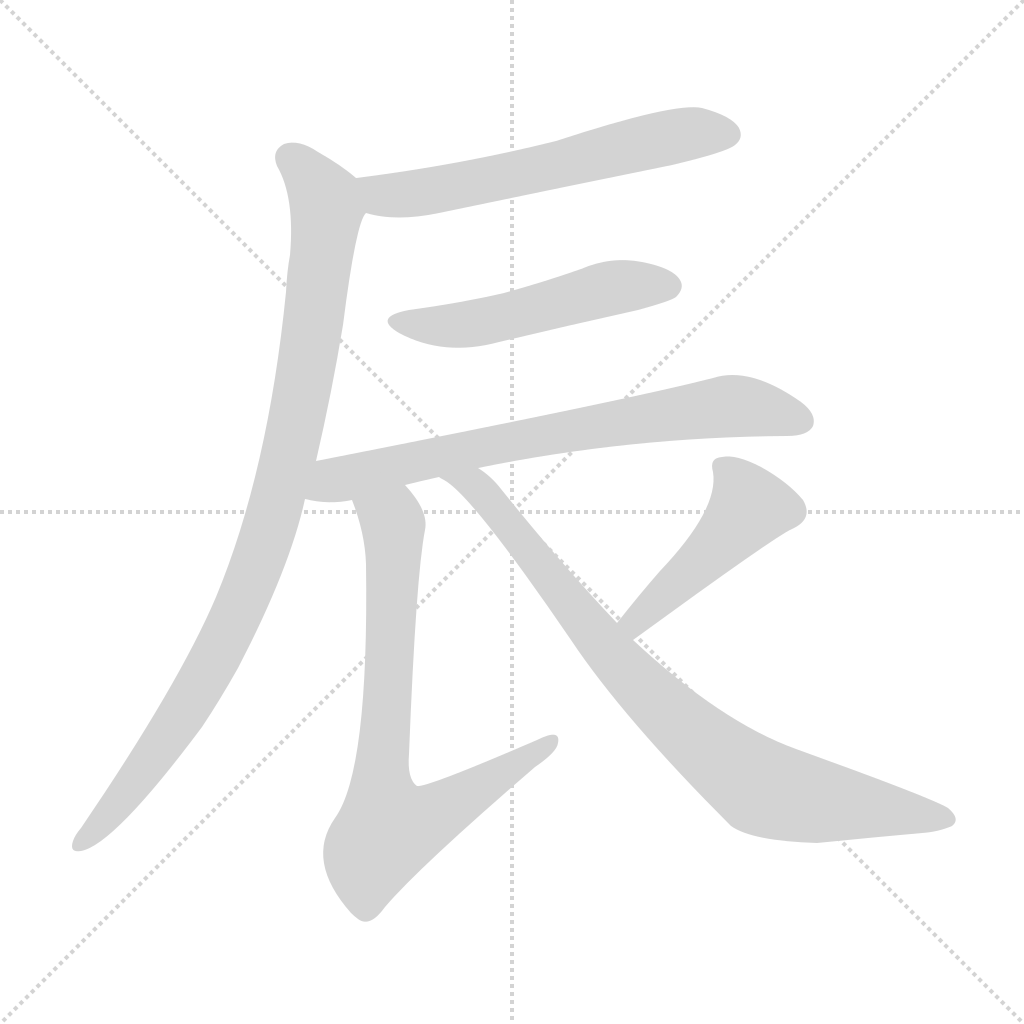
Radical: Star (chén)
Kangxi stroke count: 7
Page 1252, Entry 15
Ancient text records: Tang Rhyme (Tangyun) pronounces as zhi lin. Collected Rhymes (Jiyun), Rhyme Meetings (Yunhui), and Orthodox Rhymes (Zhengyun) pronounce as cheng zhen; the pronunciation is the same as morning.
Shuowen Jiezi explanation: The character star (chen) means vibration. In the third month, the yang energy initiates, and the sound of thunder vibrates; it is the season for commoners to plow.
Explanation of Names (Shiming) says: Star (chen) means to stretch. All things stretch, grow, and emerge. It also refers to the time of day.
Book of Documents (Shangshu), Counsels of Gao Yao: Follow the five seasons. Commentary: This refers to the seasons of the five elements.
It also refers to days. Zuo Tradition (Zuozhuan), Ninth Year of Duke Cheng: The twelve celestial positions. Commentary: From the zi day to the hai day, a total of twelve days.
It is also used as a name for a year. Er Ya, Explaining Heaven: The year when the Tai Sui is in the star position is called Zhixu.
Also, the three luminaries refer to the sun, moon, and stars. Zuo Tradition (Zuozhuan), Second Year of Duke Huan: The banners of the three luminaries. Subcommentary: The sun illuminates the day, the moon illuminates the night, and the stars move in the sky. As day and night alternate in cycles, the commoners can master the seasons by them, which is why these three are called stars.
Also, the place where the sun and moon meet is called the star position. Book of Documents (Shangshu), Canon of Yao: Observe and calculate the movements of the sun, moon, and stars. Commentary: The star position is the place where the sun and moon meet.
Also, the North Star refers to the pole star, which is the pivot of the celestial body. Er Ya, Explaining Heaven: The pole star is called the North Star. Commentary: The pole star is located in the center of the sky and is used to determine the four seasons.
Also, the Great Star is the name of a star. Spring and Autumn Annals (Chunqiu), Seventeenth Year of Duke Zhao: A comet appeared near the Great Star. Gongyang Tradition (Gongyangzhuan): What is the Great Star? It is the Fire Star. The Fire Star is a Great Star, the Fa Star is a Great Star, and the North Star is also a Great Star. Commentary: The Fire Star refers to Antares; the Fa Star refers to Orion. The Fire Star and the Fa Star are used to show the time of day to the commoners and are the basis for determining time in the world. The North Star is the center of the northern polar sky, so it is also called a Great Star.
Also, Er Ya, Explaining Teachings: Not star (bu chen) means being out of season. Book of Odes (Shijing), Greater Odes: I was born at an unlucky time. Lesser Odes: Where is my good season?
Also, clustered stars is a term from practitioners of divination. Records of the Grand Historian (Shiji), Biography of Diviners, Commentary on Clustered Stars: It is like choosing days by using the generation and restriction of the five elements as done today.
Also, Rhyme Meetings (Yunhui): It is the name of a prefecture. In ancient times, it was Yuanling Commandery; during the Sui Dynasty, Chen Prefecture was established, named after the Chen River.
Also, rhyming at the end, pronounced as chan. Han Yu poem: I hang the sun and moon; I bind the stars. Rhymes with the first category.
Textual research: Zuo Tradition (Zuozhuan), Second Year of Duke Huan: The banners of the three luminaries. Commentary: The sun illuminates the day, the moon illuminates the night, the stars move in the sky, and dusk and dawn alternate in cycles. Following the original text, the Commentary has been changed to Subcommentary.