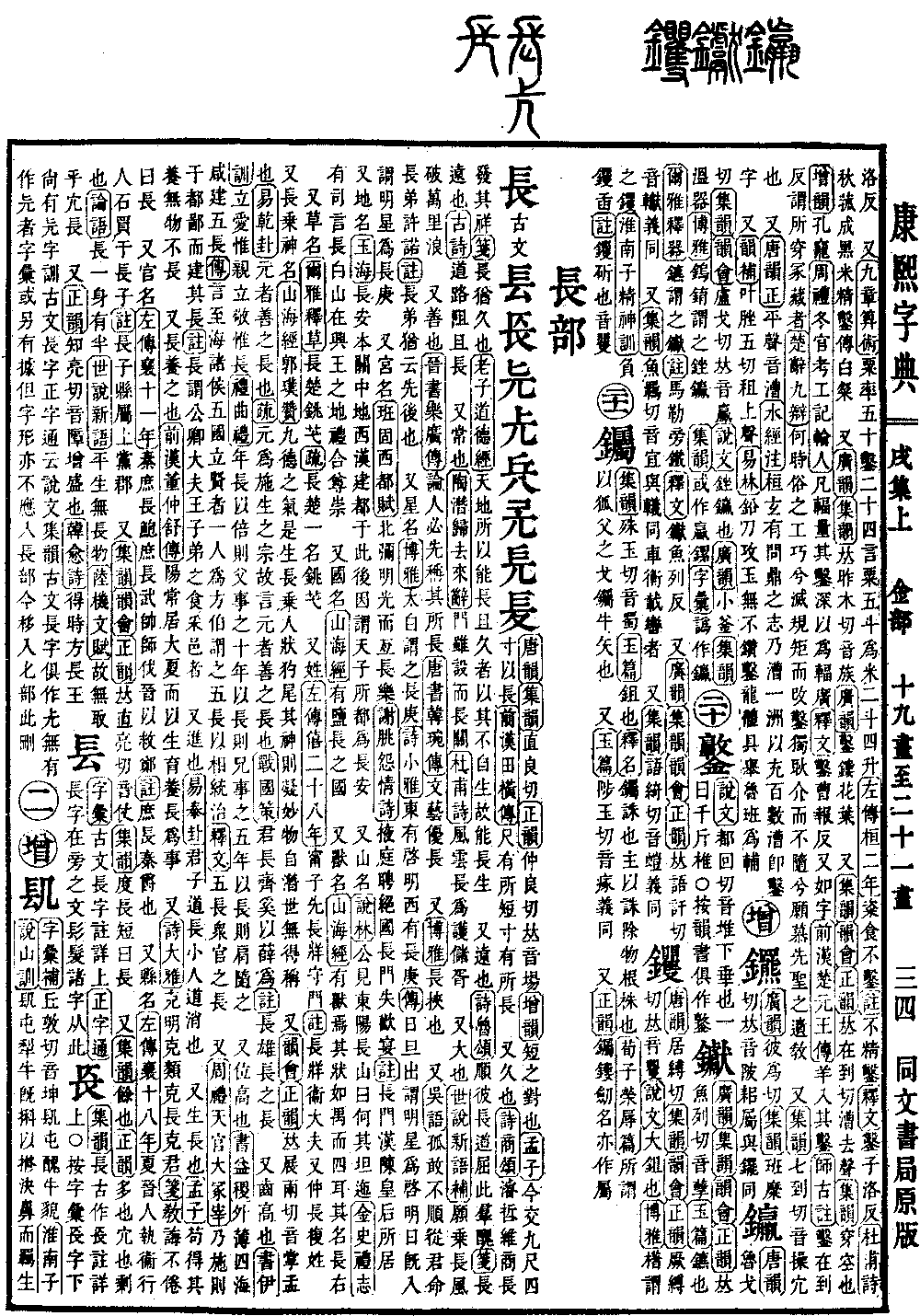
Xu Collection, Upper Volume
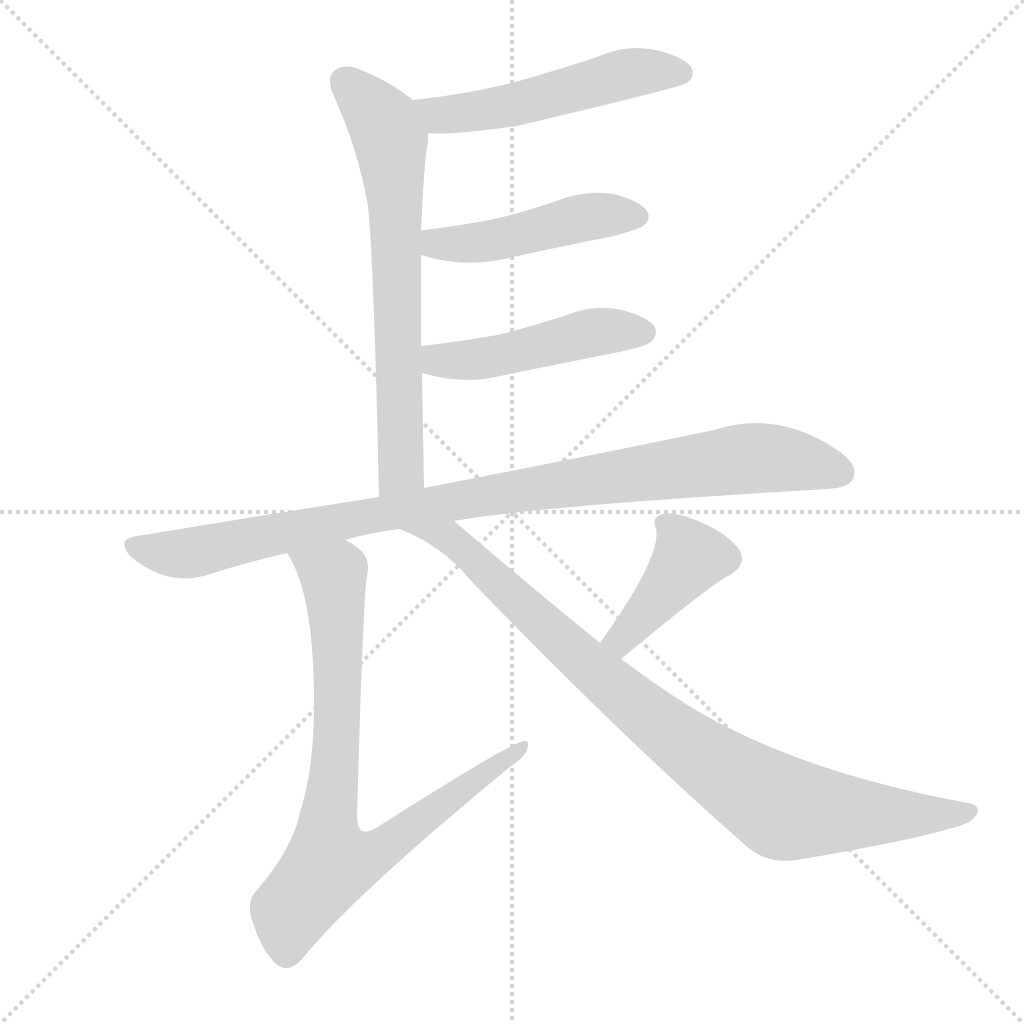
Radical: Long (cháng)
Kangxi Strokes: 8
Page 1328, Entry 07
Ancient form of the character is written as: (a character with a long upper stroke, a horizontal, and a downward stroke).
Pronounced cháng.
Opposite of short.
Mencius (Mengzi): Now, you have received nine feet and four inches in length.
History of the Former Han (Qian Hanshu), Biography of Tian Heng: An inch has its shortness, and a foot has its length.
Also means long in duration.
Book of Odes (Shijing), Odes of Shang (Shangsong): Profound and wise is the merchant, long-lasting is his prosperity.
Commentary: Long means long-lasting.
Laozi (Daodejing): The reason Heaven and Earth are able to endure and last long is because they do not live for themselves, therefore they are able to live long.
Also means far.
Book of Odes (Shijing), Odes of Lu (Lusong): Follow that long road, and bend these gathered villains.
Commentary: Long means far.
Ancient Poems: The road is blocked and long.
Also means constant.
Tao Qian, Return Home (Guiqulai Ci): Although the door is set, it is constantly closed.
Li Shangyin’s Poetry: Wind and clouds are constantly there to guard the gatehouse.
Also means great.
New Account of Tales of the World (Shishuo Xinyu), Supplement: I wish to ride the long wind and break through ten thousand miles of waves.
Also means virtuous.
Book of Jin (Jinshu), Biography of Yue Guang: When discussing people, one must first praise their virtues.
Book of Tang (Tangshu), Biography of Han Wan: Talented and virtuous.
Also means to carry or hold under the arm.
Also means to follow or be senior.
Wu Yue Chunqiu (Wuyu): I dare not fail to follow the ruler's command, to be senior and junior in mutual promise.
Note: Senior and junior, means the order of precedence.
Also a star name.
Bo Ya: Venus is called Changgeng.
Book of Odes (Shijing), Odes of Xiaoya (Xiaoya): In the east there is Qiming, in the west there is Changgeng.
Commentary: When the sun is about to rise, the bright star is called Qiming. When the sun has already set, the bright star is called Changgeng.
Also a palace name.
Ban Gu, Western Capital Rhapsody (Xidu Fu): To the north it reaches the Mingguang Palace and stretches to the Changle Palace.
Xie Tiao, Poem of Grievance (Yuanqing Shi): In the side chambers, one from a distant land is invited; in the Changmen Palace, one loses favor and feasts.
Note: Changmen is where the Han empress resided.
Also a place name.
Yuhai: Chang'an was originally land in Guanzhong; the Western Han established its capital here, and later the place where the Son of Heaven resided was called Chang'an.
Also a mountain name.
Shuolin: The Duke saw the Changshan Mountain in Dongyang and asked: Why is it so flat and winding?
History of the Jin (Jinshi), Record of Rites (Lizhi): The official stated that Changbai Mountain is in the land where the king arose, and the rites should be respected and honored.
Also a country name.
Classic of Mountains and Seas (Shanhaijing): There is the Yanchang Kingdom.
Also a beast name.
Classic of Mountains and Seas (Shanhaijing): There is a beast there, its shape is like a monkey but with four ears, and its name is Changyou.
Also a plant name.
Erya, Explanation of Plants (Shicao): Changchu is called Yaoyi.
Commentary: Changchu is another name for Yaoyi.
Also a surname.
Zuo Commentary (Zuozhuan), Year 28 of Duke Xi: Ningzi first sent Changyang to guard the gate.
Note: Changyang was a great officer of the state of Wei.
Also Zhongchang, a compound surname.
Also Changcheng, a god's name.
Classic of Mountains and Seas (Shanhaijing), Commentary by Guo Pu: The spirit of the nine virtues gives birth to Changcheng. Human-shaped with a leopard's tail, its spirit is solidified. Mysterious things hide themselves, the world cannot name them.
Pronounced zhǎng.
To be a leader.
Book of Changes (Yijing), Qian Hexagram: The Yuan is the leader of all virtues.
Commentary: Yuan is the foundation of giving life, therefore it is said that Yuan is the leader of virtues.
Strategies of the Warring States (Zhanguoce): If you are the leader of Qi, why have you come to Xue?
Note: Leader, means the leader of the strong.
Also refers to seniority in age.
Book of Documents (Shujing), Instructions of Yi (Yixun): Establishing love comes from parents, establishing respect comes from elders.
Book of Rites (Liji), Summary of Rules (Quli): If someone is ten years older, treat them like a father. If five years older, treat them like an elder brother. If two years older, follow them as an attendant.
Also refers to high rank.
Book of Documents (Shujing), Yiji: Extending outward to the four seas, all establish five leaders.
Commentary: Refers to the feudal lords of the five states reaching the sea, establishing one virtuous person as a regional leader, called the five leaders, to rule and govern each other.
Explanation of Texts (Shiewen): Five leaders, leaders of the crowd of officials.
Also, in the Rites of Zhou (Zhouli), Ministry of Heaven (Tianguan), Grand Administrator (Dazai): Then set rules for the capital and suburbs, and establish their leaders.
Note: Leaders refer to dukes, ministers, and great officers, those from the prince's family who hold fiefs.
Also means to advance.
Book of Changes (Yijing), Tai Hexagram: The way of the gentleman advances, the way of the small man diminishes.
Also means to grow.
Mencius (Mengzi): If they get their nourishment, there is nothing that will not grow.
Also means to nourish and raise.
History of the Former Han (Qian Hanshu), Biography of Dong Zhongshu: Yang always resides in the great summer, and takes birth, growth, and nourishment as its task.
Also Book of Odes (Shijing), Odes of Daya (Dayasong): Able to be bright and able to judge, able to be a leader and a ruler.
Commentary: To teach without tiring is called leading.
Also an official title.
Zuo Commentary (Zuozhuan), Year 11 of Duke Xiang: The Qin Shuzhang Bao and Shuzhang Wu led troops to attack Jin to save Zheng.
Note: Shuzhang is a title of nobility in Qin.
Also a county name.
Zuo Commentary (Zuozhuan), Year 18 of Duke Xiang: In summer, the Jin people captured the Wei traveler Shi Mai at Changzi.
Note: Changzi County belongs to Shangdang Commandery.
Pronounced zhàng.
In the sense of measuring length.
Also means surplus.
Also means many, or redundant, or leftover.
Analects (Lunyu): To have a surplus of one and a half bodies.
New Account of Tales of the World (Shishuo Xinyu): In one's whole life, one should have no redundant items.
Lu Ji, Rhapsody on Literature (Wenfu): Therefore, there is no need for anything redundant.
Pronounced zhàng.
To increase or flourish.
Han Yu’s Poetry: At the right time, it flourishes.