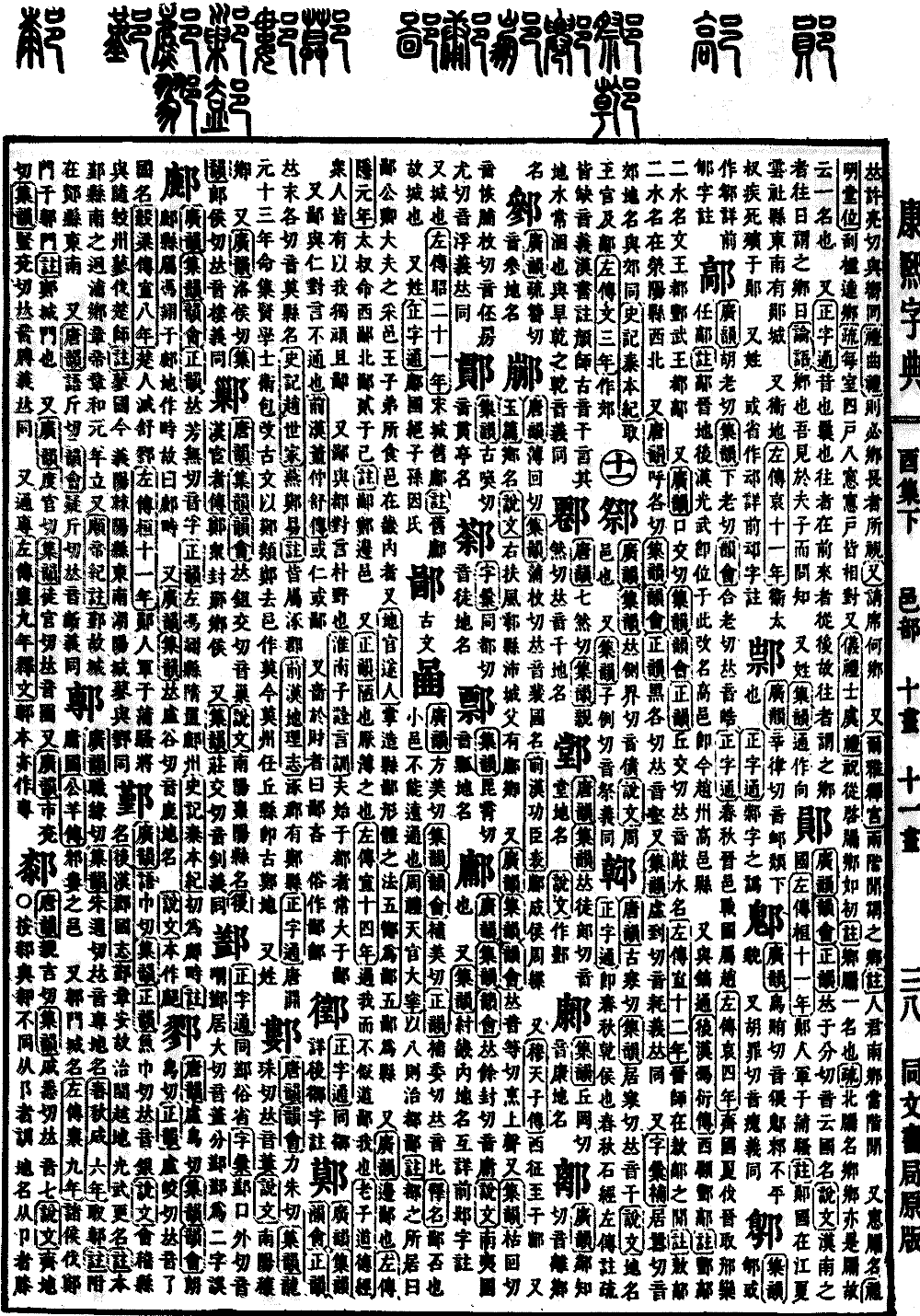
You Collection, Lower Volume
Radical: City (yì)
鄙
Kangxi Stroke Count: 18
Page Number: 1276, Character 18 (Ancient Form)
According to the Guangyun, pronounced fāngměi qiè. According to the Jiyun and Yunhui, pronounced bǔměi qiè. According to the Zhengyun, pronounced bǔwěi qiè. Pronounced bǐ. In the Shiming, bǐ means fǒu (no/blockage). It refers to a small city unable to connect with distant places. In the Rites of Zhou (Zhouli), Heavenly Officers, Grand Tutor: "Governed the capital cities and their surrounding districts according to eight principles." The commentary states: "The area where a capital city is located is called bǐ, which is the fiefdom of dukes, ministers, and grand masters, or the emolumental land of princes and their siblings within the jurisdiction of the capital." Also, in the Rites of Zhou (Zhouli), Earthly Officers, Sui Official: "Responsible for planning the administrative divisions of counties and districts, where five cuò form a bǐ, and five bǐ form a county." Also, in the Guangyun, it means a remote border region. In the Zuo Zhuan, Year One of Duke Yin: "Grand Uncle commanded the western and northern border regions to obey him simultaneously." The commentary states: "Bǐ refers to a border city or town of the State of Zheng." Also, in the Zhengyun, it means crude, unrefined, or to disdain, to hold in contempt. In the Zuo Zhuan, Year Fourteen of Duke Xuan: "To pass through our state without requesting passage is to disdain our state." In the Daodejing by Laozi: "All people have purpose; only I am dull and ignorant, like one who is crude and unrefined." Also, bǐ, when contrasted with dū (capital/refined), refers to being simple and unpolished. In the Huainanzi, Quan Yan Xun: "Starting from splendor often results in greater grandeur than starting from simplicity." Also, bǐ, when contrasted with rén (benevolence), refers to being unperceptive or narrow-minded. In the Former Han (Qian Han), Biography of Dong Zhongshu: "Some are benevolent and kind, others are crude and narrow-minded." Also, stinginess with money is called bǐlìn. Commonly written as bǐ.
Verification: In the Daodejing by Laozi, the original text reads "All people have purpose; only I am stubborn and crude." The character '似' (like) in the previous citation should be corrected to '且' (and) to reflect the original text.