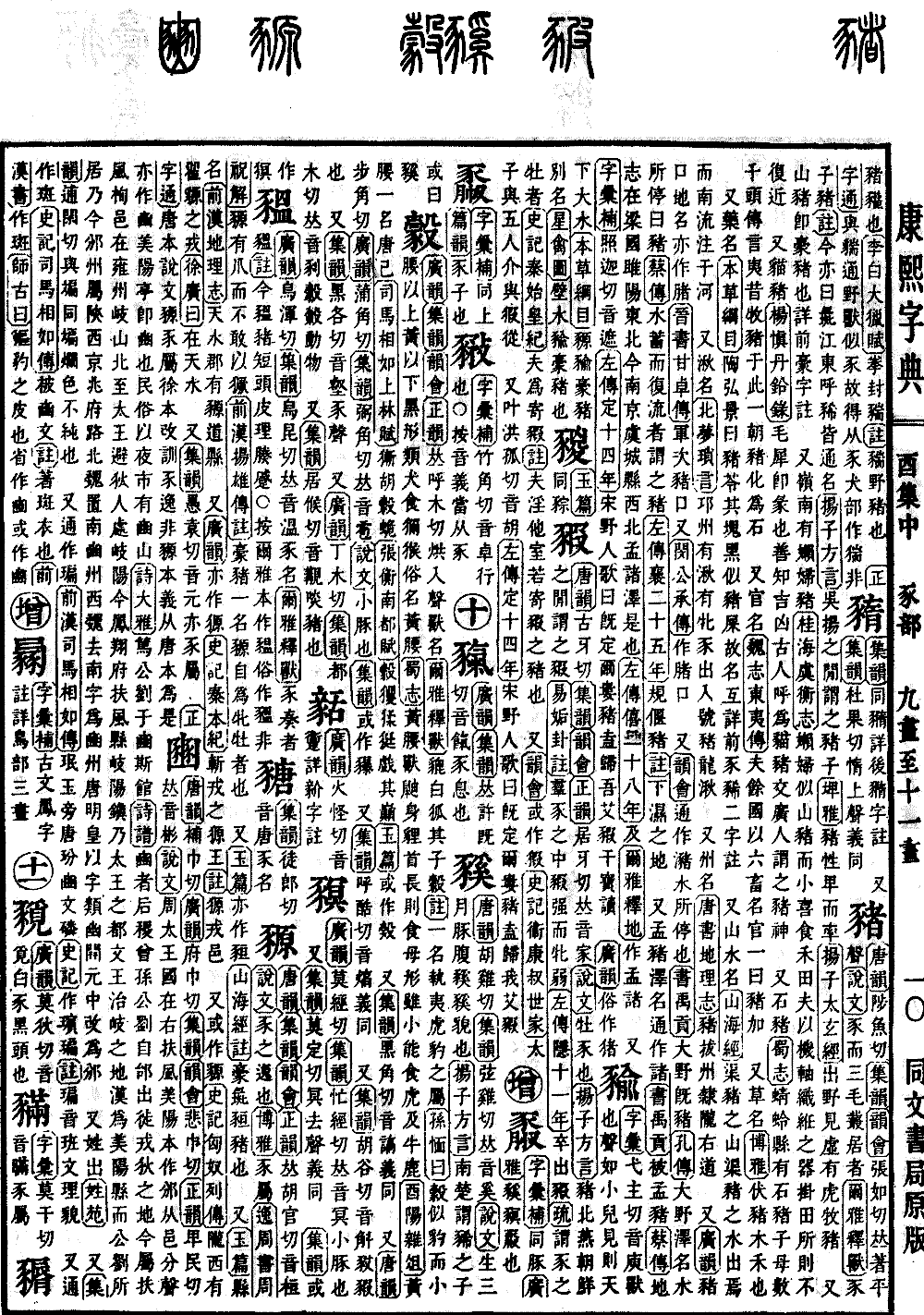
You Collection, Middle Volume
Radical: Pig (shǐ)
Kangxi strokes: 17
Page 1198, Entry 17
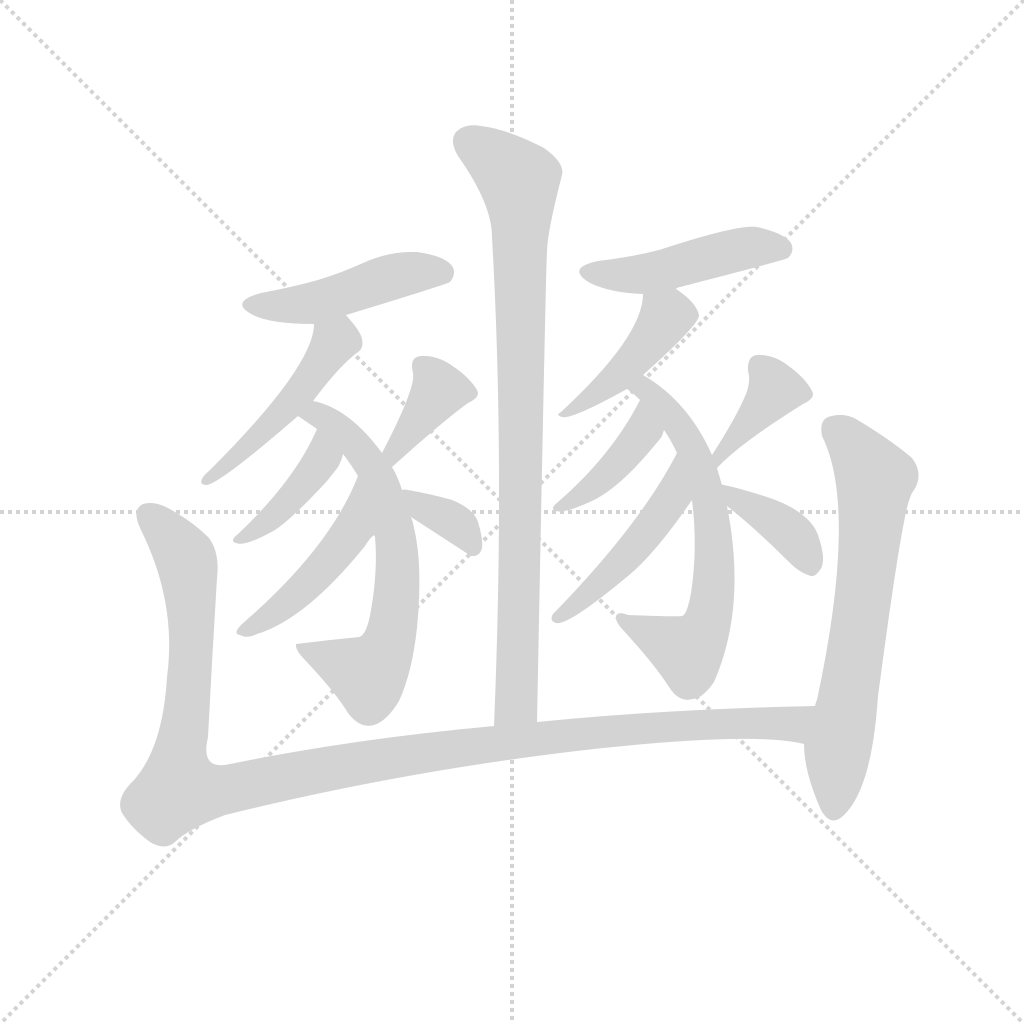
Pronounced bīn. According to the Shuowen Jiezi (Shuowen), it was the kingdom of the ancient King Tai of Zhou, located in Meiyang of Youfufeng. Originally written as Bīn, composed of the city radical with Bīn as the phonetic component. Also written as Bīn; the Meiyang Pavilion is in fact Bīn. Local customs included a night market, and there is Mount Bīn. In the Book of Odes (Shijing), Great Odes, it is written: Sincere was Duke Liu, he built his residence in Bīn. According to the Shijing Pu (Record of the Odes), Bīn was where Gong Liu, the great-grandson of Houji, migrated from Tai to the land of the Rong and Di tribes. It currently belongs to Xunyi in Fufeng, located in the Qishan region of Yong Province, extending north to the place where King Tai avoided the Di people. Qiyang, now Qiyang Town in Fufeng County, Fengxiang Prefecture, was the capital of King Tai and the place where King Wen governed Qi; during the Han Dynasty, it was Meiyang County. The place where Gong Liu resided is modern Bīn Prefecture, belonging to the Jingzhao Prefecture Circuit of Shaanxi. During the Northern Wei Dynasty, South Bīn Prefecture was established; the Western Wei removed the word South to rename it Bīn Prefecture. During the Kaiyuan era of Emperor Xuanzong of the Tang Dynasty, because the character resembled the word for dark or secluded, it was changed to Bīn. Also a surname. Recorded in the Xìngyuàn (Garden of Surnames).
Also pronounced bān. Same as bān (mottled/variegated). Bān refers to colors that are not pure. Also used interchangeably with bān. In the Biography of Sima Xiangru in the Book of Han (Hanshu), it is written as pángtáng, bīn bīn wén lín. In the Records of the Grand Historian (Shiji), it is written as bīn. The commentary states the pronunciation is bān, describing a patterned appearance. Also used interchangeably with bān (spotted). In the Biography of Sima Xiangru in the Records of the Grand Historian (Shiji), it is written as wearing bīn patterns. The commentary states this means wearing spotted clothing. The Book of Han (Hanshu) writes it as bān. Yan Shigu comments that this refers to the skins of leopards or similar beasts. The character is abbreviated to bīn. Sometimes written as bīn. The original form of the character Bīn did not contain the right-hand component of the pig radical.