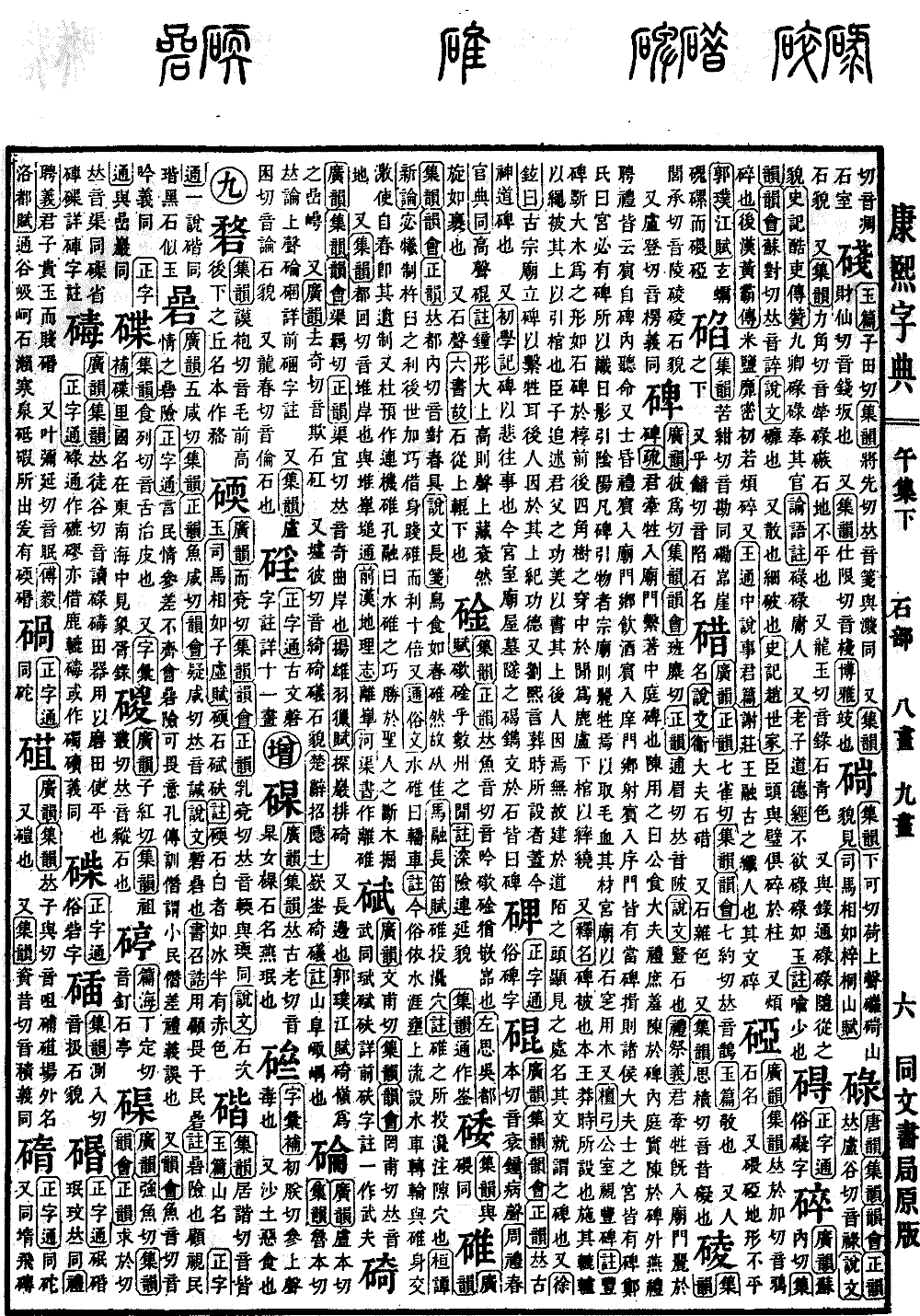
Wu Collection, Lower Volume
Radical: Stone (shí)
Kangxi Strokes: 13
Page 832, Entry 10
Pronounced bēi.
Shuowen Jiezi (Explanation of Simple and Compound Characters): An upright stone.
Book of Rites (Liji), Sacrificial Meaning (Jiyi): When the ruler leads the sacrificial animal and enters the temple gate, he secures it to the stone stele. Commentary: When the ruler leads the animal for sacrifice and enters the temple gate, he ties it to the stele in the courtyard. In ceremonies such as the Presentation of Food to Great Officers, various dishes are arranged inside the stele, while gifts displayed in the courtyard are placed outside the stele. In the Banquet Rites and the Rites of Guest Reception, it is stated that guests wait for instructions inside the stele. Additionally, in the Marriage Rites for Gentlemen, when a guest enters the temple gate, or in the Local Drinking Rites and the Local Archery Rites, where guests enter the school gate, there are rituals of bowing at a position facing the stele, indicating that the residences of feudal lords, great officers, and gentlemen all possessed such steles. Zheng Xuan stated: Residences must have steles to observe the sun's shadow and distinguish between yin and yang. When a stele is used for tethering, it is used in the ancestral temple to secure animals in order to obtain their hair and blood. Its material is stone in palaces and temples, and wood during burial.
Book of Rites (Liji), Tan Gong: The ducal palace utilizes large wooden steles. Commentary: A large wooden stele is made by hewing a large log, shaped like a stone stele, erected at the four corners before and behind the coffin. A hole is pierced in the center to install a pulley, and during burial, ropes are wound around the pulley to lower the coffin.
Shiming (Explanation of Names): A stele means to cover. It was originally established during the Wang Mang period, equipped with a windlass, with ropes covering it to pull the coffin. Subjects recount the merits and virtues of their rulers or fathers and inscribe text upon them. Later generations followed this practice, erecting them without specific cause at road ends or prominent places, calling the inscribed object a stele.
Xu Xuan stated: In ancient ancestral temples, steles were erected solely for tethering animals. Later generations subsequently used them to record merits and virtues. Liu Xi stated that the stele set up during burial is likely the origin of the current spirit-way stele.
Chuxueji (Records for Early Learning): A stele is used to lament the past. Nowadays, stone tablets placed near palaces, temples, houses, or tomb paths upon which text is engraved are all called steles.