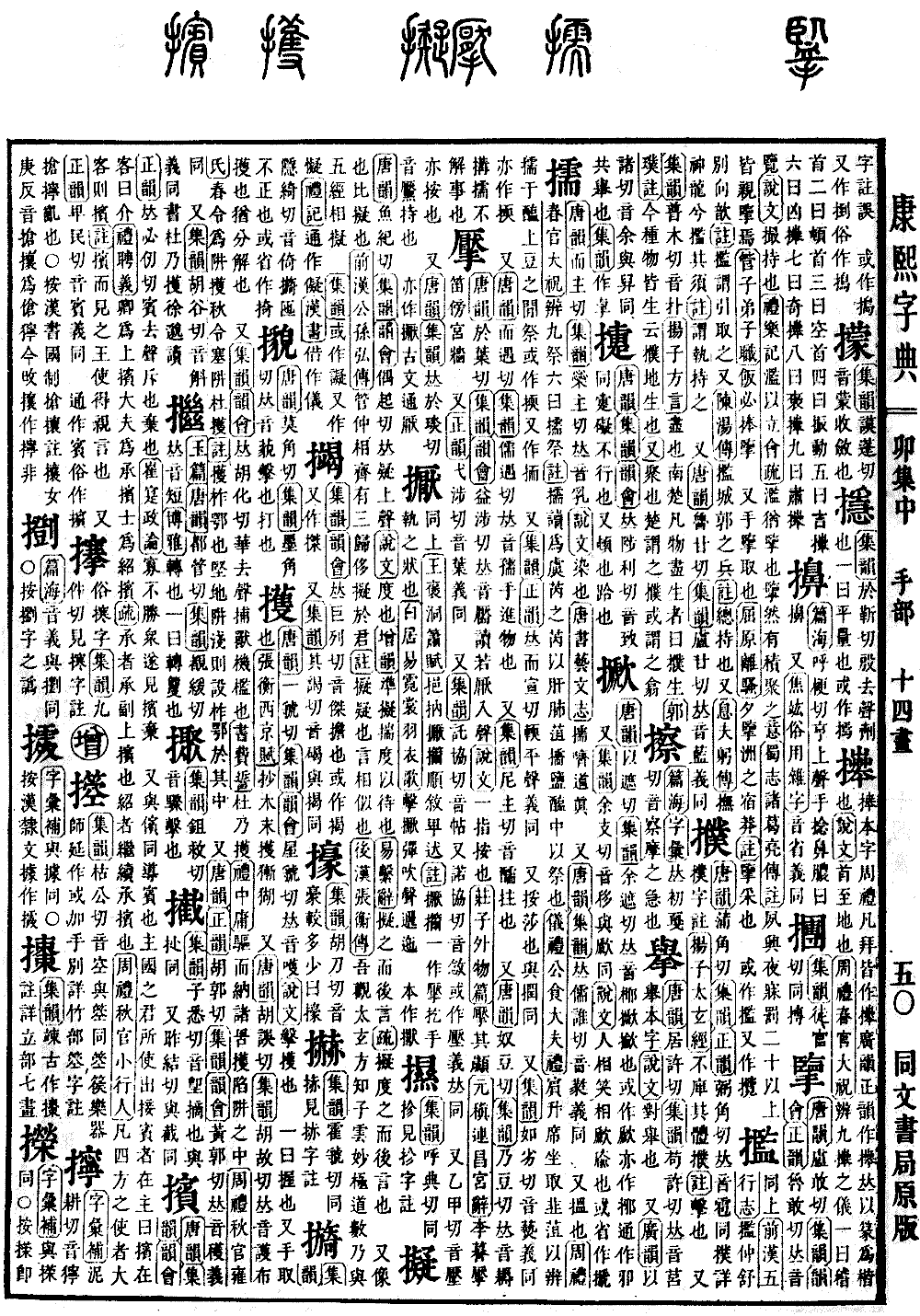
Mao Collection, Middle Volume. Radical: Hand (shǒu). Kangxi strokes: 18. Page 460, Entry 04.
Pronounced bin (falling tone). Meaning: to reject, to cast aside. According to the Political Discourse (Zheng lun) by Cui Shi, when a small group of people cannot overcome a larger group, they are rejected and cast aside.
Also the same as the character bin (to usher). Refers to the act of guiding guests. Those sent by the ruler of a state to receive guests are termed bin when representing the host, and jie when representing the guest. According to the Book of Rites (Liji), specifically the section on the meaning of the formal visit (Pin yi), a high official serves as the primary usher, a grand master serves as the secondary usher, and a scholar serves as the tertiary usher. The commentary explains that secondary implies assisting the primary usher, and tertiary implies continuing the duties of the secondary usher. According to the Rites of Zhou (Zhouli), in the section concerning the autumn officials and the minor protocol officer, all envoys from the four quarters are received by an usher when they are important guests. The commentary notes that the usher guides them to an audience with the ruler so that they may personally state their mission.
Also, according to the Zheng yun, pronounced min (rising tone), with the same sound as bin. The meaning is the same. It is also commonly used interchangeably with bin (guest). A common variant form is written as a character consisting of the radical for hand and the phonetic element for guest.