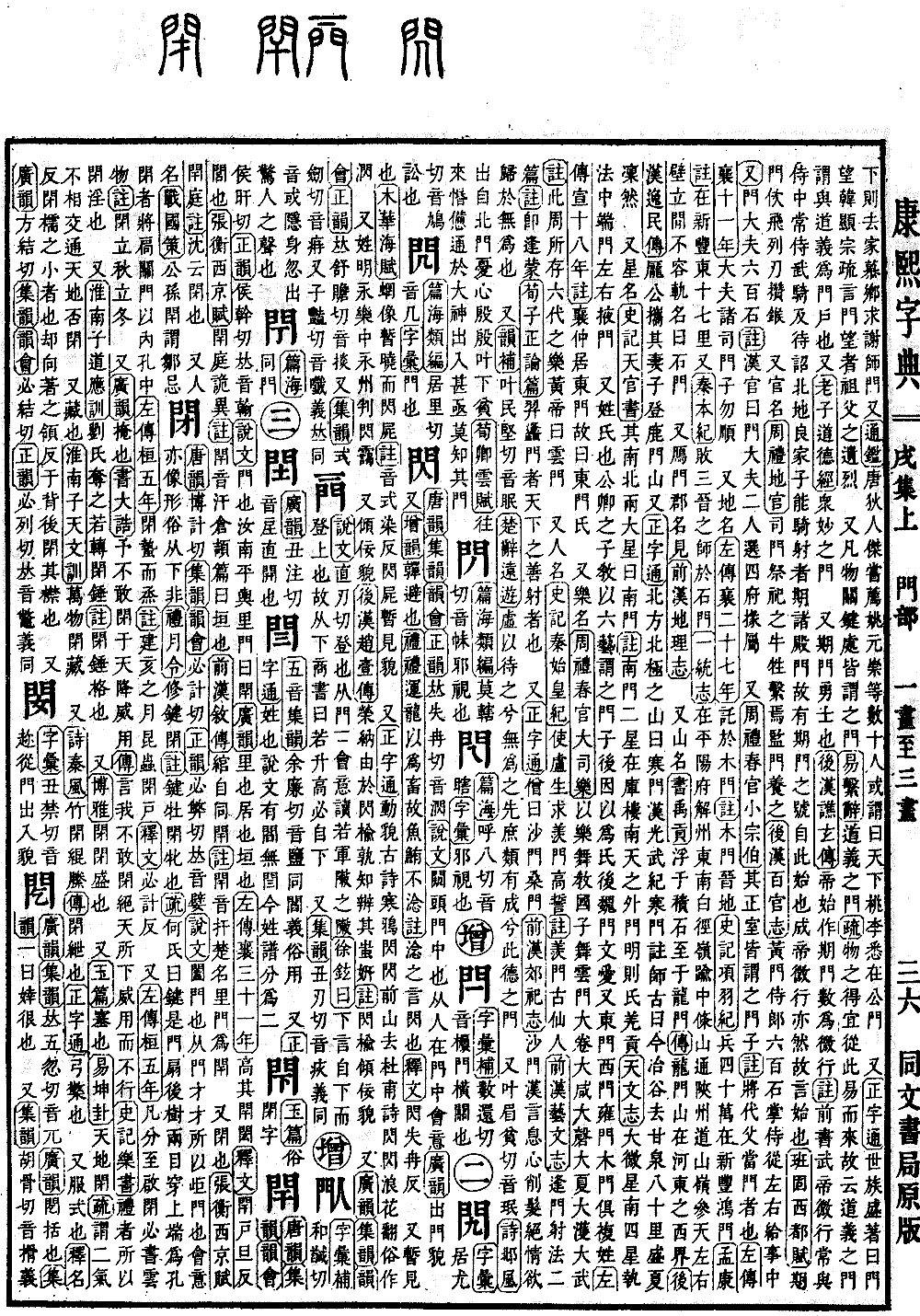
Xu Collection, Upper Volume
Radical: Gate (mén)
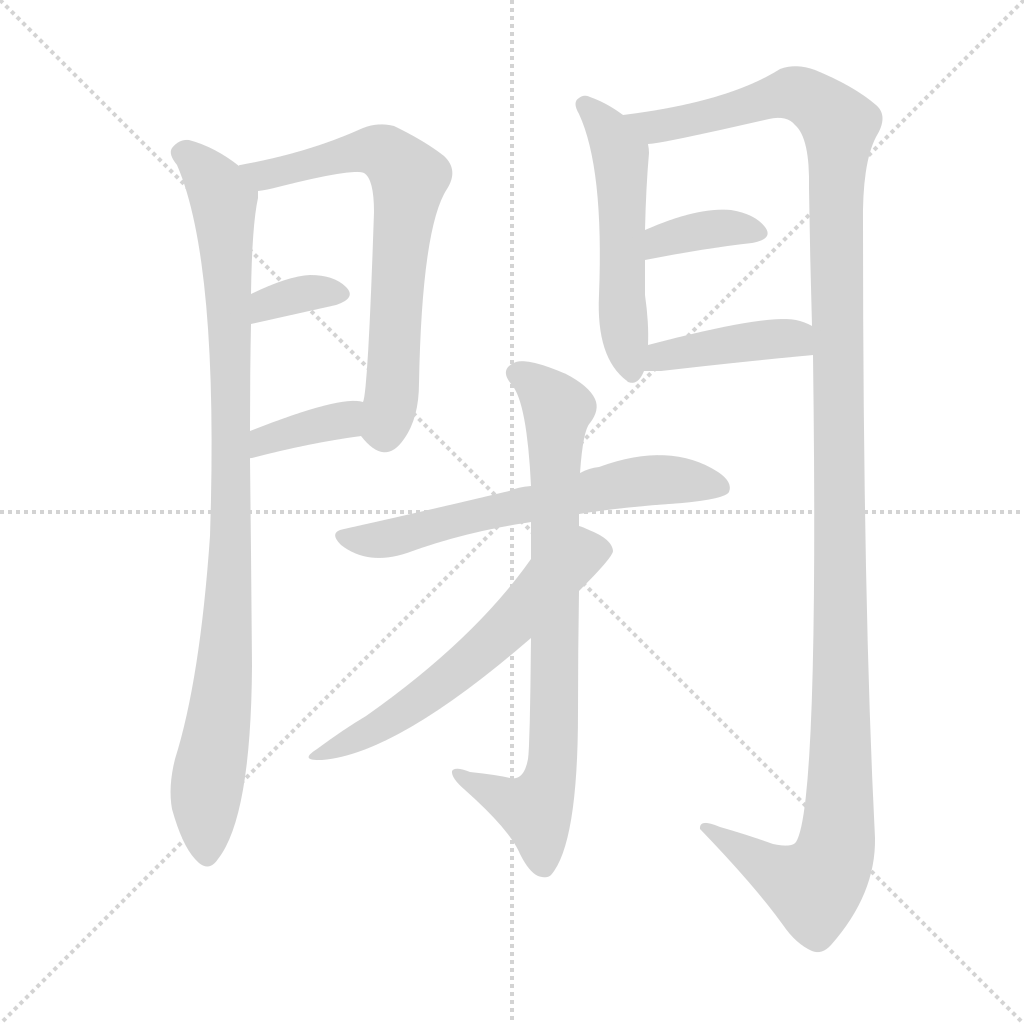
Closed; Kangxi strokes: 11
Page 1330, Entry 14
Pronounced bi.
According to the Explaining Graphs and Analyzing Characters (Shuowen Jiezi), it means to shut a door. It is formed from the elements for gate and timber, with the timber serving as a device to block the gate. It is a compound ideograph that also functions as a pictograph. Common usage incorrectly adds the element for bottom.
In the Book of Rites (Liji), specifically the Monthly Ordinances (Yueling), it states to repair keys and bolts. The commentary notes that the key is the male part, and the bolt is the female part. The sub-commentary explains that He says the key is the gate leaf, and two pieces of timber are erected behind it with holes drilled in the upper ends; the bolt is used for pulling the crossbar to close the gate, inserting it into the holes.
In the Zuo Tradition (Zuo Zhuan), in the fifth year of Duke Huan, it states to close against hibernation and steam the grains. The commentary notes that in the month of the tenth lunar sign, insects close their doors. The Explanation of Texts (Shiwen) says it is pronounced bi.
Also in the Zuo Tradition, in the fifth year of Duke Huan, it states that all equinoxes and solstices, openings and closings, must record celestial phenomena. The commentary notes that closing refers to the beginning of autumn and the beginning of winter.
According to the Extensive Rhymes (Guangyun), it means to cover. In the Book of Documents (Shangshu), in the Great Announcement (Dagao), it states I dare not close off the awe-inspiring power sent down by Heaven. The commentary explains that this means I dare not obstruct or cut off the power that Heaven sends down. In the Records of the Grand Historian (Shiji), in the Treatise on Music (Yueshu), it states that rites are the means by which to close off excess.
In the Huainanzi, in the Treatise on the Response of the Way (Daoying Xun), it states the Liu family seized it, like a rotating bolt. The commentary notes that a bolt is a stopper.
According to the Erudite Elegant (Boya), repeated, it means abundant.
According to the Jade Chapters (Yupian), it means to block. In the Book of Changes (Yijing), in the Kun Hexagram, it states Heaven and Earth are closed. The sub-commentary explains this refers to the two vital breaths not intercommunicating, causing the state of Heaven and Earth to be blocked.
It also means to store. In the Huainanzi, in the Treatise on Astronomy (Tianwen Xun), it states all things are closed and stored away.
In the Book of Odes (Shijing), in the Odes of Qin (Qin Feng), it mentions bamboo bindings and cords. The commentary notes that closed here means tied.
The Correct Meaning of Characters (Zhengzitong) defines it as a bow press.
It also refers to a style of clothing. In the Explanatory Names (Shiming), it is a small garment, worn backwards, with the collar fastened at the back to close the lapel.
Also pronounced bie. The meaning is the same.
Verification: In the Book of Rites, Monthly Ordinances, regarding the comment about keys and bolts, the sub-commentary originally contained a typo of two eyes; it has been corrected to two pieces of timber in accordance with the original text.