Wu Collection, Middle Volume
Radical: Eye (mù)
Kangxi Strokes: 13
Page 811, Entry 01
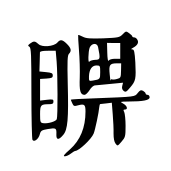
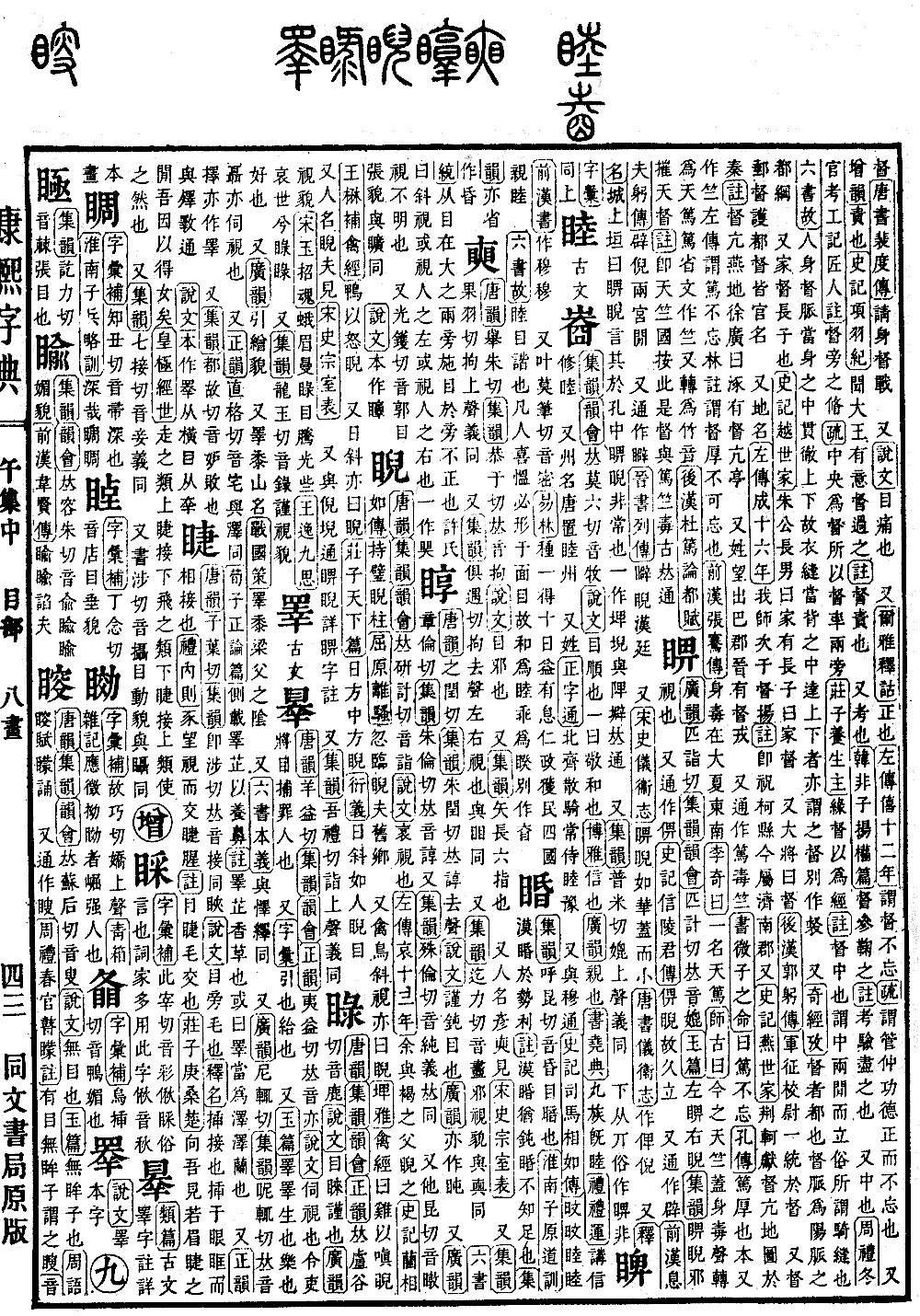
Pronounced pi. According to the Comprehensive Glossary (Guangyun) and Collected Rhythmic Lexicon (Jiyun) and the Rhythmic Compendium (Yunhui), the pronunciation is pi.
According to the Jade Chapters (Yupian), the left side is pi and the right side is ni.
According to the Collected Rhythmic Lexicon (Jiyun), pini means to look askance. It is also written in a variant form. In the Records of the Grand Historian (Shiji), biography of Lord Xinling, it is written as ni, standing there for a long time.
It is also written in a variant form as pi. In the History of the Former Han (Qianhan shu), biography of Xifu Gong, it is written as pini between the two palaces.
It is also written in a variant form. In the History of the Jin (Jinshu), biographies section, it is written as ni at the Han court.
Also, in the History of the Song (Songshi), annals of ceremonial guards, it is written as pini, resembling a floral canopy but smaller. In the History of the Tang (Tangshu), annals of ceremonial guards, it is written as bini.
Also, according to the Explaining Names (Shiming), the wall on a city rampart is called pini. This refers to looking askance through the holes at what is unusual. It is also written as ni. It is interchangeable with pi and bei.
Also, according to the Collected Rhythmic Lexicon (Jiyun), it is pronounced pi (rising tone). The meaning is the same. The lower part is formed with the radical for stand (ji). The common form is incorrect.
Textual Research: According to the Explaining Names (Shiming), the wall on a city rampart is called pini. This refers to looking askance through the holes at what is unusual. The original text has been corrected from through the holes to look askance at what is unusual.