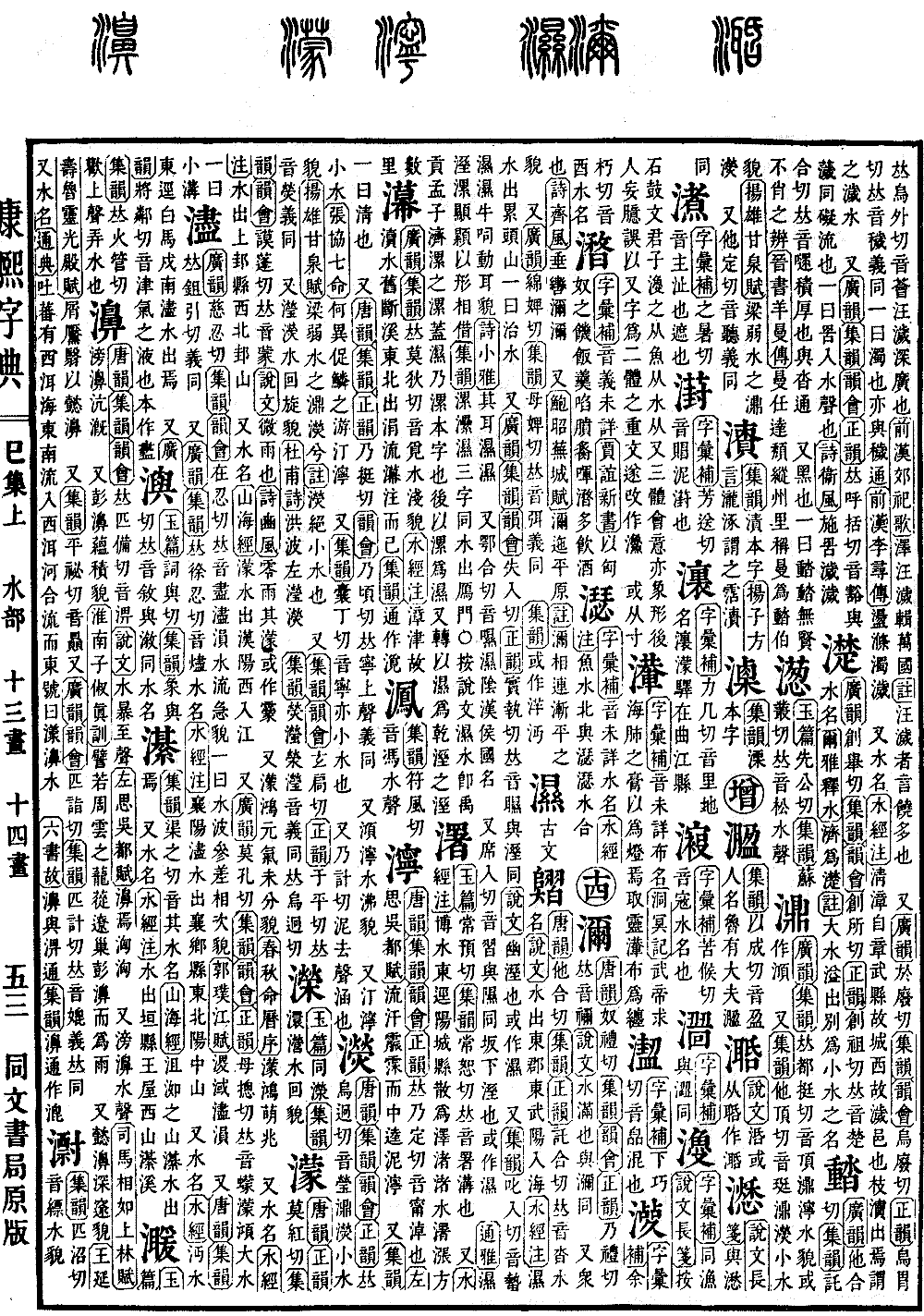
Si Collection, Upper Volume
Radical: Water (shuǐ)
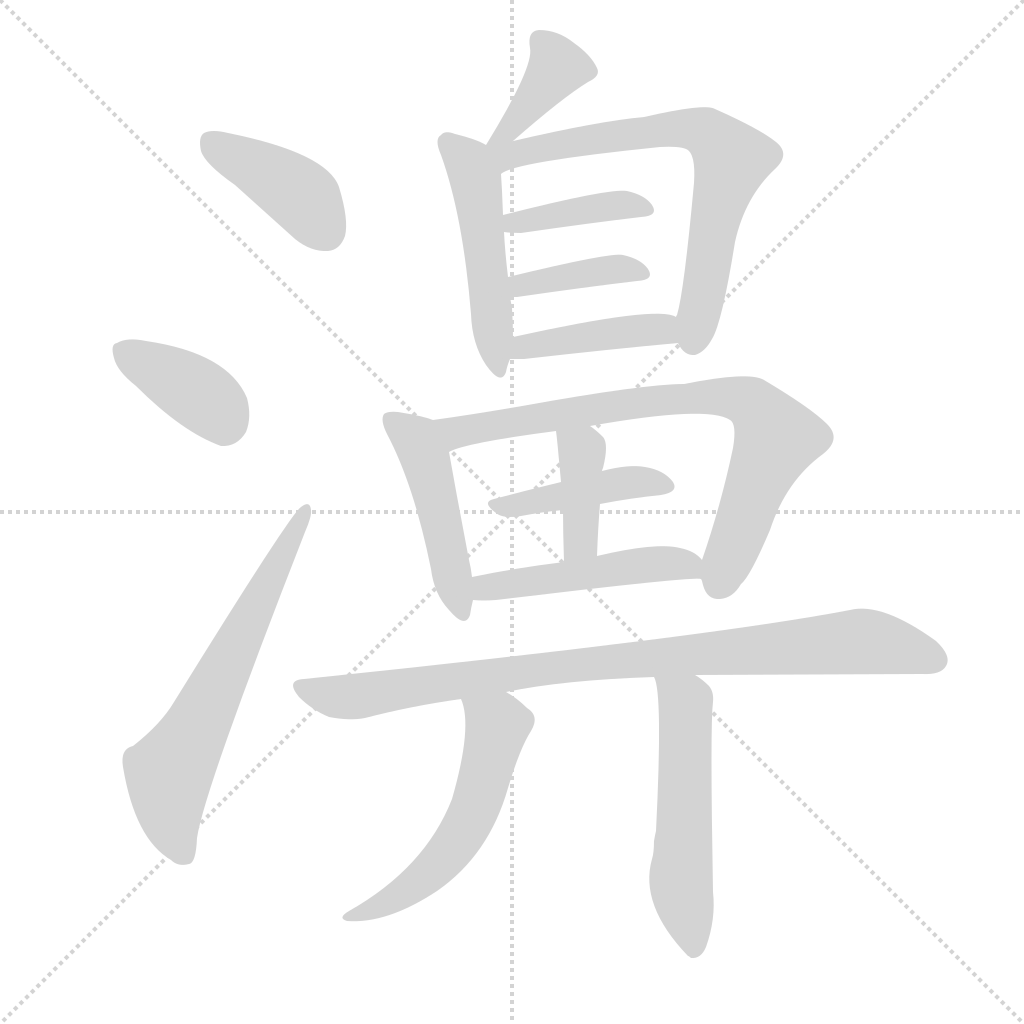
Entry: pi
Kangxi strokes: 18
Page 655, Entry 35
Pronounced pi (falling tone) according to Tang Rhyme (Tangyun), Collected Rhymes (Jiyun), and Rhyme Meeting (Yunhui).
According to Explaining Graphs and Analyzing Characters (Shuowen): the sound of water rushing forth. In the Ode on the City of Wu (Wudu fu) by Zuo Si: It rushes with a pi sound. Also, pangpi, the sound of water. In the Rhapsody on the Shanglin Park (Shanglin fu) by Sima Xiangru: pangpi hanggai.
Also pengpi, describing the appearance of things accumulated and gathered. In the Master of Huainan (Huainanzi): Like the gathering of clouds, condensing and accumulating to become rain.
Also yipi, describing the appearance of something deep and profound. In the Rhapsody on the Lingguang Hall of Lu (Lu lingguangdian fu) by Wang Yanshou: The appearance is obscure and yipi.
Also pronounced bi (falling tone) according to Collected Rhymes (Jiyun). Also pronounced pi (falling tone) according to Extensive Rhymes (Guangyun) and Rhyme Meeting (Yunhui), and also Collected Rhymes (Jiyun). The meaning is the same.
Also the name of a river. According to Comprehensive Statutes (Tongdian): In the territory of the Tibetans (Tufan) there is the Western Er Sea, which flows southeast into the Western Er River; it flows together to the east and is called the Yangpi River.
According to Six Writings Refined (Liushu gu): The character is used interchangeably with pi. According to Collected Rhymes (Jiyun): The character is also written as a variant form.