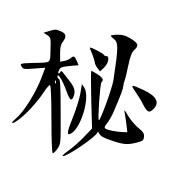
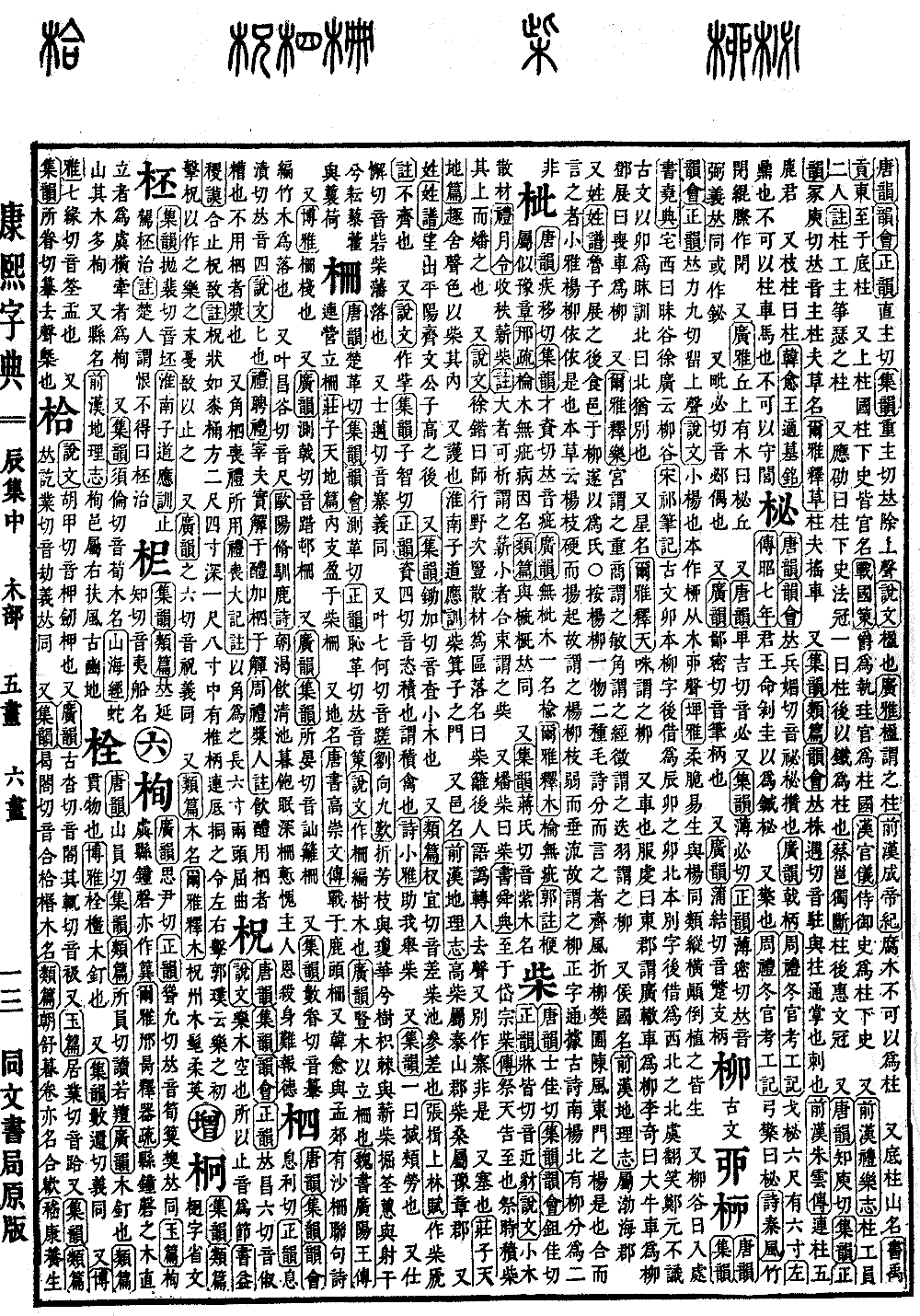
Chen Collection, Middle Volume. Radical: Tree (mù). Kangxi stroke count: 9. Page 521, Entry 01.
Pronounced mi (falling tone). Bi signifies gathering or collecting.
Broad Rhymes (Guangyun) refers to the handle of a halberd.
Book of Rites: Winter Official, Record of Trades (Zhouli: Dongguan Kaogongji) states the handle of a ge-halberd is six feet six inches long.
Commentary on the Zuo Tradition (Zuo Zhuan: Zhao Qinian) notes the sovereign ordered the jade scepter to be split to fashion an axe handle.
Also refers to a device for correcting bows and crossbows.
Ceremonial and Rituals (Yili: Jixi Ji) mentions the use of a bi, which the commentary explains as a bow-straightener.
Book of Odes (Shijing: Qin Feng) mentions the use of bamboo closures and cords for binding. Here it is written as a variant form (bi).
Additionally, the Broadening of Refinement (Guangya) states that a mountain hill with trees is called a bi-qiu.
Also pronounced bi (falling tone).
Also, in the Collected Rhymes (Jiyun) and Correct Rhymes (Zhengyun), pronounced bi (falling tone). The meaning is the same. Sometimes written in a variant form (bi).
Also pronounced bi (falling tone). Refers to a pair or a spouse.
Also in the Broad Rhymes (Guangyun), pronounced bi (falling tone). Refers to the handle of an implement.
Also in the Broad Rhymes (Guangyun), pronounced bie. Refers to a supporting handle.
Textual Research: The Book of Rites: Winter Official, Record of Trades (Zhouli: Dongguan Kaogongji) states a bow-straightener is called a bi. Note: Upon examination, the Record of Trades does not contain the phrase a bow-straightener is called a bi. This has been amended to reflect that the Ceremonial and Rituals: Record of the Evening After (Yili: Jixi Ji) mentions a bi, which the commentary explains as a bow-straightener.