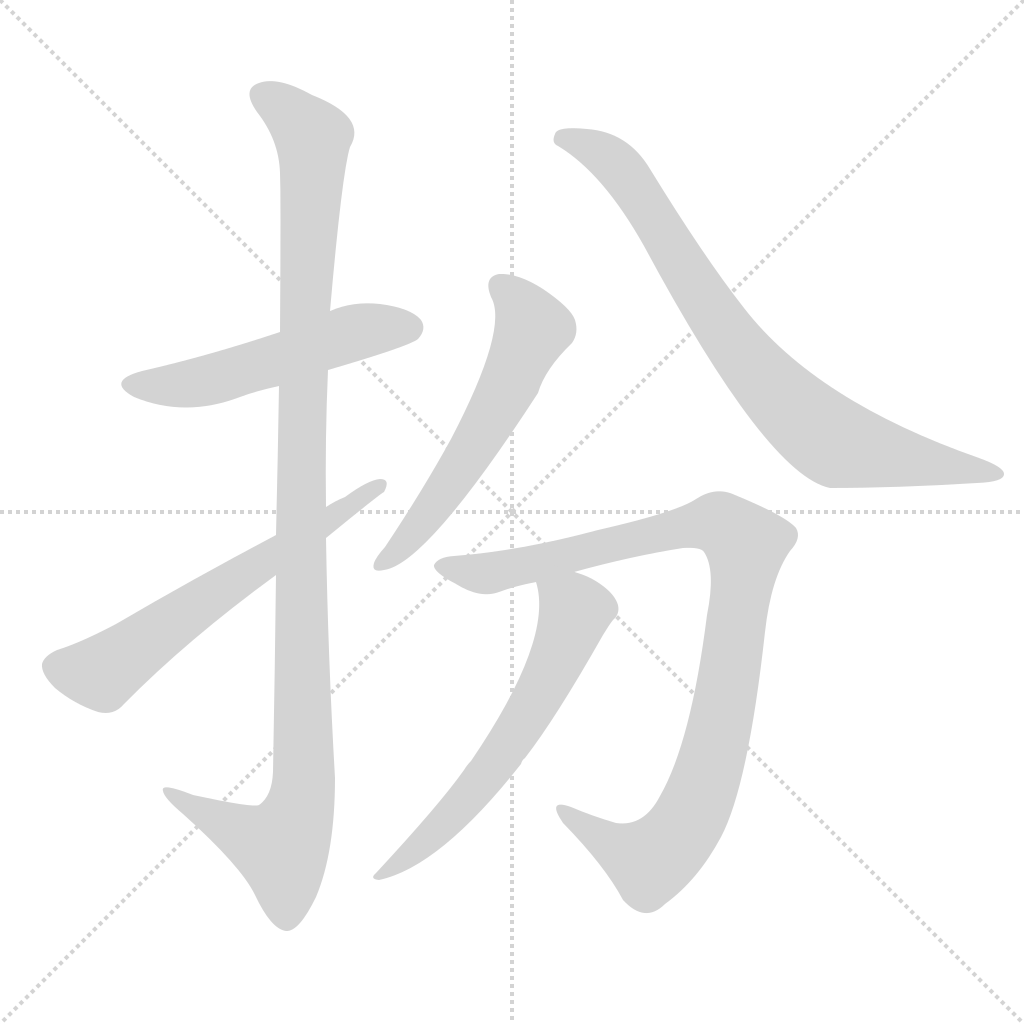
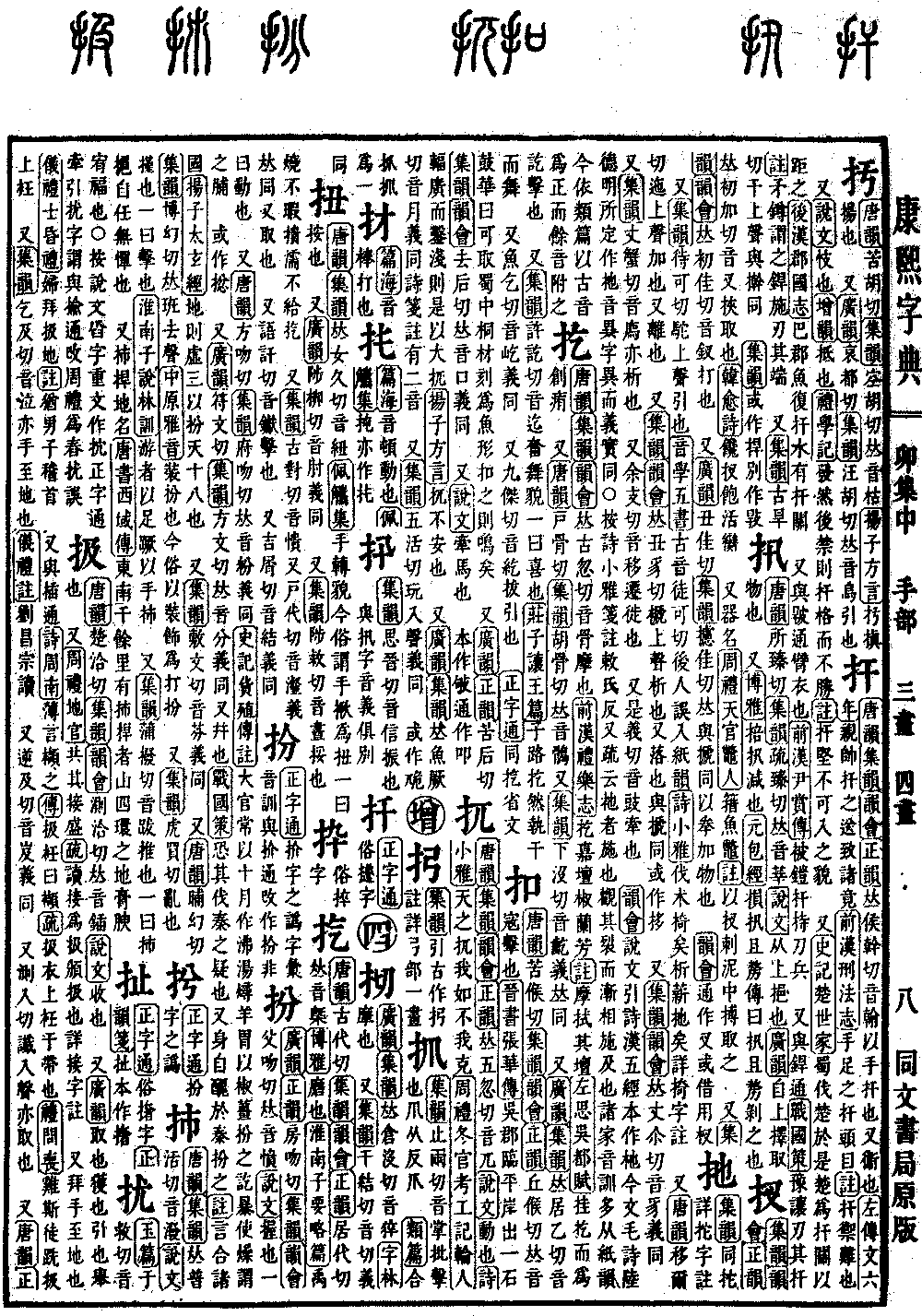
Mao Collection, Middle Volume. Radical: Hand (shǒu). Kangxi strokes: 8. Page 418, Entry 20.
Pronounced fen (falling tone). As defined in the Erya (Guangyun) and Correct Rhymes (Zhengyun), and also noted in the Collected Rhymes (Jiyun) and Rhyme Collection (Yunhui), the sound is fen (falling tone). According to the Explaining Graphs and Analyzing Characters (Shuowen), it means to grasp. Another definition is to move.
Also pronounced fen (rising tone), as noted in the Tang Rhyme (Tangyun) and the Collected Rhymes (Jiyun). The meaning is the same. As cited in the Commentary to the Biographies of Money-makers from the Records of the Grand Historian (Shiji), high officials would often use boiling water in the tenth month to scald sheep tripe, seasoning it with pepper and ginger, drying it in the sun, and calling it jerky. It is sometimes written as a variant form.
Also pronounced fen (level tone), as noted in the Guangyun and the Collected Rhymes (Jiyun). The meaning is the same. It also means to unite. As seen in the Strategies of the Warring States (Zhanguoce), fearing the suspicion of attacking Qin, one would compromise with Qin oneself. The commentary explains this as uniting the states. In Yangzi’s Great Mystery (Taixuanjing), the earth empties three to unite with the eighteen of heaven.
Also pronounced fen (level tone), as noted in the Collected Rhymes (Jiyun). The meaning is the same.
Also pronounced ban (departing tone), as noted in the Tang Rhyme (Tangyun) and the Collected Rhymes (Jiyun). In the Sounds of the Central Plains (Zhongyuan Yayin), it refers to dressing up. Colloquially, decoration is now called dressing up (daban).
Also pronounced mai (rising tone), as noted in the Collected Rhymes (Jiyun). It means to be in disorder.