Wu Collection, Lower Volume
Radical: Stone (shí)
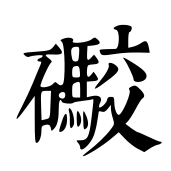
Pao
Kangxi strokes: 21
Page 838, Entry 29
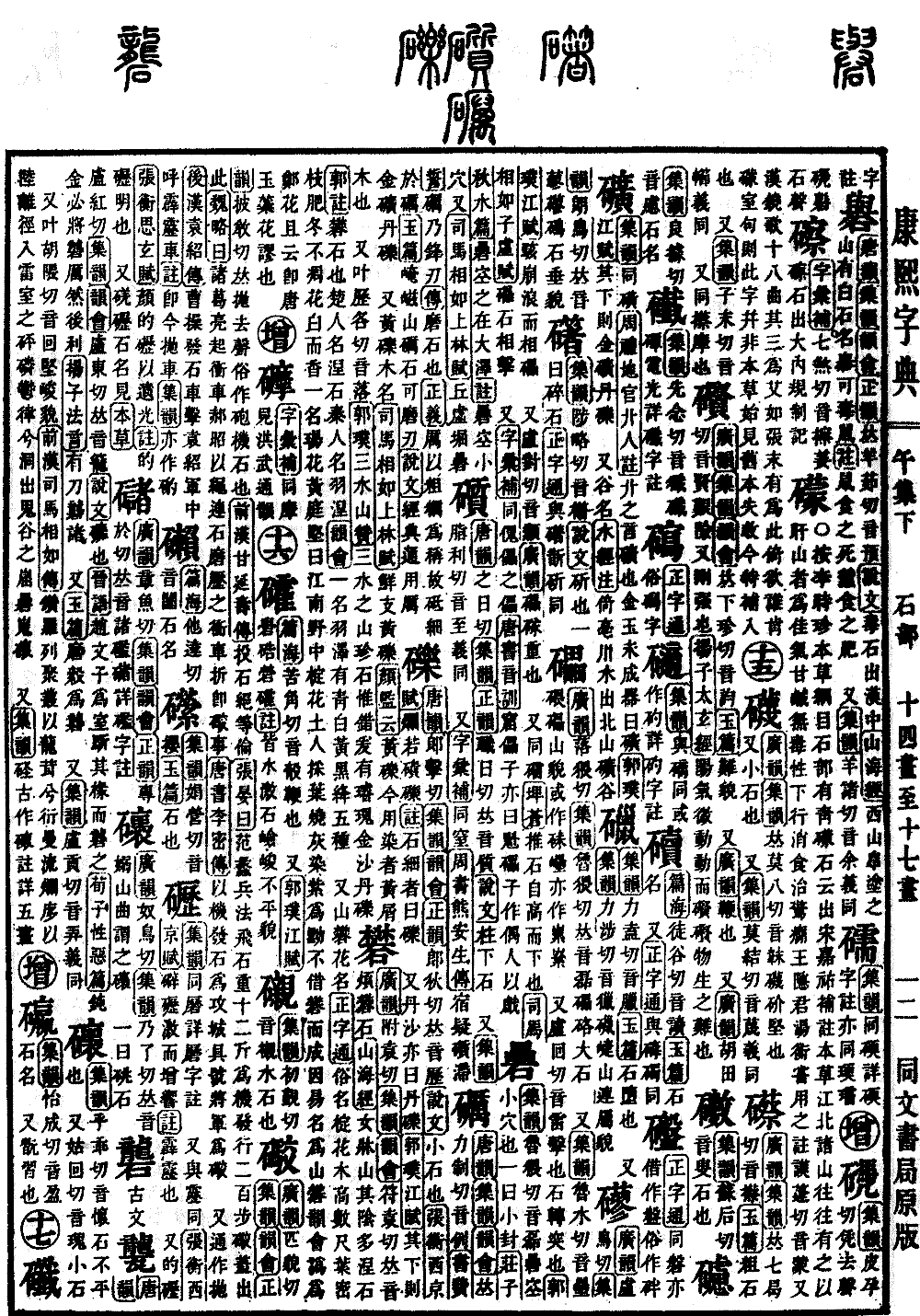
According to the Extensive Rhymes (Guangyun), it is pronounced pào. According to the Collected Rhymes (Jiyun), the Rhyme Assembly (Yunhui), and the Correct Rhymes (Zhengyun), it is pronounced pào (falling tone). It is commonly written as pào. It refers to a stone-throwing machine. In the Biography of Gan Yanshou in the History of the Former Han (Qian Hanshu), it states: "Throwing stones to surpass those of equal rank." Zhang Yan comments: "According to the Military Strategy of Fan Li, a flying stone weighing twelve jin is launched by a mechanism for two hundred paces; the pao likely originated from this." The Records of Wei (Weilüe) states: "Zhuge Liang built a ramming carriage; Hao Zhao used ropes to connect stone millstones to crush it, causing the ramming carriage to break, which is a matter related to the pao." In the Biography of Li Mi in the History of the Tang (Tangshu), it says: "Using a mechanism to launch stones as an instrument for attacking cities, they were called General Pao." It is also commonly written as pāo. In the Biography of Yuan Shao in the History of the Later Han (Hou Hanshu), it states: "Cao Cao used stone-launching carts to attack Yuan Shao; in the army, they were called thunderbolt carts." The commentary notes: "This is the current throwing cart." In the Collected Rhymes (Jiyun), it is also written as a variant form.
Textual research: In the Biography of Li Mi in the History of the Tang (Tangshu), it says: "Using a mechanism to launch stones as an instrument for attacking cities, they were called General Pao." Based on the original text, the word instrument has been corrected to mechanism, and the word as has been omitted after the word General.