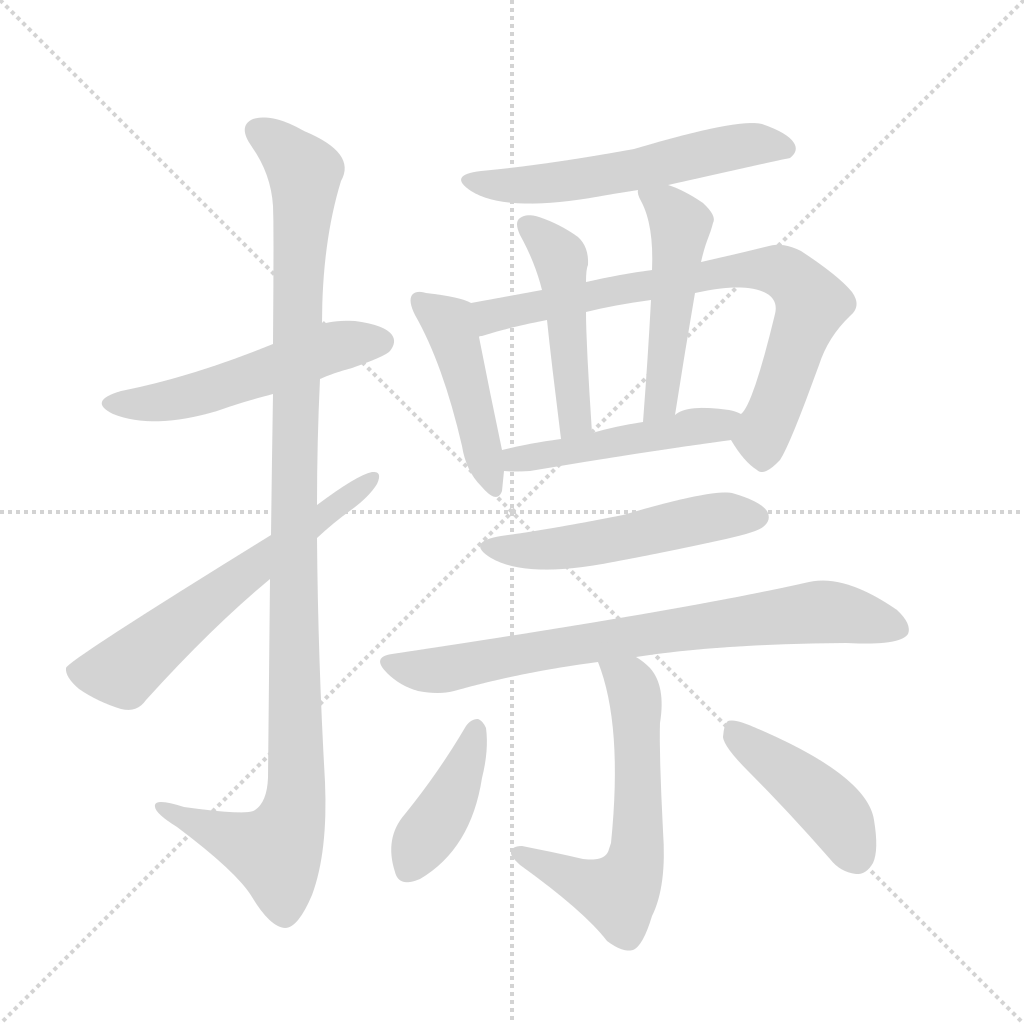
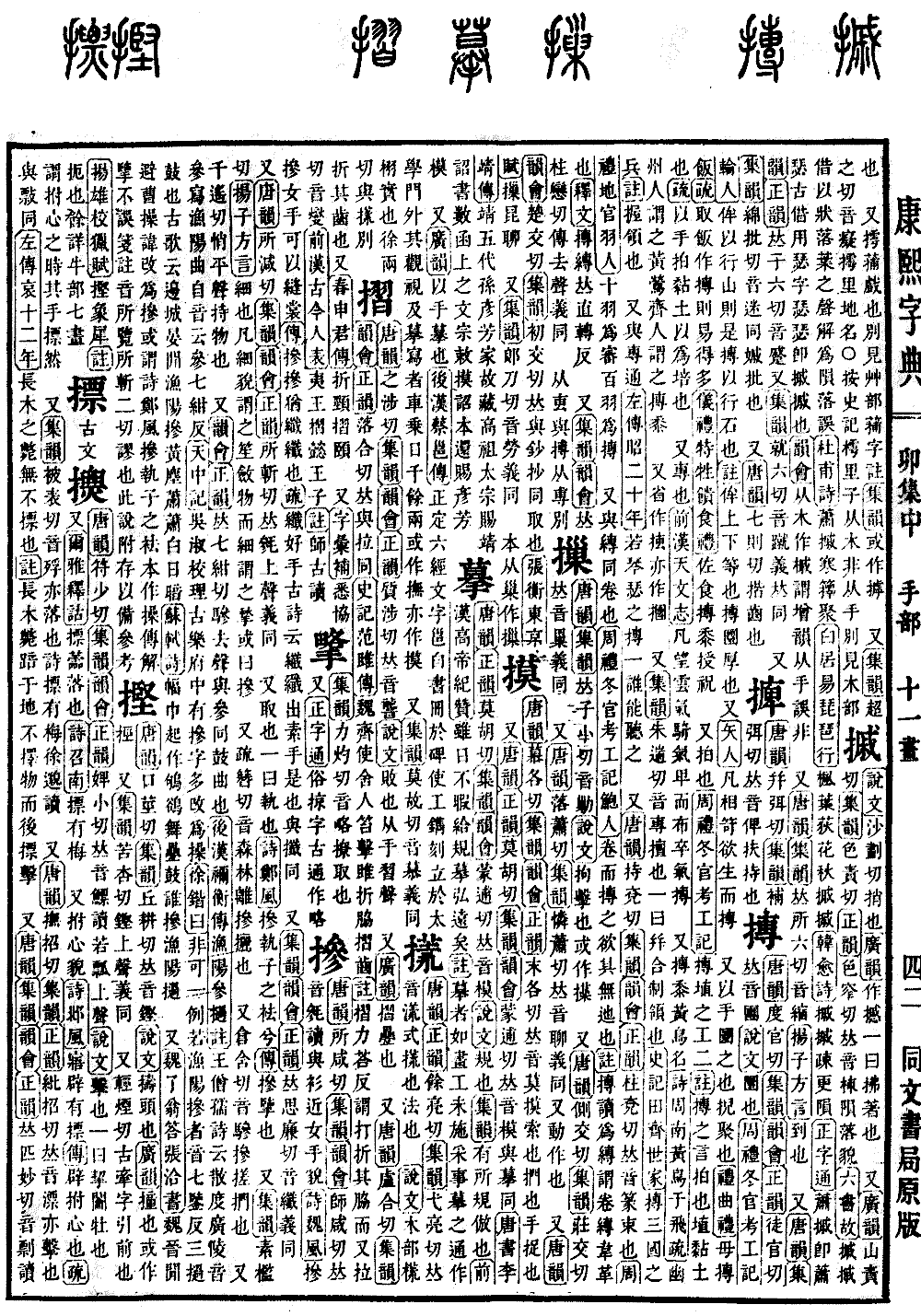
Mao Collection, Middle Volume. Radical: Hand (shǒu). Kangxi strokes: 15. Page 452, Entry 12.
According to the Tang Rhyme (Tangyun), the pronunciation is biao (rising tone). According to the Collected Rhymes (Jiyun), the Rhyme Collection (Yunhui), and the Correct Rhymes (Zhengyun), the pronunciation is biao (rising tone). It is pronounced like biao. It is read with the rising tone of piao. The Explaining Graphs and Analyzing Characters (Shuowen Jiezi) defines it as to strike. Another interpretation is to lift a door latch. Furthermore, the Erya (Glossary of Terms) defines biao ling as to fall. The Book of Odes (Shijing), Shao South section, contains the line, there are plums falling. It also describes the act of beating one's chest. The Book of Odes (Shijing), Bei Airs section, contains the line, waking, I beat my breast and cry out. The Commentary explains pi as beating the chest. The Subcommentary explains the movement of the hands when beating the chest. Also, according to the Collected Rhymes (Jiyun), the pronunciation is biao (falling tone). It also means to fall. Xu Miao reads the line, there are plums falling, in this way. Also, according to the Tang Rhyme (Tangyun), the pronunciation is biao. According to the Collected Rhymes (Jiyun) and the Correct Rhymes (Zhengyun), the pronunciation is biao. It also means to strike. It is identical to the character meaning to strike. The Zuo Tradition (Zuozhuan), twelfth year of Duke Ai, contains the line, when a tall tree collapses, there is nothing it does not strike. The Commentary notes that tall trees falling to the ground strike indiscriminately. Also, according to the Tang Rhyme (Tangyun), the Collected Rhymes (Jiyun), the Rhyme Collection (Yunhui), and the Correct Rhymes (Zhengyun), the pronunciation is biao (departing tone). It is read with the departing tone of piao. The meaning is the same. It also means to fall. Also, according to the Collected Rhymes (Jiyun), the pronunciation is biao (departing tone). It is read with the departing tone of piao. It also means to strike. Also, the pronunciation is pi. The meaning is the same. Also, according to the Collected Rhymes (Jiyun), the Rhyme Collection (Yunhui), and the Correct Rhymes (Zhengyun), the pronunciation is biao. The meaning is the same. It also means to wave or to direct. The Gongyang Tradition (Gongyangzhuan), thirteenth year of Duke Zhuang, contains the line, Cao Zi waved his sword and departed. The Mencius contains, he waved to the messenger to go out beyond the great gate. It also refers to the tip of a blade or sword. The History of the Former Han (Qian Hanshu), Biography of Wang Mang, contains the line, the merit of the blade tip. The Commentary notes that this refers to the edge of the tip of a blade. Also, according to the Tang Rhyme (Tangyun), the Collected Rhymes (Jiyun), the Rhyme Collection (Yunhui), and the Correct Rhymes (Zhengyun), it is identical to the character for to throw (pāo). The Explaining Graphs and Analyzing Characters (Shuowen Jiezi) explains that the character for to throw is sometimes written with the hand radical and the sound piao. It is used interchangeably with biao. See the entry for to throw for further details. Note: The Tang Rhyme (Tangyun) records the pronunciation as biao, which belongs to the xiao rhyme and is a rising tone. The Explaining Graphs and Analyzing Characters (Shuowen Jiezi) incorrectly categorized it under the departing tone. The newly added Extensive Rhymes (Guangyun) changes this to biao (rising tone), which should be followed.