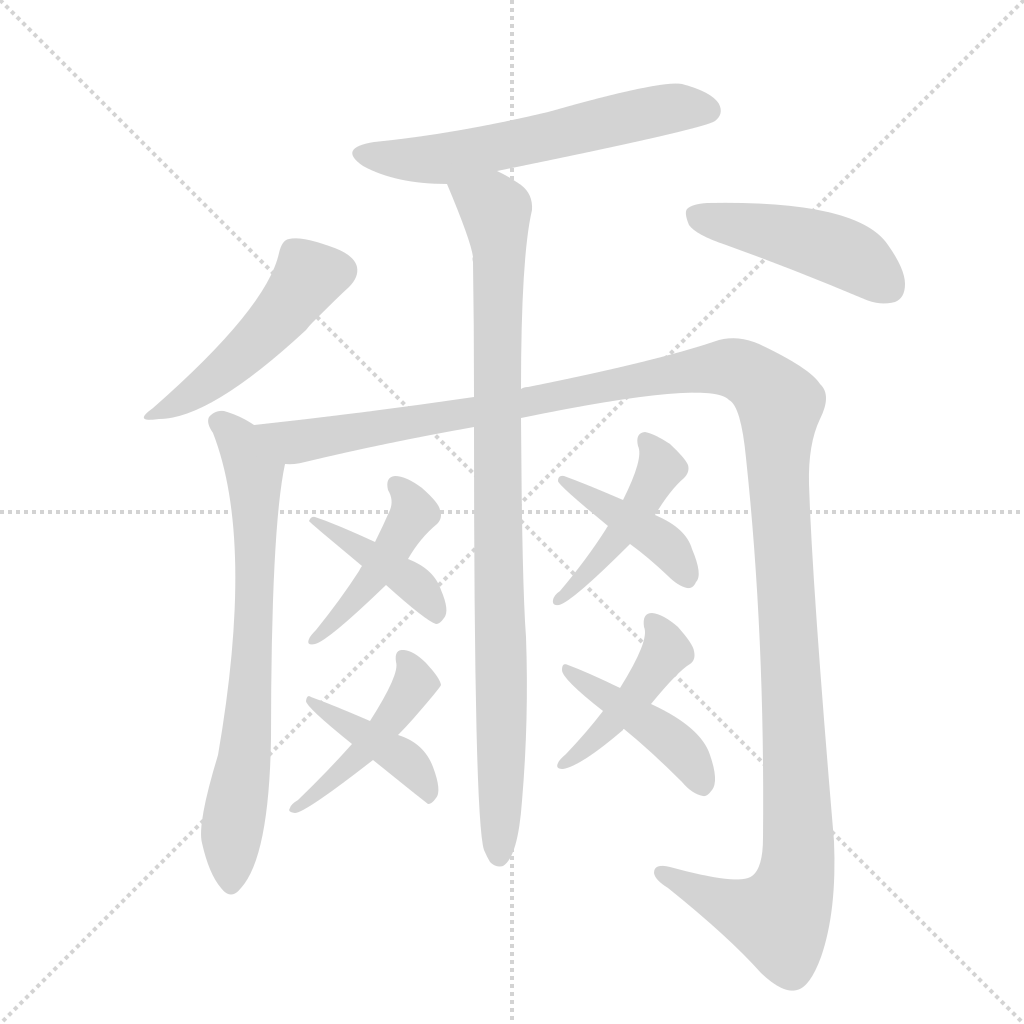
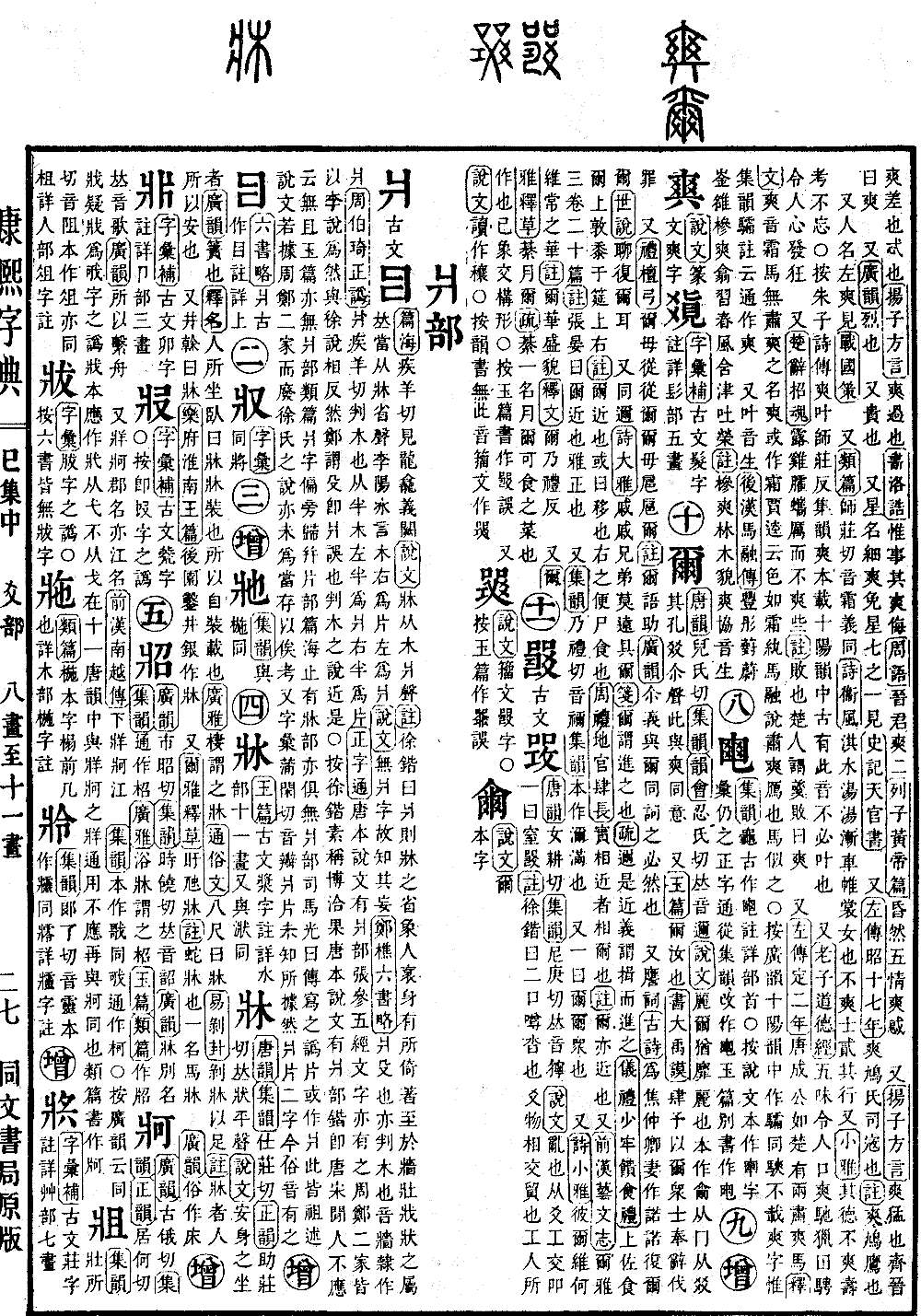
Si Collection, Middle Volume
Radical: Crossed lines (yáo)
Kangxi stroke count: 14
Page 691, Entry 04
Pronounced er (rising tone).
Shuowen Jiezi (Dictionary of Graphic Components): Li er means beautiful or delicate. Originally written as a different character. Composed of the radical for covering and the component for small, with its aperture, and the sound-indicator er. This is similar in principle to the character shuang.
Yupian (Jade Chapters): Er, meaning you.
Book of Documents (Shangshu): The reason I use you, all my generals and soldiers, to carry out the order to attack the guilty.
Book of Rites (Liji): Do not be too hasty; do not be too ostentatious.
Commentary: Er is a modal particle.
Guangyun (Broad Rhymes): The meaning of the character with the small radical is the same as er. It expresses a tone of necessity. Also a word for answering.
Old Poetry: Written for the wife of Jiao Zhongqing: Repeatedly answering yes, yes, yes.
A New Account of Tales of the World (Shishuo Xinyu): Merely thus, that is all.
Also equivalent to er (near).
Book of Odes (Shijing): Intimate brothers, do not alienate them but keep them close.
Jian (Commentary): Er means to cause them to approach.
Shu (Sub-commentary): Er means near, signifying bowing and gesturing for them to come forward.
Book of Etiquette and Ceremonial (Yili): The assistant of the food offering moves the millet to the right of the person presiding over the sacrifice.
Commentary: Er means near. Or it is said to mean to move. Placing it to the right makes it convenient for the recipient to eat.
Rites of Zhou (Zhouli): Goods that are similar should be grouped together.
Commentary: Er also means near.
History of the Former Han (Hanshu): Erya (Approaching Propriety), three volumes, twenty chapters.
Commentary: Zhang Yan states: Er means near; ya means correct.
Jiyun (Compendium of Rhymes): Pronounced ni (rising tone).
Jiyun (Compendium of Rhymes): Originally written as the character for overflowing. Meaning full.
Another source says er-er describes something numerous.
Book of Odes (Shijing): What is it that blooms so, it is the flower of the flowering cherry.
Commentary: Er hua, meaning the appearance of lushness.
Shiwen (Explanation of Text): Pronounced ni (rising tone).
Erya (Approaching Propriety): Qi is called yue er.
Sub-commentary: Qi, also called yue er, is a type of edible vegetable.
Textual verification: Book of Etiquette and Ceremonial (Yili), in the section regarding food offerings, it is noted that the assistant moves the millet to the right on the mat. The commentary states that er means near, or to move, implying that placing it to the right facilitates the recipient's consumption. Following the original text, the character for to move has been added.