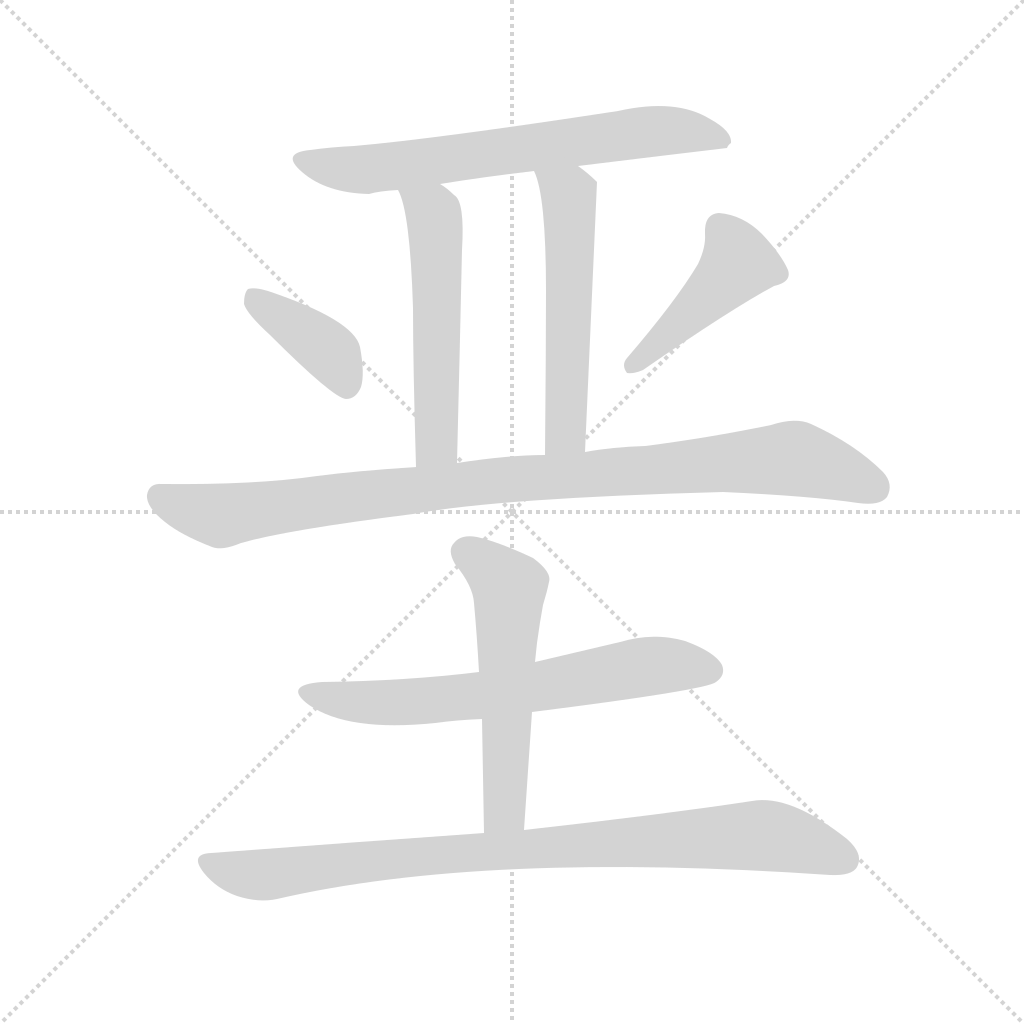
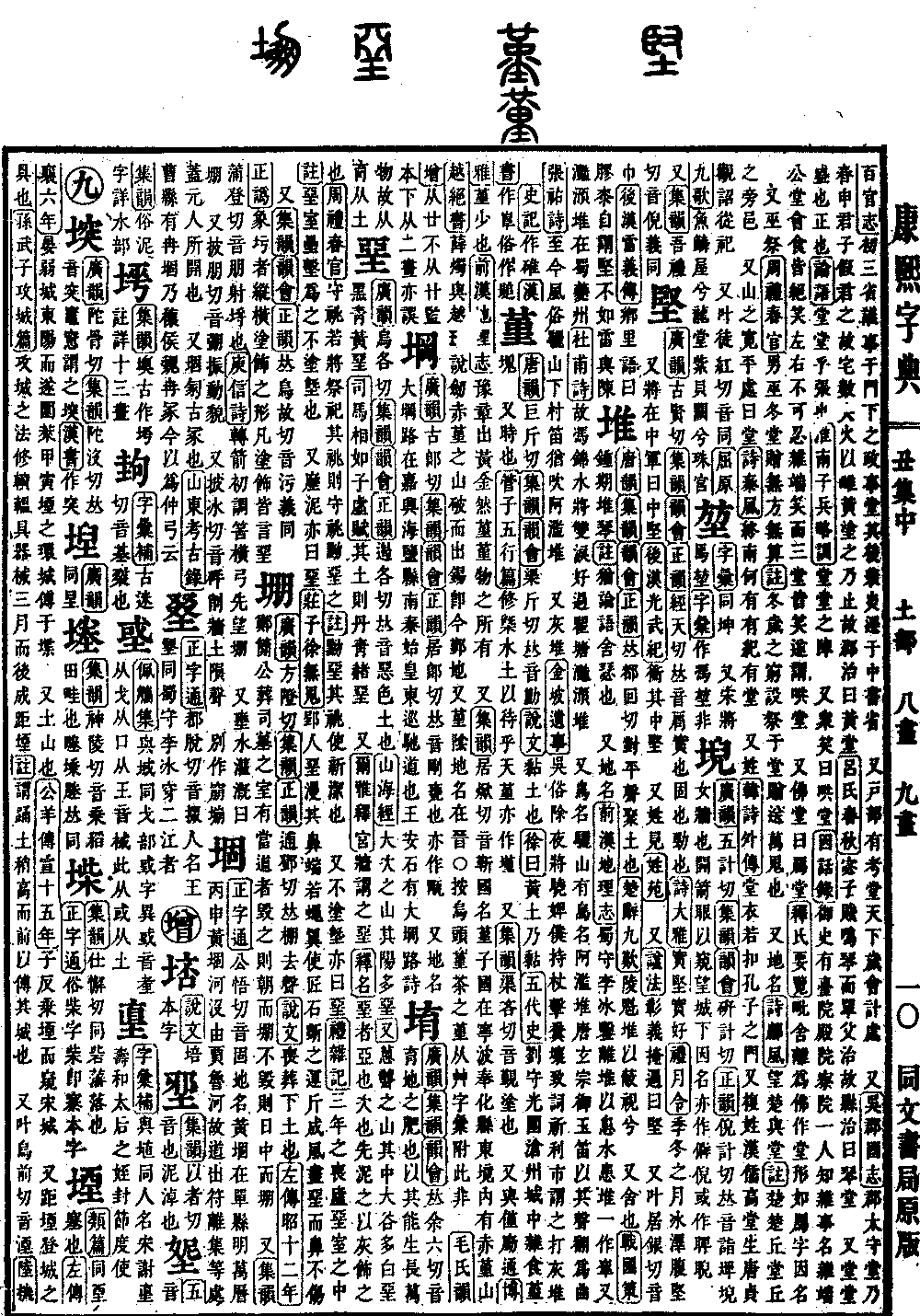
Chou Collection, Middle Volume
Radical: Earth (tǔ)
Kangxi stroke count: 11
Page 232, Entry 01
Pronounced e. Colored earth. Classic of Mountains and Seas (Shanhaijing): On the Great Next Mountain, the south side is abundant in white earth. Also, on the Onion Deaf Mountain, within its great valleys, there is much white, black, blue, and yellow earth. Rhapsody on Sir Fantasy (Zixu fu) by Sima Xiangru: As for its soil, there is vermilion, blue, ochre, and white earth.
Also, Elegantia (Erya), Explanation of Palaces: To plaster a wall is called e. Names Explained (Shiming): E means second, a secondary layer. First mud it, then decorate it with lime.
Rites of Zhou (Zhouli), Spring Officials: When guarding ancestral shrines, if there is to be a sacrificial ceremony, the temple guard shall blacken and whiten the shrine. Commentary: To blacken and whiten the shrine is to make it new and clean.
Also, to plaster is also called e. Record of Miscellaneous Matters (Zaji) in the Book of Rites (Liji): During the three-year mourning period, one resides in a plastered chamber. Commentary: A plastered chamber is made of stacked bricks and is not finished with fine plaster.
Also, to smear with mud is also called e. Zhuangzi, Xu Wugui: A man from Ying had a speck of white plaster on the tip of his nose like a fly's wing. He had the craftsman Shi hew it off. Shi swung his axe to make a wind, completely removing the plaster without harming the nose.
Also, pronounced wu. The meaning is the same.
True Errors (Zheng'e): It represents a plastering tool, the shape of coating and decorating in all directions. All coating and decorating is referred to as e.