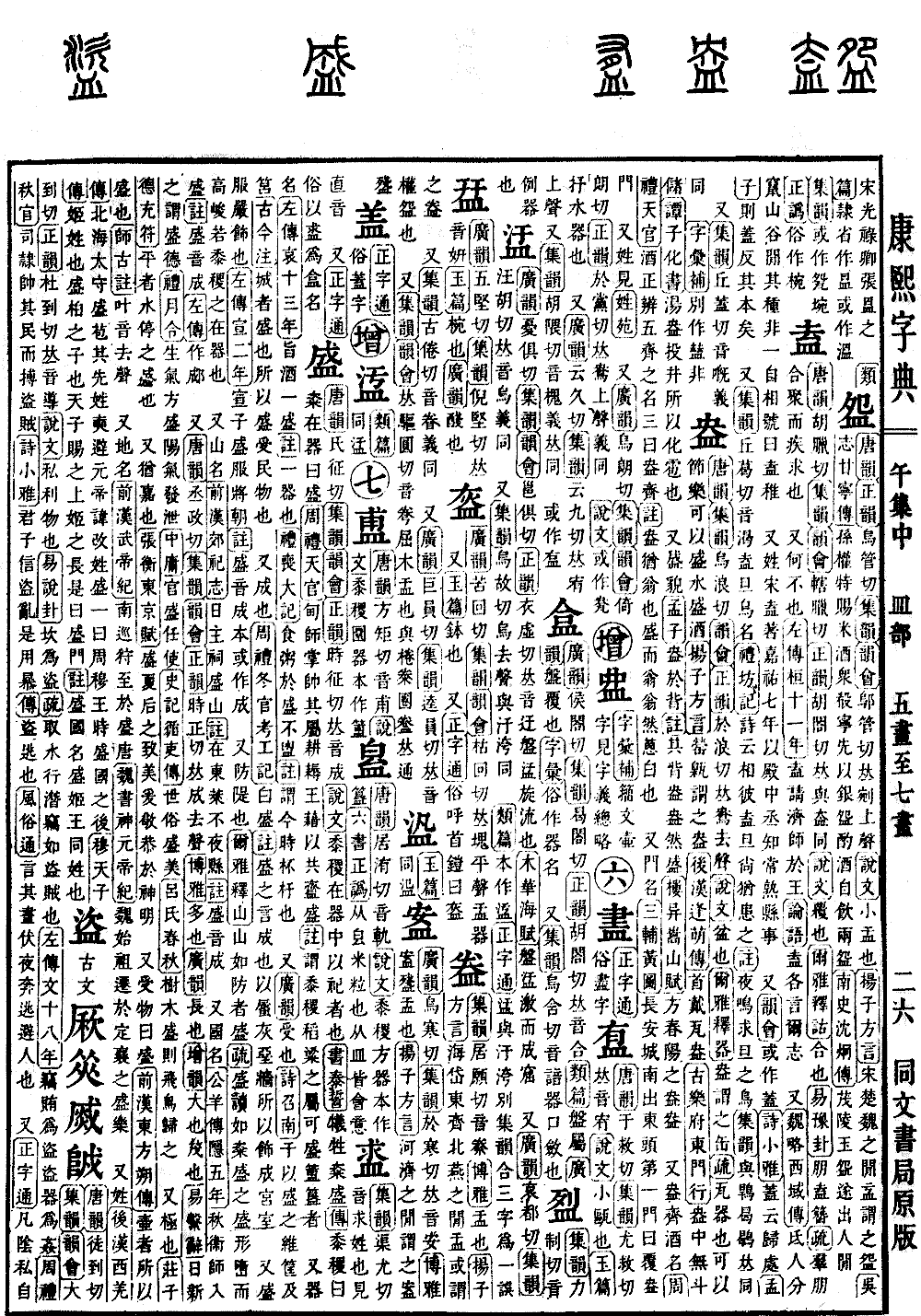
Wu Collection, Middle Volume
Radical: Vessel (mǐn)
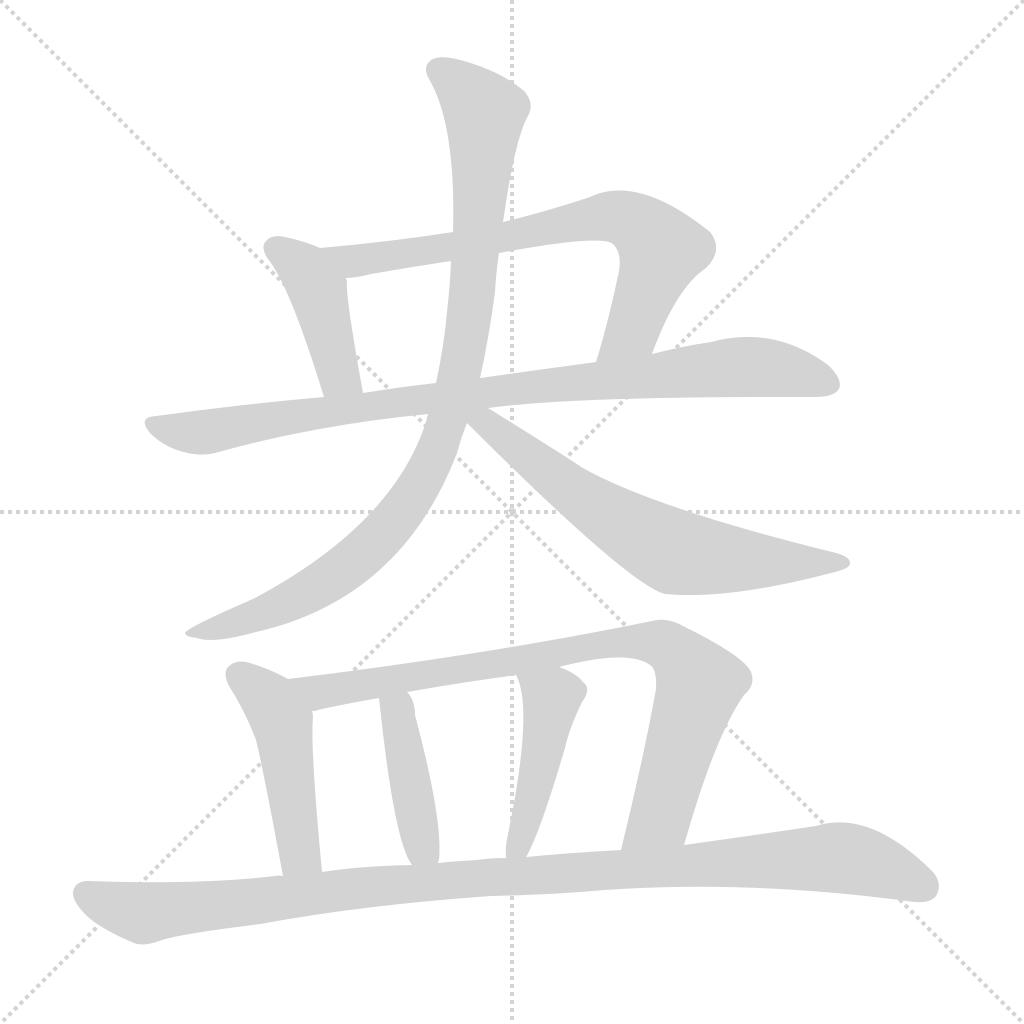
Ang
Kangxi strokes: 10
Page 794, Entry 03
Pronounced ang (falling tone)
According to the Tang Dynasty Rhyme Dictionary (Tangyun) and the Collection of Rhymes (Jiyun), the pronunciation is ang (falling tone). According to the Collection of Rhymes (Yunhui) and the Standard Rhymes (Zhengyun), the pronunciation is ang (falling tone).
Defined in the Explaining Graphs and Analyzing Characters (Shuowen) as a basin.
According to the Erya, Explaining Vessels (Erya: Shiqi), an ang is called a fou (earthenware jar). The commentary states it is an earthenware vessel. It can be used to provide musical rhythm, and can be used to hold water or wine.
According to Yang Xiong’s Regional Dialects (Fangyan), a ying and a qi are both called an ang.
In the Biography of Feng Meng in the Book of the Later Han (Houhan shu), it is written: Carrying an earthenware basin on the head.
In the Ancient Music Bureau (Gu yuefu) poem East Gate Trip (Dongmen xing), it is written: There is not even a peck of supplies in the basin.
In Tan Zi’s Book of Transformations (Tanzi huashu), it is written: Throwing a hot-water vessel into a well is how one transforms hail.
Also means abundant or full appearance.
In the Book of Mencius (Mengzi), it is written: Abundant on the back. The commentary states: His back is full and abundant.
In Lou Yi’s Ode to Mount Song (Songshan fu), it is written: In the spring, the sun is abundant.
Also refers to ang qi, a type of wine.
In the Rites of Zhou, Officials of Heaven (Zhouli: Tianguan), it is written: The Wine Administrator distinguishes the names of the five types of qi, the third being ang qi. The commentary states: Ang is like weng (swelling). It is full and looks weng-weng, with a green-white appearance.
Also a gate name.
In the Illustrations of the Three Supports (Sanfu huangtu), it is written: To the south of Chang’an city, exiting the east end, the first gate is called the Fu'ang Gate.
Also a surname. Found in the Garden of Surnames (Xingyuan).
Also pronounced ang (rising tone). According to the Expanded Rhyme Dictionary (Guangyun), the pronunciation is ang (rising tone). According to the Collection of Rhymes (Jiyun) and the Collection of Rhymes (Yunhui), the pronunciation is ang (rising tone). According to the Standard Rhymes (Zhengyun), the pronunciation is ang (rising tone). The meaning is the same.
According to the Explaining Graphs and Analyzing Characters (Shuowen), it is sometimes written in a variant form.