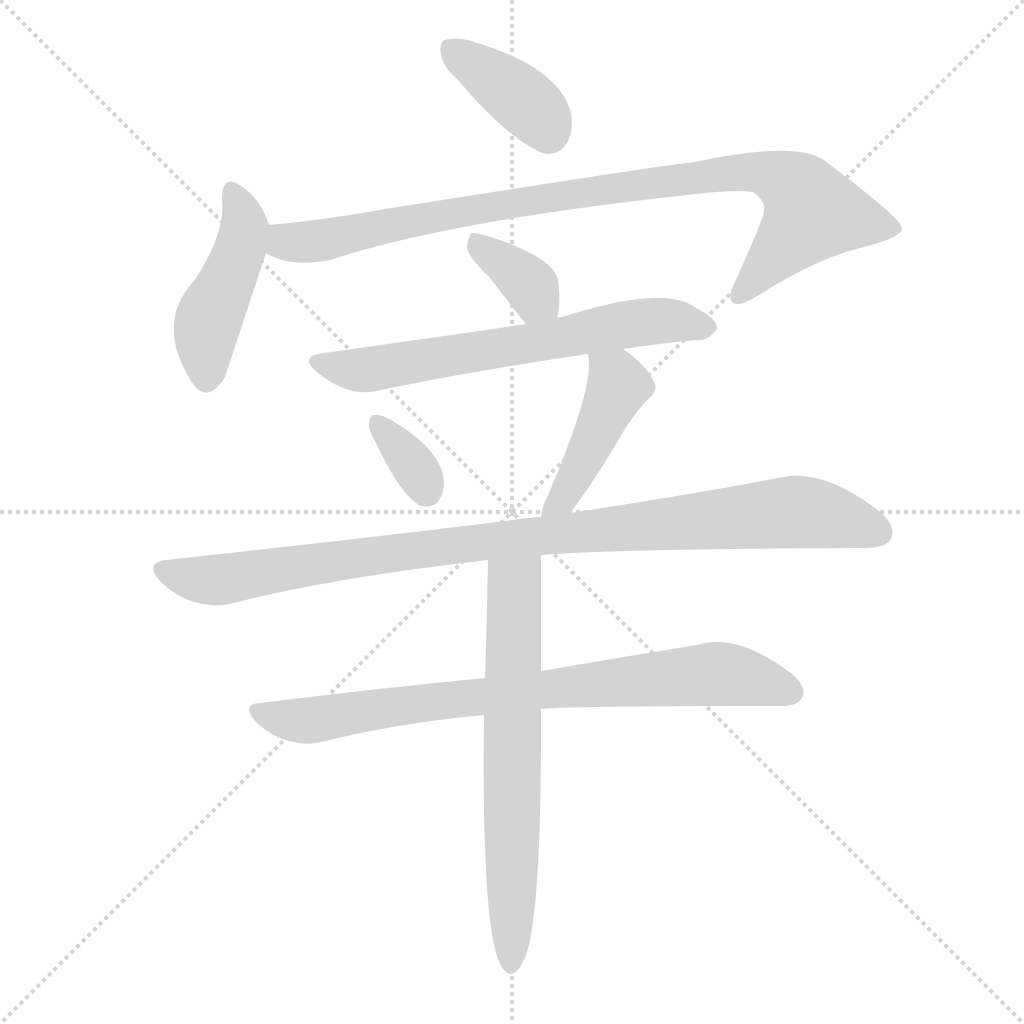
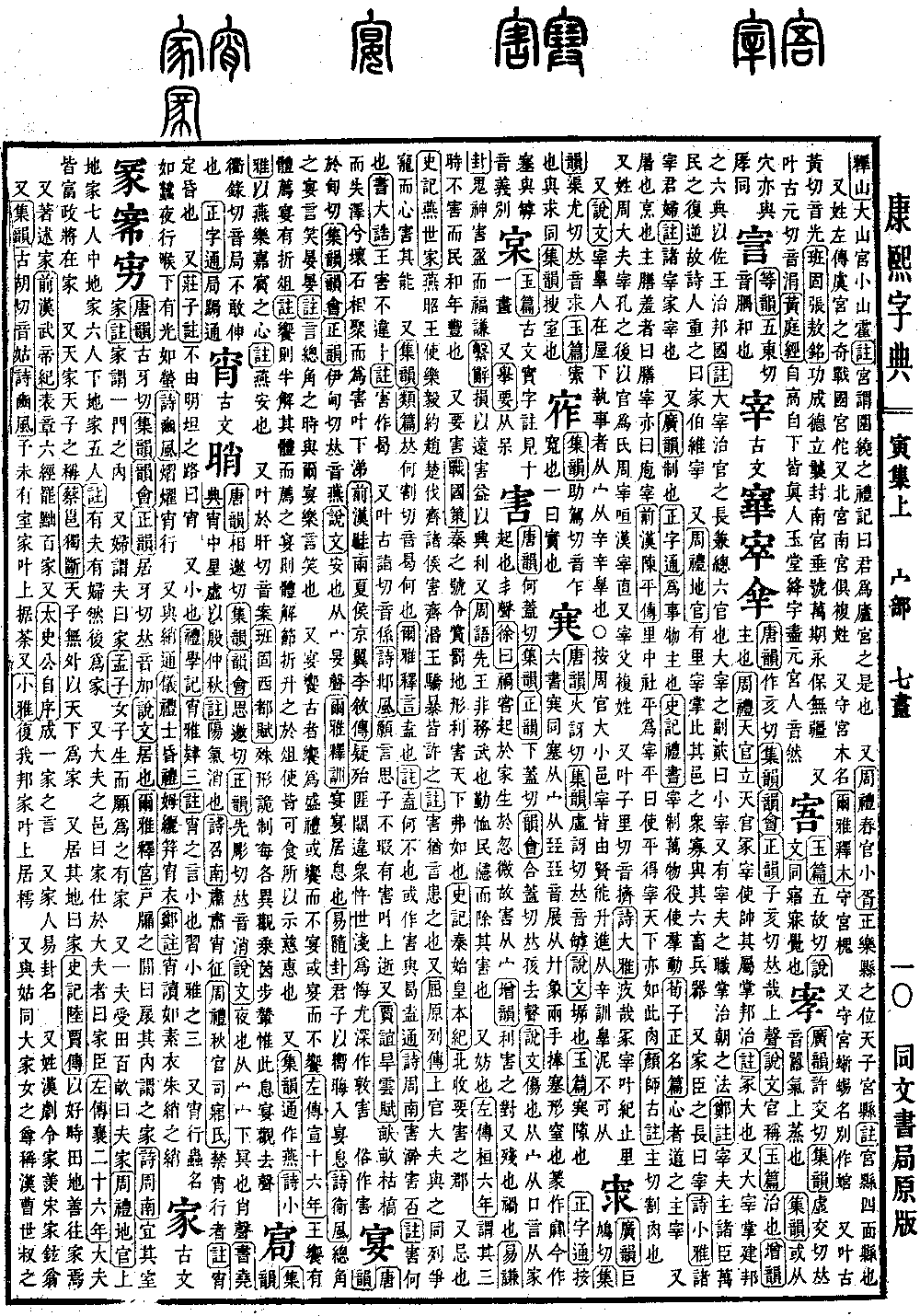
Yin Collection, Upper Volume. Radical: Roof (bù).
Kangxi strokes: 10. Page 286, Entry 04.
In ancient scripts, according to Tangyun, it is pronounced zai (rising tone). According to Jiyun, Yunhui, and Zhengyun, it is pronounced zai (rising tone), which sounds like zai in the rising tone.
Shuowen Jiezi defines it as a title for an official post. Yupian defines it as to govern. Zengyun defines it as a supervisor.
Book of Rites (Zhouli), Heaven Officials, records the establishment of the Heaven Official Prime Minister (Zhong Zai), who leads subordinates in managing the governance of the state. Annotation: Zhong means great. There is also the Grand Prime Minister (Da Zai), who manages the establishment of the six codes of the state to assist the ruler in governing. Annotation: The Grand Prime Minister is the head of the governing officials and oversees the six ministries. The deputy of the Grand Prime Minister is called the Lesser Prime Minister (Xiao Zai). There is also the office of the Prime Minister's Aide (Zai Fu), who manages the laws of the court. Zheng Xuan's annotation: The Prime Minister's Aide manages the petitions and appeals of ministers and commoners; thus the poet values him, saying, "The house uncle is the prime minister."
Book of Rites (Zhouli), Earth Officials, mentions the neighborhood prime minister (Li Zai), who manages the auditing of population numbers, livestock, and weapons in their jurisdiction.
The head of household retainers is also called prime minister. Book of Odes (Shijing), Lesser Odes (Xiao Ya): "The various prime ministers and noble wives." Annotation: Various prime ministers refers to house prime ministers.
Guangyun defines it as to control. Zhengzitong defines it as to act as the master of things. Records of the Grand Historian (Shiji), Treatise on Rites: To master and control all things, driving all activities. Xunzi, Rectification of Names: The mind is the master of the Way.
It also refers to slaughtering and cooking. Those who manage diet are called dietary prime ministers or kitchen prime ministers. Book of Han (Qian Hanshu), Biography of Chen Ping: When the village held a sacrifice, Chen Ping acted as the person in charge of dividing the sacrificial meat. Chen Ping said: If I could govern the world, I would be as fair as I am in dividing this meat. Yan Shigu's annotation: To preside over the cutting of meat.
It is also a surname. Descendants of Zai Kong, a grand officer of the Zhou Dynasty, used his office as their surname; the Zhou Dynasty had Zai Xuan, and the Han Dynasty had Zai Zhi. There is also the compound surname Zaifu.
It also rhymes, pronounced ji (rising tone), sounding similar to ji. Book of Odes (Shijing), Greater Odes (Da Ya): "Distressed is the Prime Minister." Rhymes with ji, zhi, and li.
Shuowen Jiezi explains that zai represents a sinner, someone who works under a roof. The character is composed of roof and painful/sinful (xin). Xin represents crime. Note: The Zhou Records (Zhouguan) entries regarding prime ministers of large and small cities all refer to virtuous people promoted to these roles. Using xin to mean crime is a pedantic interpretation and should not be followed.