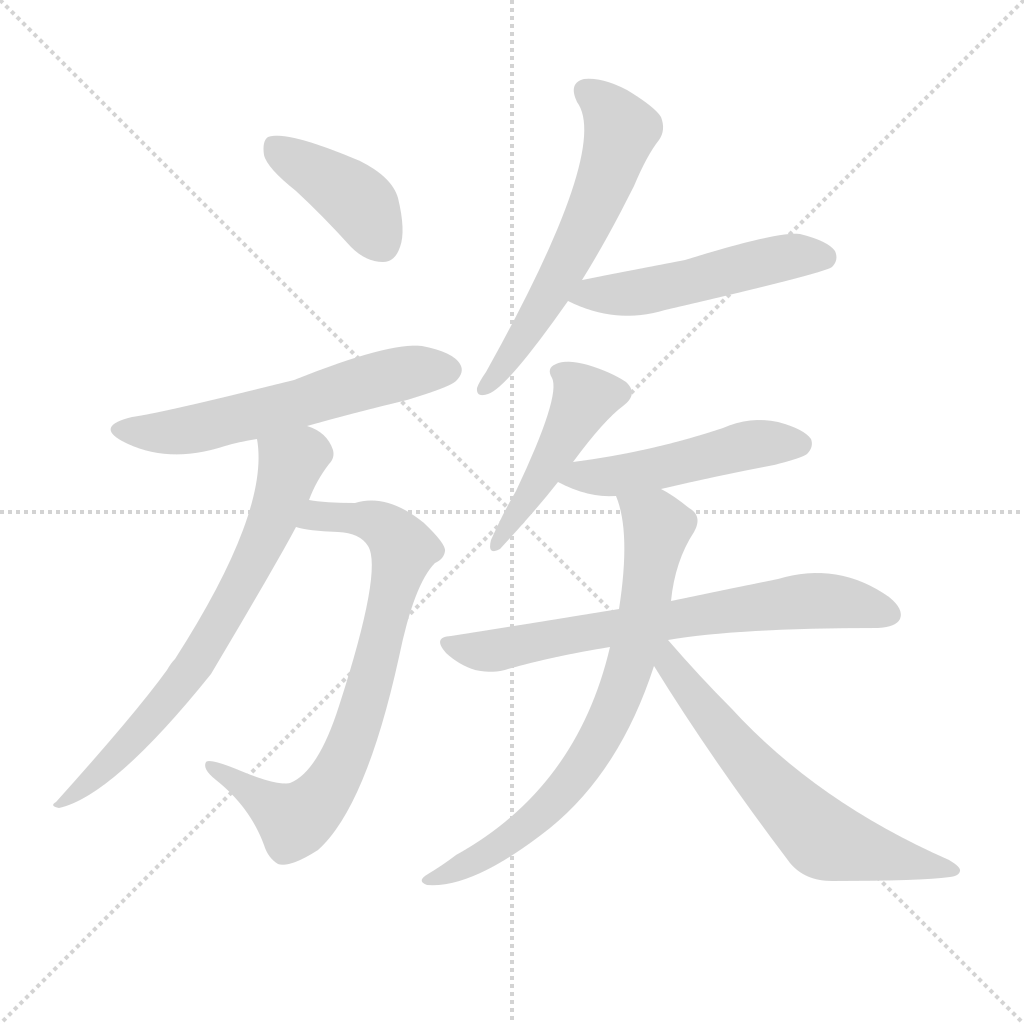
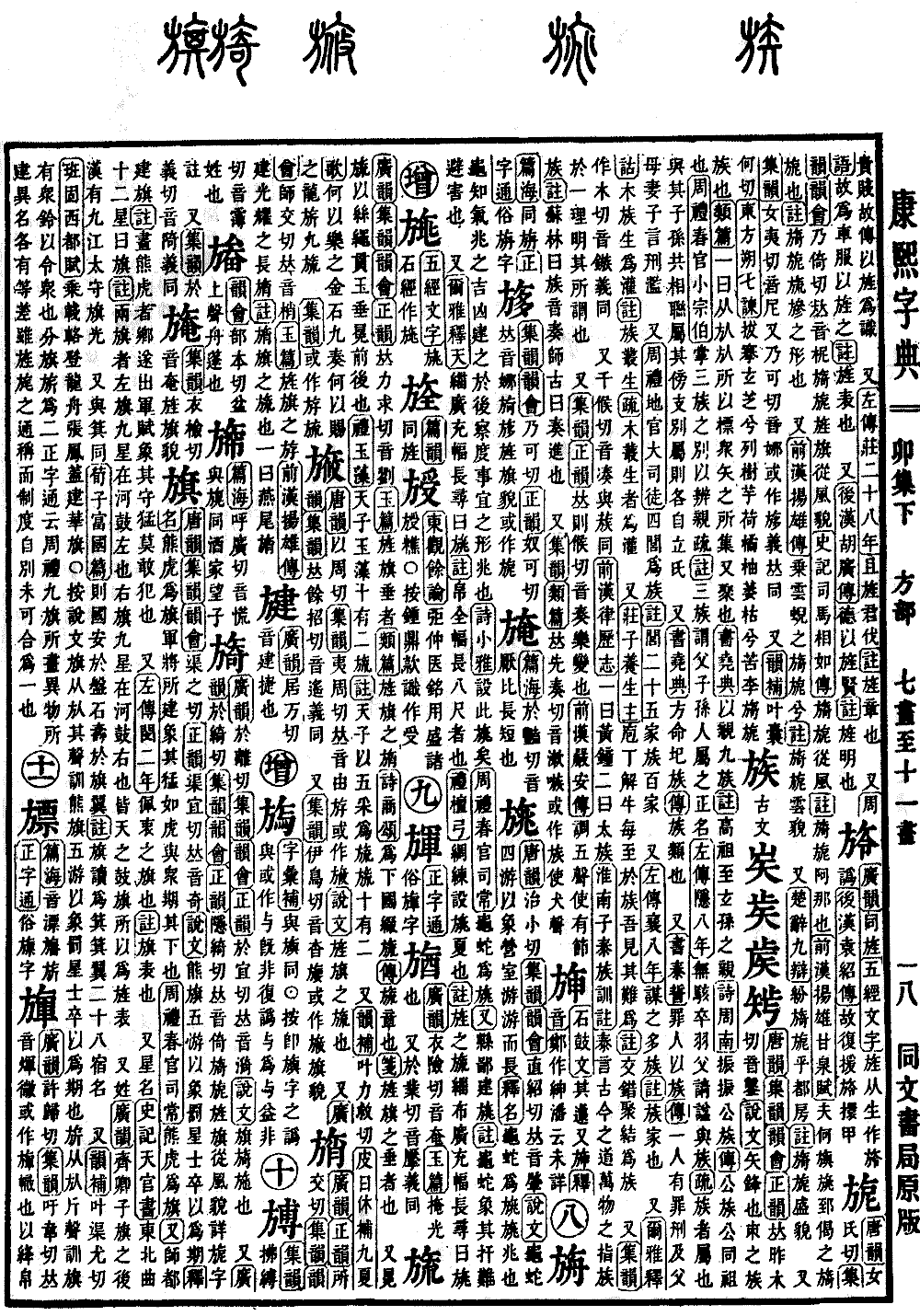
Mao Collection, Lower Volume
Radical: Square (fāng)
Kangxi Strokes: 11
Page 484, Entry 03
Ancient texts. Pronounced zuo.
According to the Explaining Graphs and Analyzing Characters (Shuowen Jiezi), it refers to the tip of an arrow or things bundled together in clusters.
According to the Classified Collection of Characters (Leipian), one theory suggests it is derived from the symbol for a banner, used to mark the place where many arrows gather.
Also refers to gathering.
Book of Documents (Shujing), Canon of Yao: "To bring harmony to the nine branches of kin." The commentary explains this as relatives from one's great-great-grandfather down to one's great-great-grandchildren.
Book of Odes (Shijing), Zhounan: "The honorable clans are flourishing." The commentary explains public clans as those sharing the same ancestor as the ruler.
Rites of Zhou (Zhouli), Spring Offices, Minor Recorder of Clans: "Responsible for distinguishing the three branches of kin to clarify degrees of intimacy." The commentary notes the three branches refers to father, son, and grandson, which is the formal definition in human relationships.
Zuo Tradition (Zuo Zhuan), Eighth Year of Duke Yin: "When Wuhai passed away, Yufu requested a posthumous title and clan name." The sub-commentary explains that clan refers to kinship. It signifies common lineage with one's descendants, while collateral branches each establish their own family names.
Also Book of Documents (Shujing), Canon of Yao: "Opposing orders and destroying the kin." The commentary defines clan here as those of the same kind.
Also Book of Documents (Shujing), Great Declaration: "Punishing the criminal and his clan." The commentary explains that when one person commits a crime, it implicates parents, spouse, and children, referring to the excessive use of punishment.
Also Rites of Zhou (Zhouli), Earth Offices, Grand Minister of Instruction: "Four hamlets make one clan." The commentary notes that a hamlet is twenty-five families, so a clan is one hundred families.
Also Zuo Tradition (Zuo Zhuan), Eighth Year of Duke Xiang: "Planning with many kin." The commentary defines clan here as family groups.
Also Approaching the Standards (Erya), Explaining Plants: "When trees grow in groups, they are called shrubs." The commentary defines clan as growing in thickets. The sub-commentary explains that trees growing together are called shrubs.
Also Zhuangzi, Nourishing the Lord of Life: "When the cook Ding butchered an ox, whenever he encountered places where tendons and bones were knotted together, he saw them as difficult to handle." The commentary notes that knotted and gathered together is the meaning of clan.
Also in the Classified Collection of Characters (Leipian), pronounced zu. The meaning is the same.
Also pronounced cou. It is the same as the character for nest (cu). Book of Han (Hanshu), Treatise on Harmonics and Calendrical Astronomy: "The first is the Yellow Bell, the second is the Great Clan." Huainanzi, Treatise on the Great Clan: "The Great refers to ancient and modern principles and the goal of all things; everything is歸 (guijie - brought back) to one principle to clarify what is being discussed."
Also in the Classified Collection of Characters (Leipian) and Proper Rhymes (Zhengyun), pronounced zou. It refers to the rhythmic variations in music. Book of Han (Hanshu), Biography of Yan An: "Harmonizing the five notes to give them rhythm." The commentary by Su Lin says the sound is zou. The commentary by Yan Shigu says zou means to advance.
Also in the Classified Collection of Characters (Leipian) and the Classified Dictionary (Leipian), pronounced sou. The character for inciting dogs is sometimes written as this.