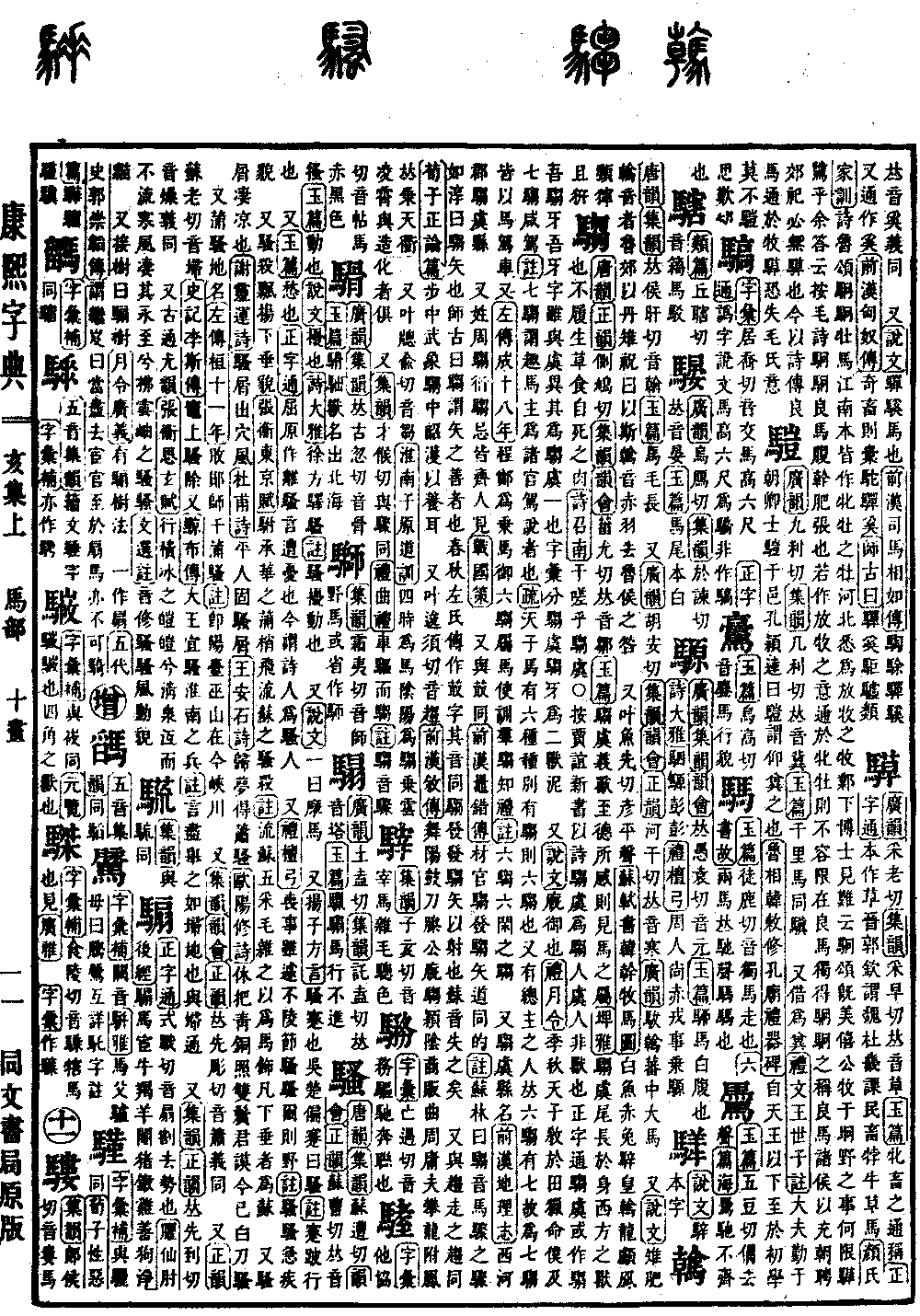
Hai Collection, Upper Volume
Radical: Carriage (chē)
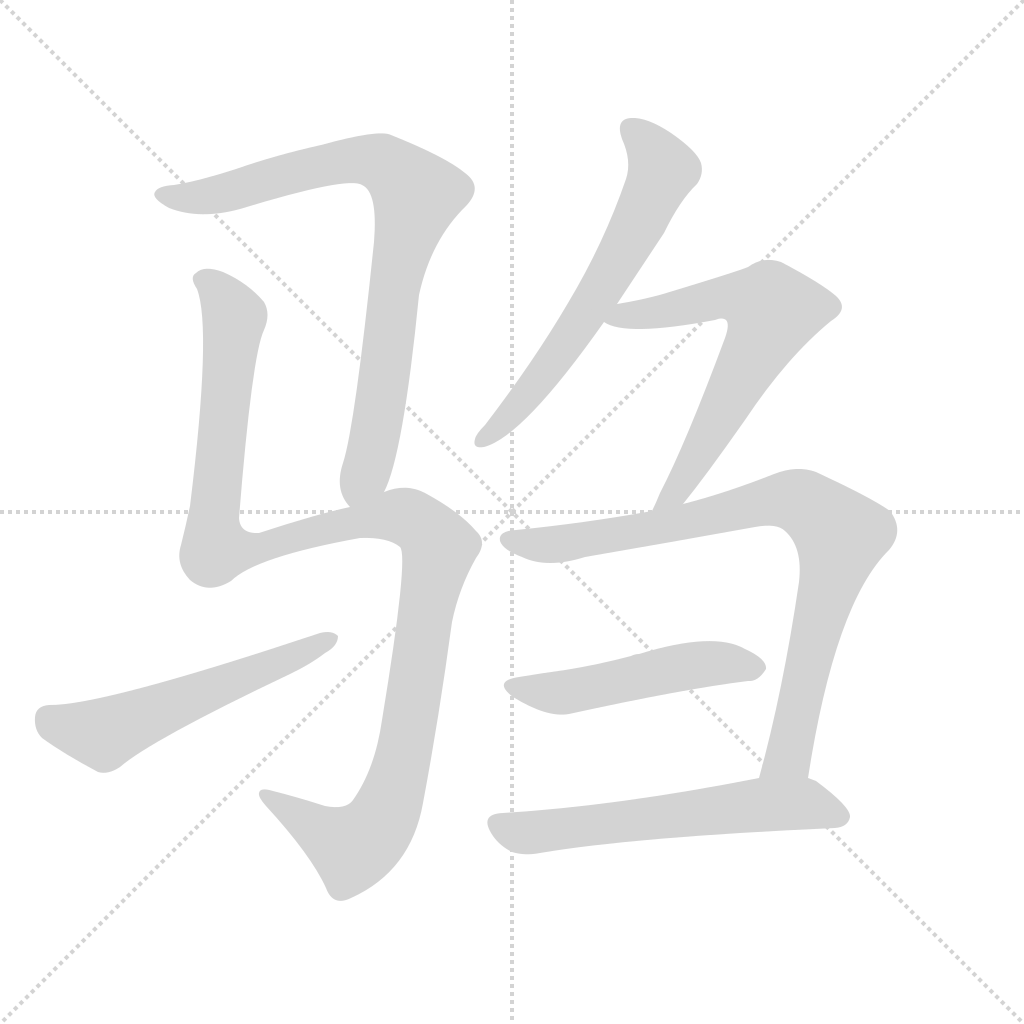
騶
Kangxi strokes: 20
Page 1443, Entry 01
Pronounced zōu.
In Jade Chapters (Yupian): Zouyu is a righteous beast that appears when influenced by supreme virtue. It belongs to the horse family.
According to Piya: The tail of a Zouyu is longer than its body; it is a beast of the west. It does not trample living grass and eats the meat of animals that have died naturally.
Book of Odes (Shijing), Shao Nan: Oh, the Zouyu. According to New Book (Xinshu) by Jia Yi, the Zouyu in the poem refers to the groom and the forest warden, not a beast. According to Corrected Meaning of Characters (Zhengzitong), Zouyu is sometimes written as Zouwu or Zouya. Although the characters wu and ya differ from yu, they all refer to the Zouyu. The Dictionary of Characters (Zihui) incorrectly distinguishes Zouyu and Zouya as two separate beasts due to excessive rigidity.
Also, in Explaining Characters (Shuowen): A stable master.
Book of Rites (Liji), Monthly Ordinances (Yueling): In the last month of autumn, the Son of Heaven conducts training in hunting and commands the charioteers and the seven grooms to harness the horses.
Commentary: The seven grooms refer to the horse attendants who manage the harnessing and unharnessing of carriages for various officials.
Sub-commentary: The Son of Heaven has six types of horses, each managed by a groom, totaling six grooms. There is also a chief administrator; the six grooms plus the administrator make seven, all of whom use horses to drive carriages.
Also, in Zuo Tradition (Zuo Zhuan), Eighteenth Year of Duke Cheng: Cheng Zheng was the imperial charioteer, the six grooms were under his jurisdiction, and he was tasked with training the various grooms in etiquette.
Commentary: The six grooms refer to the grooms of the six stables.
Also, Zouyu is the name of a county.
History of the Former Han (Qianhan Shu), Treatise on Geography: Zouyu County in Xihe Commandery.
Also, a surname. Zou Yan and Zou Ji of the Zhou dynasty were both people of Qi, as seen in Stratagems of the Warring States (Zhanguo Ce).
Also, identical to the character meaning arrow stalks (zōu).
History of the Former Han (Qianhan Shu), Biography of Chao Cuo: Excellent archers shoot the arrows, with the paths of the arrows hitting the same target.
Commentary: Su Lin says: The character is pronounced like the zòu in horse gallop. Ru Chun says: It refers to arrows. Yan Shigu says: It refers to fine arrows. In Zuo Tradition (Zuo Zhuan), the character for arrow stalks is used, with the same pronunciation. It means shooting fine arrows. Su Lin's phonetic annotation is incorrect.
Also, identical to the character meaning to walk quickly or hasten (qū).
Xunzi, Correct Discussion (Zheng lun pian): The pace conforms to the music of the martial dance, and the rapid walking conforms to the music of the Shao and Hu, which are used to cultivate the hearing.
Also, rhymes with the sound qū.
History of the Former Han (Qianhan Shu), Narrative Biography: The butcher of Wuyang, the groom of the Duke of Teng. The merchant of Yingyin, the servant of Quzhou. Climbing the dragon and attaching to the phoenix, riding the heavenly thoroughfare.
Also, rhymes with the sound chú.
Huainanzi, Original Way (Yuan dao xun): Using the four seasons as horses and the yin and yang as the groom, riding the clouds to soar into the heavens, accompanying the creator.
Also, in Collection of Rhymes (Jiyun): Pronounced zhòu. Identical to the character meaning to gallop (zhòu).
Book of Rites (Liji), Summary of Etiquette (Qu li): When the carriage is driven, it gallops.
Commentary: Pronounced zhòu.
Textual Research: In Zuo Tradition (Zuo Zhuan), Eighteenth Year of Duke Cheng: Cheng Zheng was the imperial charioteer, the six grooms were under his jurisdiction. Following the original text, changed from subordinate to horses to under his jurisdiction.
In History of the Former Han (Qianhan Shu), Biography of Chao Cuo: Excellent archers shoot the arrows, the paths of the arrows hit the same target. Following the original text, removed the extra character.
In Xunzi, Correct Discussion (Zheng lun pian): The pace conforms to the martial dance, the rapid walking conforms to the music of the Shao and Hu, to cultivate the hearing. Following the original text, added the character for to cause above the word meaning to cultivate.