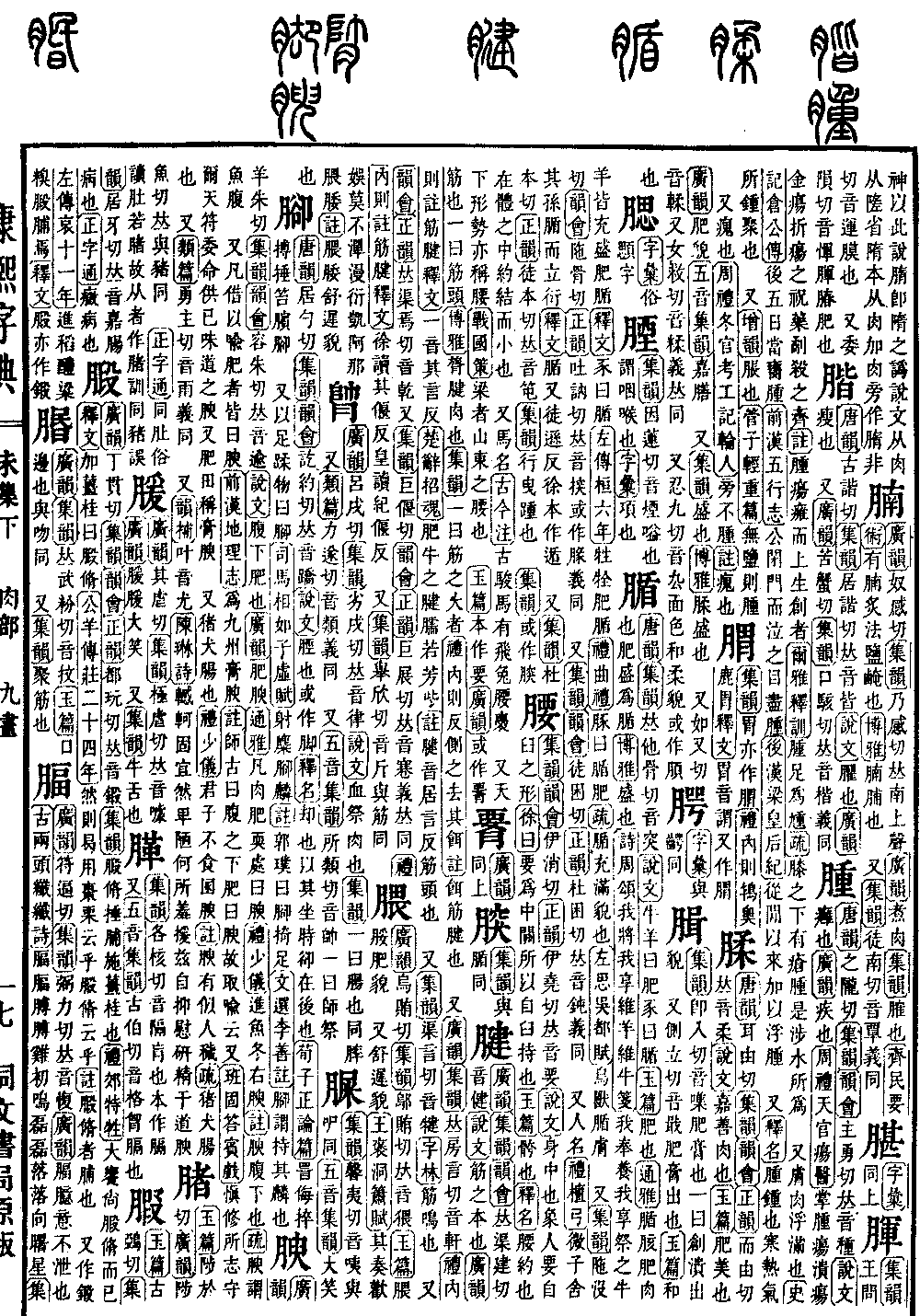
Wei Collection, Lower Volume
Radical: Meat (ròu)
腫
Kangxi strokes: 15
Page 989, Entry 01
Tang Rhymes (Tangyun): Pronounced zhong (rising tone).
Collected Rhymes (Jiyun) and Rhymes Collection (Yunhui): Pronounced zhong (rising tone).
Explanation:
Explanatory Text (Shuowen): A carbuncle.
Broad Rhymes (Guangyun): An ailment.
Rites of Zhou (Zhouli), Section on Celestial Officials, Medical Practitioners for Sores: Manage the medicinal applications, scraping, and sterilizing agents for swollen sores, ruptured sores, metal-inflicted wounds, and bone fractures.
Commentary: Swollen sores are those upon which an ulcer develops.
Literary Approximations (Erya), Explanation of Teachings: Swollen feet are called chong.
Sub-commentary: Sores and swelling below the knee are caused by wading through water.
Also: Flesh that is puffy and swollen.
Records of the Grand Historian (Shiji), Biography of Master Cang: After five days, swelling should occur.
History of the Former Han (Qianhan Shu), Treatise on the Five Phases: The duke closed the door and wept for him, until his eyes were entirely swollen.
History of the Later Han (Houhan Shu), Annals of Empress Liang: Since some time ago, I have been afflicted with edema.
Also: Explanation of Names (Shiming): To swell means to accumulate; it is where cold and hot vapors gather and aggregate.
Also: Increased Rhymes (Zengyun): Distension.
Guanzi, Section on Light and Heavy: Without salt, there is swelling.
Also: A knotted growth.
Rites of Zhou (Zhouli), Section on Winter Officials, Artificers' Record, Wheelwrights: The sides should not have knotted growths.
Commentary: This refers to knotted growths.