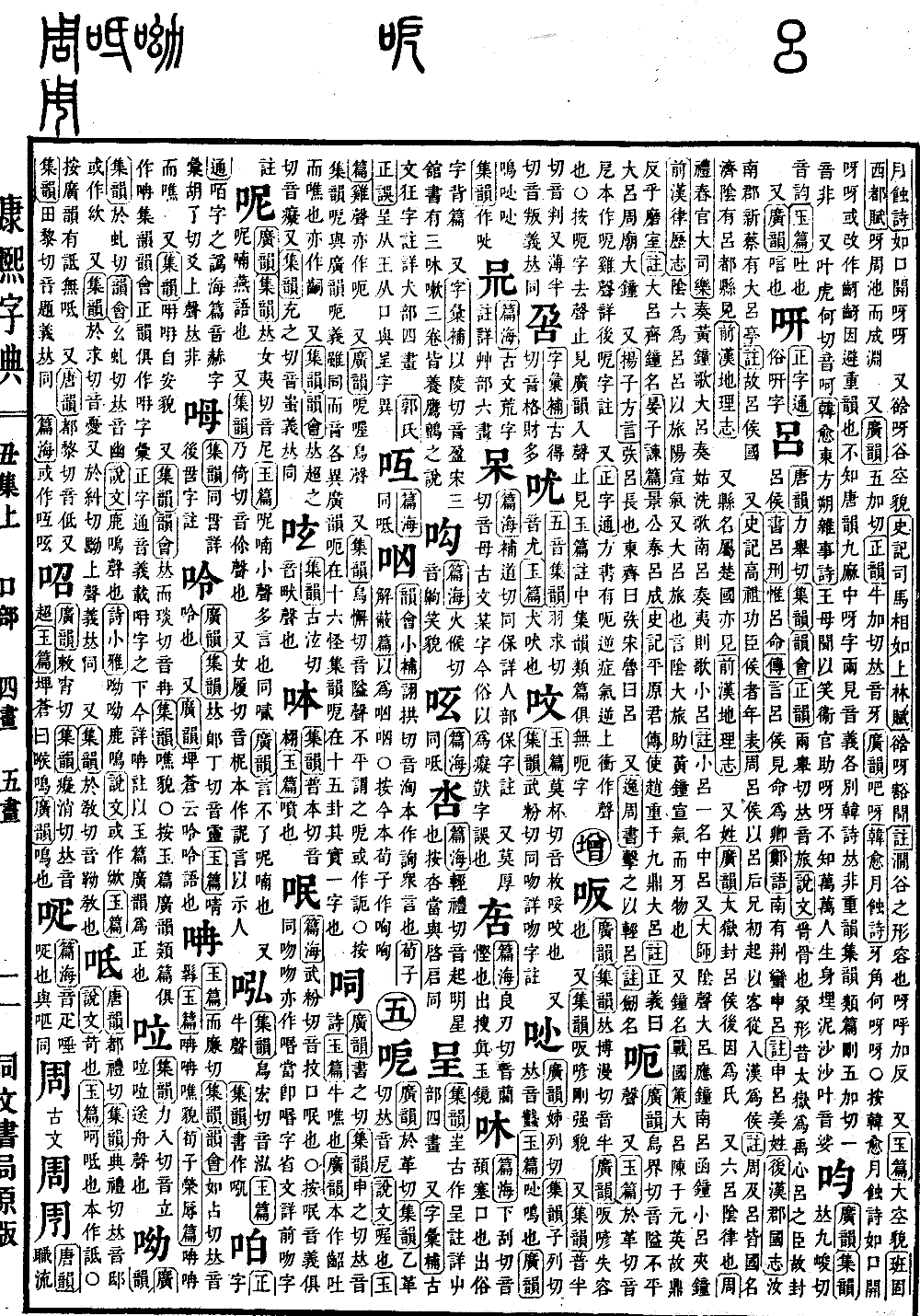
Chou Collection, Upper Volume
Radical: Mouth (kǒu)
Kangxi stroke count: 8
Page 181, Entry 36
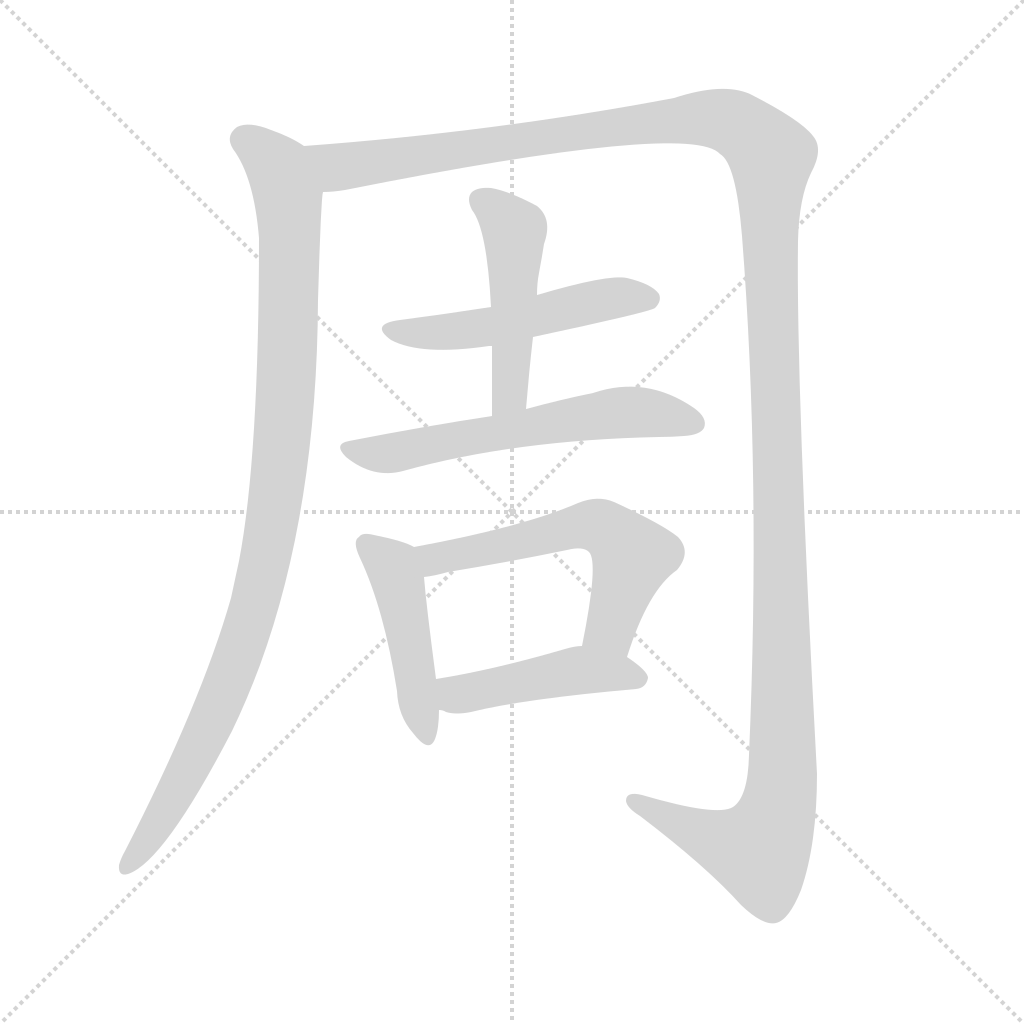
Ancient script. Pronounced zhōu.
Guangyun: Everywhere. Book of Changes (Yijing), Xici: Knowing extends to all things.
Also: To arrive. Book of Documents (Shangshu), Taishi: Though one has close relatives, it is not as good as having benevolent men. Commentary: Zhou means to arrive.
Also: Loyalty and trust. Book of Documents (Shangshu), Taijia: From loyalty and trust comes a successful conclusion. Commentary: Applying loyalty and trust to reach a conclusion. Book of Odes (Shijing), Xiaoya: Returning to the Zhou state. Analects (Lunyu): The noble man is loyal and trustworthy, not partial and fawning. Annotation: Loyalty and trust is zhou, favoring cliques is bi.
Also: To end. Zuo Zhuan, 20th Year of Duke Zhao: To conclude matters for you. Annotation: Zhou means to finish or complete.
Also: Shuowen Jiezi: Dense or secret. Guanzi, Shuyan: Ancient kings valued appropriateness and valued secrecy; the secret person does not speak with the mouth, does not show with the expression, like a dragon or a snake, changing five times in a day; this is called zhou. Annotation: Deep, secret, and unfathomable, thus it is called zhou.
Also: Curved. Book of Odes (Shijing), Tangfeng: Growing by the bend in the road. Commentary: Zhou means curved.
Also: Book of Odes (Shijing), Zhounan Shu: Zhou is the name of a dynasty, its territory was south of Mount Qi; in the Han dynasty, it belonged to Meiyang County of Fufeng.
Also: Guangyun: Prepared or complete. Book of Han, Biography of Lu Wenshu: Forged and completed to trap him inside. Annotation: Jin Zhuo says: Refined, mature, thorough, and precise according to the law.
Also: Guangyun: To circle around. Book of Han, Biography of Liu Xiang: Encircling five li and more. Yunhui: Commonly written as the variant form (zhōu), which is incorrect.
Also: A bird name. Erya, Shinia: The suizhou bird. Commentary: Today it is called the cuckoo (zigui).
Also: Han Feizi, Shuolin: There is a bird called the zhouzhou; it has a heavy head and a bent tail; when it wants to drink from the river it must tip over, so it holds its feathers to drink. Sometimes written in a variant form (fú).
Also: Buzhou, a mountain name, located at Kunlun. Qu Yuan, Lisao: The road goes by Buzhou and turns left.
Also: A wind name. Baihu Tong: The northwest wind is called the Buzhou wind. Buzhou means not meeting, suggesting the yin qi has not yet merged or transformed.
Also: Yangzhou, Pingzhou, Dingzhou; all are county names. Book of Han, Geography Gazetteer: Yangzhou County in Shang Commandery, Pingzhou County in Xihe Commandery, Dingzhou County in Yulin Commandery.
Also: A surname. Guangyun: Originally descended from the sons of King Ping of Zhou, separately enfeoffed in Ruchuan; people called them the Zhou family, and thus they took it as a surname.
Also: The elder brother of Emperor Xian of Wei, Pu family, later changed to the Zhou surname.
Also: A compound surname. In the early Wei dynasty, there was the hermit Zhousheng Lie from Dunhuang.
Also: Interchangable with the character (zhōu, to provide aid). Analects (Lunyu): The noble man provides aid to the needy but does not add to the wealth of the rich. Mencius: When the ruler deals with the common people, he truly provides for them.
Also: Rhyming with the character (shū). Ji Li Ai Mu Ge: The paulownia trees are lush, growing by the bend in the road. The palaces and halls linger, the platforms and pavilions are cleared away.