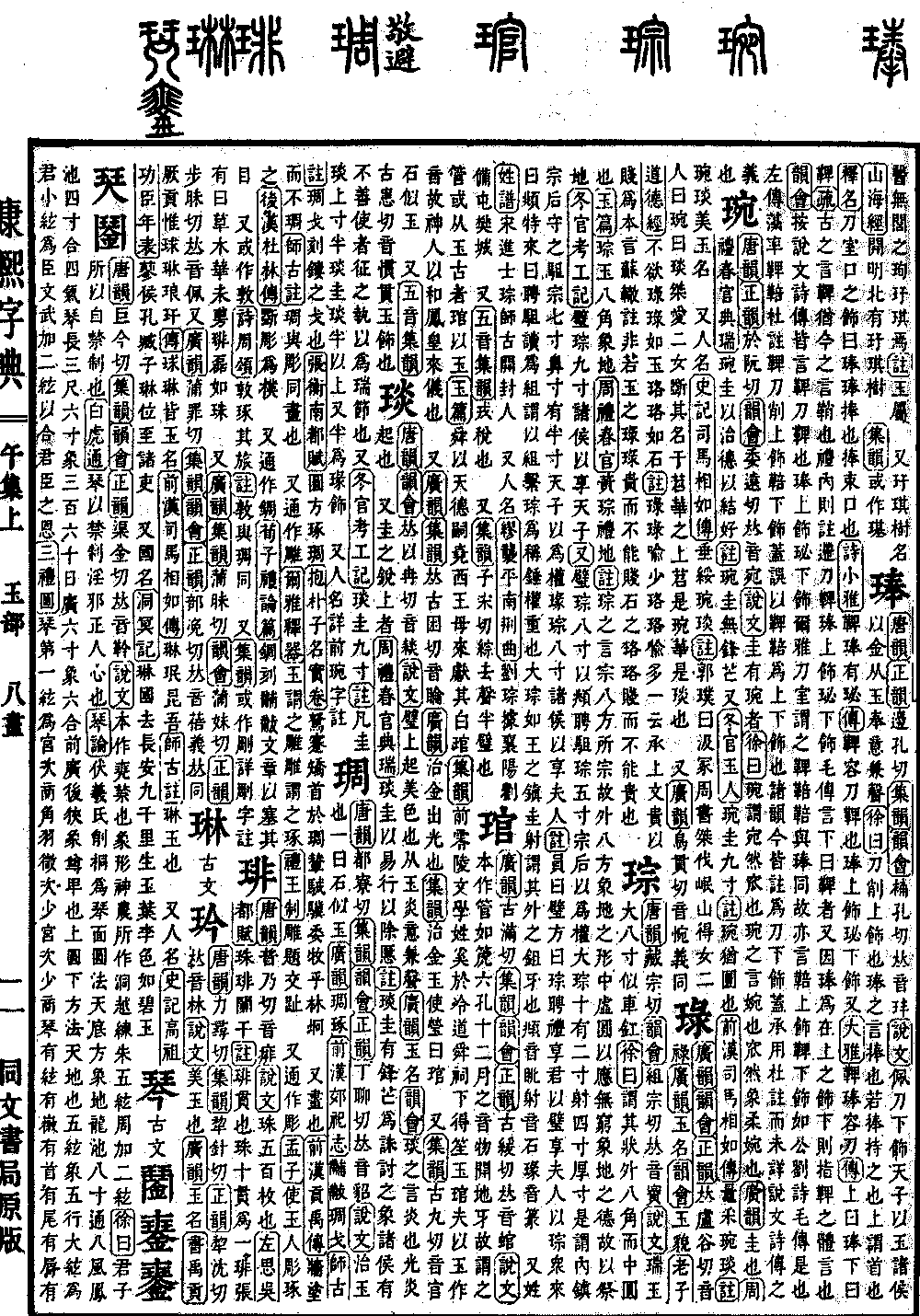
Wu Collection, Upper Volume
Radical: Jade (yù)
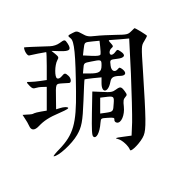
琱
Kangxi strokes: 13
Page 735, Entry 07
Tang Dynasty Rhymes (Tangyun): Pronounced diao. Collected Rhymes (Jiyun), Rhyme Meetings (Yunhui), and Correct Rhymes (Zhengyun): Pronounced diao.
According to the Explaining Graphs and Analyzing Characters (Shuowen), it means to work jade. Another definition is a stone resembling jade.
In Broad Rhymes (Guangyun), it means to carve or polish.
In the History of the Former Han (Qianhan Shu), Records of Suburban Sacrifices (Jiaosi Zhi): A decorative carved dagger.
Teacher Gu’s Commentary (Shigu Zhu): A carved dagger is a dagger with intricate engravings.
Zhang Heng, Southern Capital Rhapsody (Nandu Fu): Circular and square, polished and carved.
In the Baopuzi, Section on Names and Realities (Ming Shi Juan): A common, sluggish horse raises its head while pulling a carved carriage, while a swift, fine horse is left to graze in the wilderness.
It also means to paint or adorn.
In the History of the Former Han (Qianhan Shu), Biography of Gong Yu: Walls are plastered and not painted or carved.
Teacher Gu’s Commentary (Shigu Zhu): Carved is the same as engraved. It also means to paint.
It is also used interchangeably with the character meaning to carve.
In the Erya, Explanations of Implements (Shi Qi): Working jade is called carving, and carving is called polishing.
In the Book of Rites (Liji), Royal Regulations (Wang Zhi): With tattooed foreheads in Jiaozhi.
It is also used interchangeably with the character meaning to carve.
In the Mencius (Mengzi): Have the jade artisan carve and polish it.
In the History of the Later Han (Houhan Shu), Biography of Du Lin: Carving away the decorations to return to simplicity.
It is also used interchangeably with the character meaning to engrave.
In the Xunzi, Section on Enriching the State (Fu Guo Pian): Engraving and carving embroidery and patterns to satisfy the eyes.
It is sometimes written as a variant form (dun).
In the Book of Odes (Shijing), Zhou Hymns (Zhou Song): Polishing their armaments.
Commentary: Dun is the same as carved.
Also, Collected Rhymes (Jiyun): Sometimes written as a variant form; please refer to the entry for that character for details.
Textual Research: The quotation from the Xunzi, Section on Rites (Li Lun Pian) regarding engraving and carving embroidery and patterns to satisfy the eyes has been checked. The cited lines are actually in the Section on Enriching the State, not the Section on Rites. The correction has been made to reflect the Section on Enriching the State.