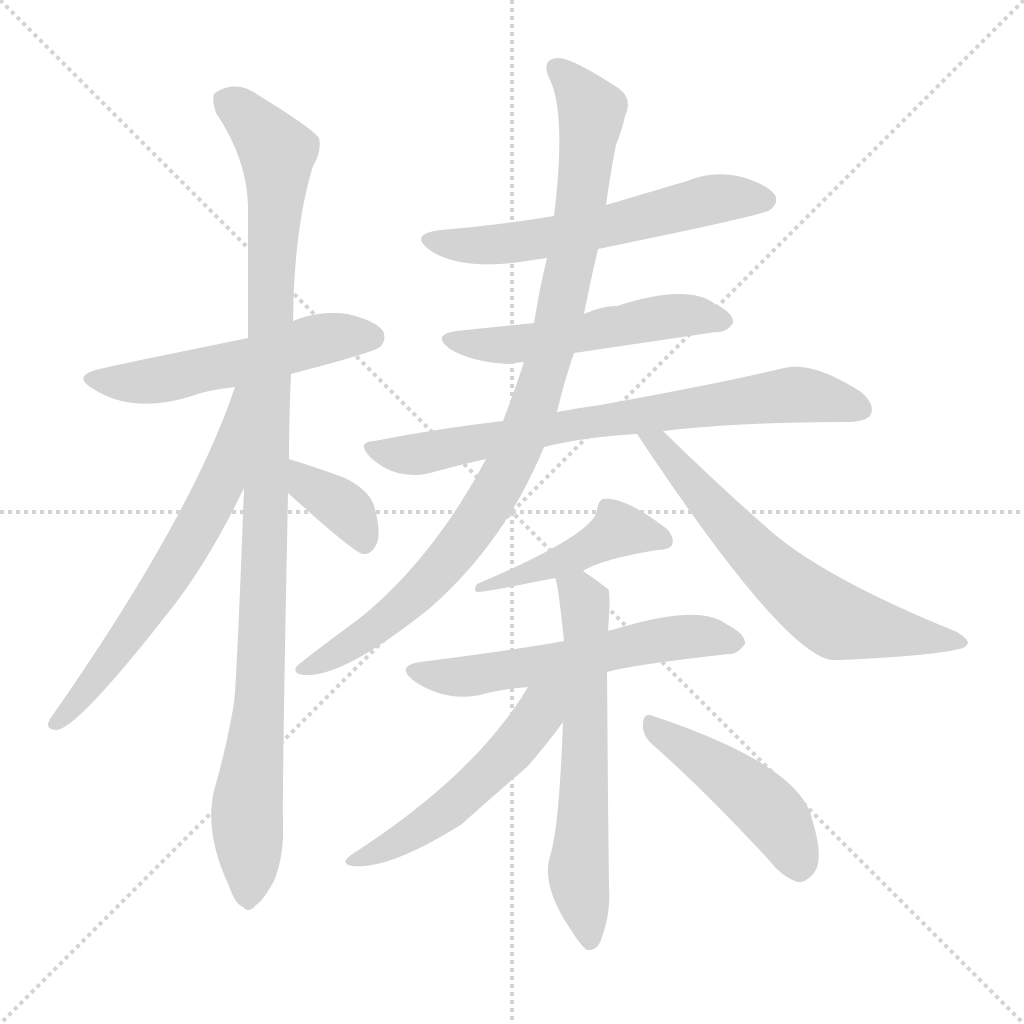
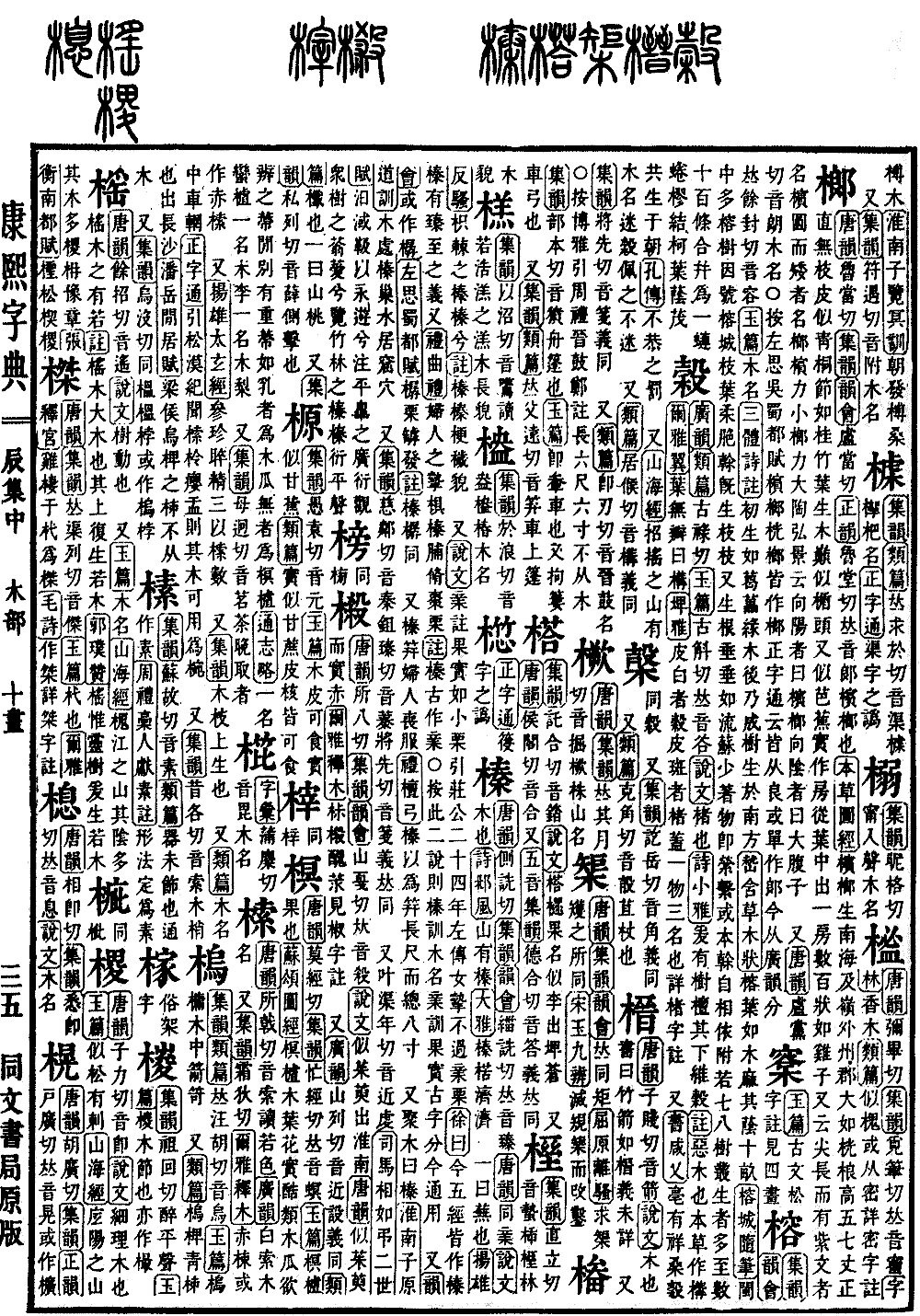
Chen Collection, Middle Volume. Radical: Tree (mù). Kangxi stroke count: 14. Page 543, Entry 18.
Tangyun (Tang Dictionary of Rhymes) records the pronunciation as zhen (level tone). Jiyun (Collected Rhymes) and Yunhui (Collection of Rhymes) record the pronunciation as zhen (level tone).
According to Shuowen Jiezi (Explanation of Graphs and Analysis of Characters), it is a type of tree. Book of Odes (Shijing), Beifeng section: "On the mountains are hazel trees." Great Odes (Daya) section: "The hazel and the hule trees are thick and luxuriant."
It also means overgrown or tangled. Yang Xiong, in his Anti-Li Sao, writes: "The brambles and thorns are tangled and dense." The commentary states: "Zhen-zhen describes a state of blocked or dirty obstruction."
Shuowen Jiezi also notes that it is a fruit resembling a small chestnut, citing the 24th year of Duke Zhuang in the Zuo Tradition (Zuo Zhuan): "A woman's gift of betrothal should not exceed the value of chestnuts." Xu Kai notes that in the Five Classics, the character is written as hazel (zhen), which carries the meaning of arriving or attaining.
Furthermore, in the Record of Rites (Liji), Section on Summary of Propriety (Quli): "A woman's gift includes the hovenia, hazel, dried meat, preserved fruit, dates, and chestnuts." The Explanation of Text (Shiewen) notes that the ancient text used the variant form. It is noted that these two interpretations suggest the character refers to a tree name and a fruit. In antiquity, the characters were distinct, but they are used interchangeably today.
Yunhui (Collection of Rhymes) suggests it may also be written as the variant form (zhen). Zuo Si, in his Rhapsody on the Capital of Shu (Shudu Fu), writes: "Hazel and chestnut trees sprout from the crevices." The commentary states that hazel and the variant form (zhen) are the same.
It also refers to a hazel hairpin, worn by women in mourning dress. Record of Rites (Liji), Section on Tan Gong: "Using hazel wood to make a hairpin, one foot long and with a tie of eight inches."
It also refers to a thicket of trees. Huainanzi, Chapter on Original Way (Yuandao Xun): "Birds nest in the thickets, while those in water dwell in caves."
Jiyun records additional pronunciations as qin (level tone), zhen (level tone), and jian (level tone). The meaning remains the same.
It also rhymes with nian (level tone). Sima Xiangru, in his Rhapsody on Lamenting the Second Emperor, writes: "Floating along rapidly and endlessly, I observe the vast and extended plains; I gaze at the dense and lush trees, and view the tangled thickets of bamboo." Here, the word rhymes with the level tone of the preceding character.