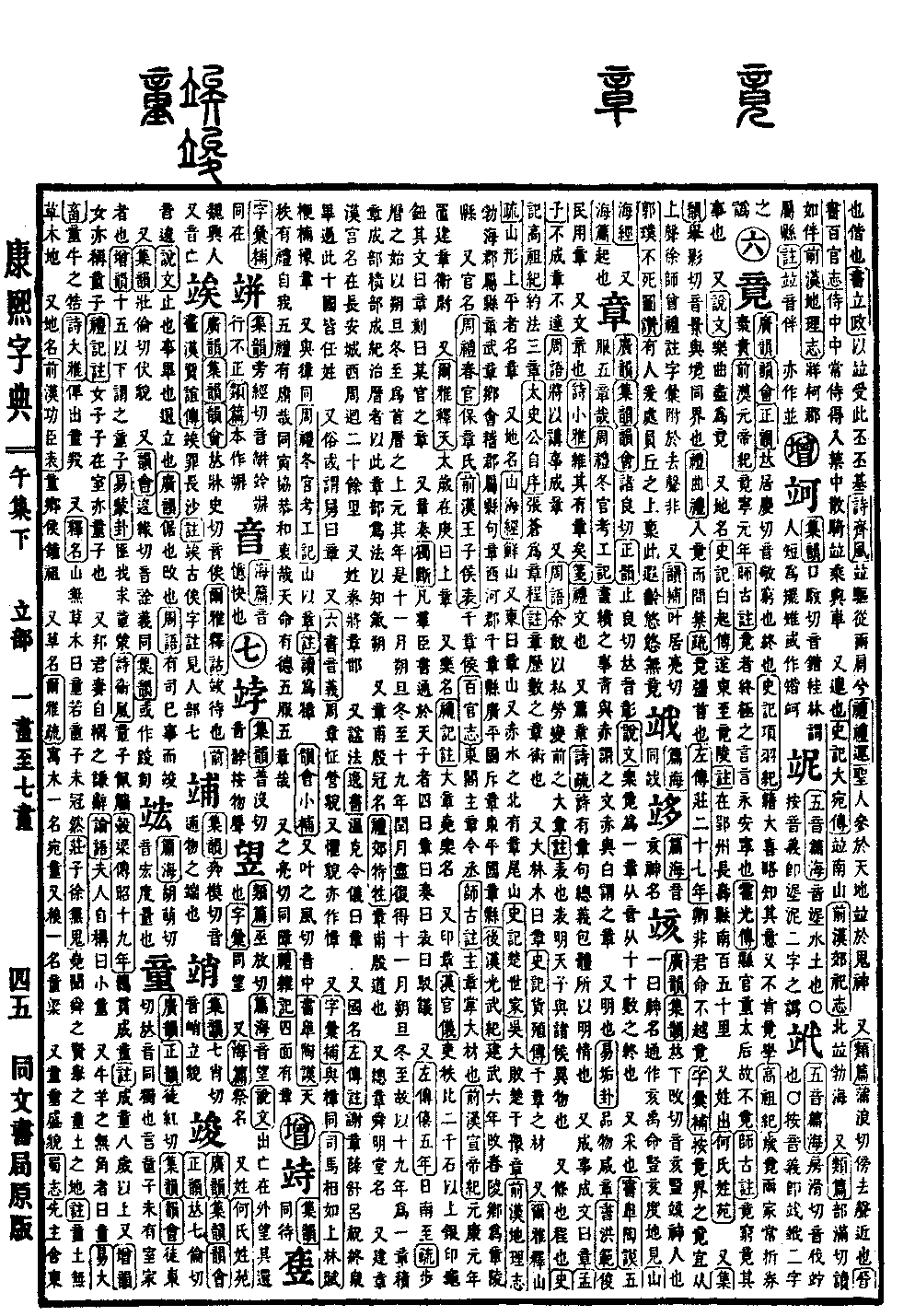
Wu Collection, Lower Volume
Radical: Stand (lì)
Page 871, Entry 08
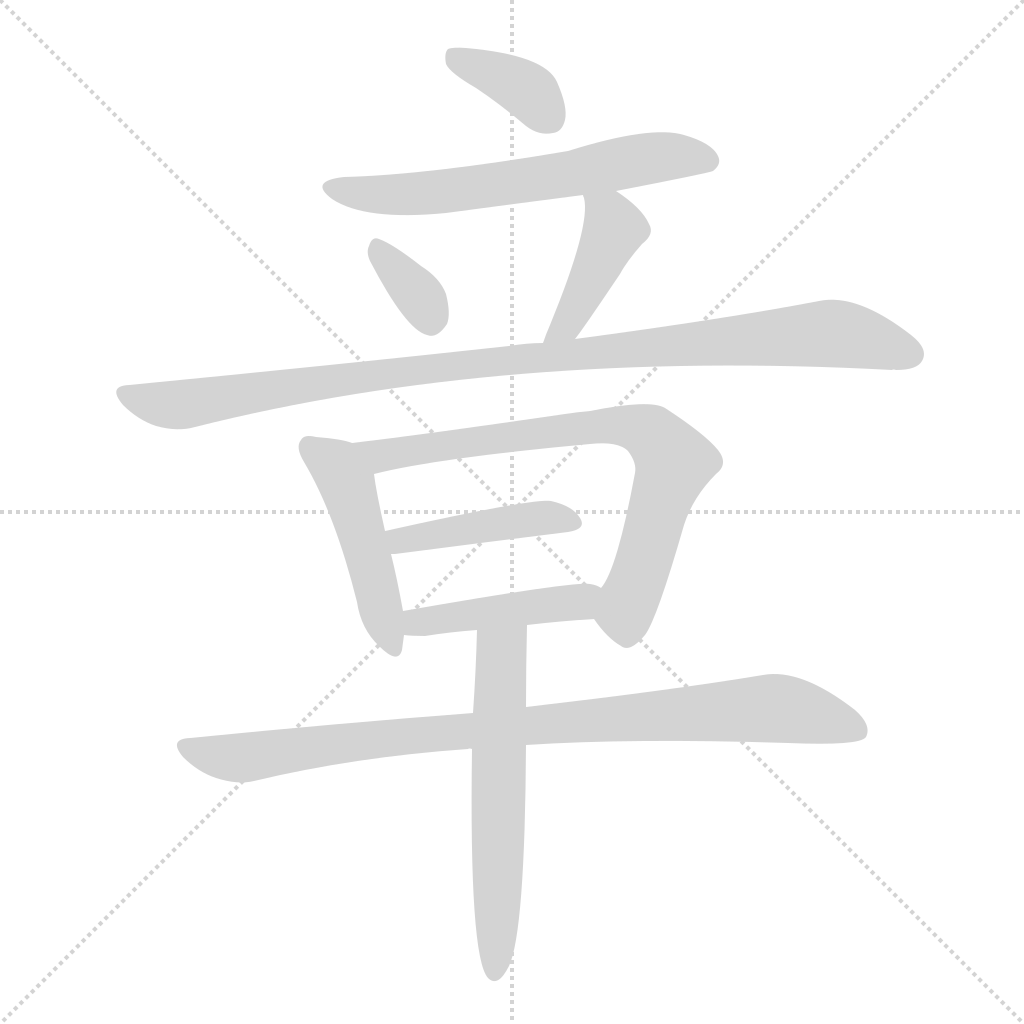
Pronounced zhang.
As defined in the Analytical Dictionary of Chinese Characters (Shuowen Jiezi), a musical composition ending is called a zhang. Formed from sound and ten; ten is the termination of numerical digits.
Also refers to colorful patterns.
Document of History (Shangshu), Gao Yao Mo: The five ranks of official vestments each have their own colored decorations.
Book of Rites (Zhouli), Winter Bureau, Records of Examination of Craftsmen (Kaogongji): In painting, the combination of blue and red is called wen, while red and white is called zhang.
Also means to be manifest or clear.
Book of Changes (Yijing), Gou Hexagram: All things are manifest.
Document of History (Shangshu), Great Plan (Hongfan): When worthy people are employed, government affairs become manifest.
Also refers to ritual music systems and literary compositions.
Book of Odes (Shijing), Lesser Odes (Xiaoya): Because it possesses literary refinement (in accordance with ritual systems).
Annotation: Refers to ritual and musical ceremonial systems.
Also refers to paragraphs or chapters in poetry and prose.
Commentary on the Odes (Shishu): Poetry has chapters, clauses, and pauses, summarizing meanings and encompassing systems, used to express sentiments and intent.
Also means that when an affair is completed and its logic is fully formed, it is called a zhang.
Mencius: Without forming complete logic, one cannot be articulate.
Discourses of the States (Zhouyu): Will be used to deliberate on affairs and form established codes.
Also, Discourses of the States (Zhouyu): How would I dare, because of personal merit, to alter the great established codes of the past?
Annotation: Zhang means a model or standard, indicating that the vessels used by the Son of Heaven and the feudal lords differ.
Also refers to clauses or regulations.
Records of the Grand Historian (Shiji), Annals of Gaozu: Formulated a code of three articles.
Authorial Preface of the Grand Historian (Taishigong Zixu): Zhang Cang established the calendar and the regulations for weights and measures.
Annotation: Zhang refers to the zhang technique of astronomical calculation.
Also refers to large timber.
Records of the Grand Historian (Shiji), Biographies of Money Makers (Huozhi Zhuan): Tens of thousands of large timber trees.
Also, Commentary on the Erya, Explaining Mountains (Shishan Shu): A mountain shape that is flat on top is called a zhang.
Also a place name.
Classic of Mountains and Seas (Shanhaijing): Further east from Xian Mountain is Zhang Mountain. Also, north of the Red River is Zhangwei Mountain.
Records of the Grand Historian (Shiji), House of Chu: The state of Wu defeated the Chu army at Yuzhang.
History of the Former Han Dynasty, Treatise on Geography: Districts under Bohai Commandery include Zhangwu and Zhangxiang; districts under Kuaiji Commandery include Gouzhang; Xihe Commandery has Qianzhang District; Guangping Kingdom has Chizhang; Dongping Kingdom has Zhang District.
History of the Later Han Dynasty, Annals of Guangwu: In the sixth year of Jianwu, Chuling Township was renamed Zhangling District.
Also a government office title.
Book of Rites (Zhouli), Spring Bureau: Officer for Baozhang (Protector of the Manifestations).
History of the Former Han Dynasty, Table of Princes and Marquises: Marquis of Qianzhang.
Treatise on Officialdom (Baiguanzhi): Eastern Pavilion Chief of the Zhang Prefect.
Annotation by Shigushi: Chief of the Zhang manages large timber.
History of the Former Han Dynasty, Annals of Emperor Xuan: In the first year of Yuankang, the Jianzhang Palace Guard was established.
Also, Erya, Explaining Heaven (Shitian): The year when the Grand Duke (Jupiter) is in the Geng year is called Shangzhang.
Also the name of a piece of music.
Annotation to the Book of Rites (Liji): Dazhang is the name of music from the time of Yao.
Also a seal.
Han Government Ceremonies (Hanguanyi): Officials with a salary of two thousand shi or more used a silver seal with a turtle-shaped knob; the inscription was called a zhang, engraved as "Seal of such-and-such official."
Also refers to documents submitted by subjects to the Emperor.
Judicious Decisions (Duduan): There are four types of documents submitted by subjects to the Emperor, called zhang, zou, biao, and boyi.
Also, Commentary on the Zuo Tradition (Zuozhuan), Fifth Year of Duke Xi: Winter solstice.
Commentary: The beginning of calendar calculation starts with the winter solstice on the morning of the first day of the lunar month (shuo). The upper origin (shangyuan) of the calendar is when that year has the winter solstice on the morning of the first day of the eleventh month. After nineteen years, the intercalary months are fully arranged, and it returns to the winter solstice on the morning of the first day of the eleventh month, thus nineteen years constitutes a zhang. Accumulated zhang form a bu, and accumulated bu form a ji. Calendar makers use this zhang and bu as a rule to know the solar terms, new moons, and full moons.
Also Zhangfu, the name of a headpiece from the Yin Dynasty.
Book of Rites (Liji), Suburban Sacrifice (Jiaotesheng): Wearing a Zhangfu cap is the ritual system of the Yin Dynasty.
Also Zongzhang, the name of the Bright Hall (Mingtang) during the time of Shun.
Also Jianzhang, the name of a Han Dynasty palace. Located in Chang'an. The walls spanned over twenty li.
Also a surname. Qin Dynasty general Zhang Han.
Also a posthumous title system.
Book of Zhou (Yizhoushu): Being gentle, self-restrained, and having a beautiful appearance is called zhang.
Also a state name.
Annotation to the Zuo Tradition (Zuozhuan): Xie, Zhang, Xue, Shu, Lü, Zhu, Zhong, Quan, Bi, and Guo; these ten states are all of the Ren surname.
Also, colloquially, sometimes refers to a maternal uncle.
Also, according to The Six Scripts and Phonetic Meanings (Liushu Yinyi), Zhouzhang refers to a state of being fearful and uneasy. Also means the appearance of being afraid. Sometimes written in a variant form (zhuan).
Also, according to the Supplement to the Dictionary (Zihuibu), it is the same as the camphor tree (zhang).
Sima Xiangru, Rhapsody on the Suburbs (Zixu Fu): Pian, nan, yu, and zhang (all are names of trees).
Also the same as the deer (zhang).
Book of Rites (Zhouli), Winter Bureau, Records of Examination of Craftsmen (Kaogongji): A mountain that is zhang.
Annotation: Read as zhang (deer).
Supplement to the Rhyme Dictionary (Yunhui Xiaobu): Also rhymes with the sound zhong, and the sound of wind.
Document of History (Shangshu), Gao Yao Mo: Heaven has established standard rituals, and we ourselves possess the five constant rituals; reverently aligned and harmoniously impartial; Heaven appoints the virtuous, using the five ranks of vestments to manifest them.
Also pronounced zhang (rising tone). Same as barrier (zhang).
Book of Rites (Liji), Miscellaneous Records (Zaji): Surrounded by screens on four sides.