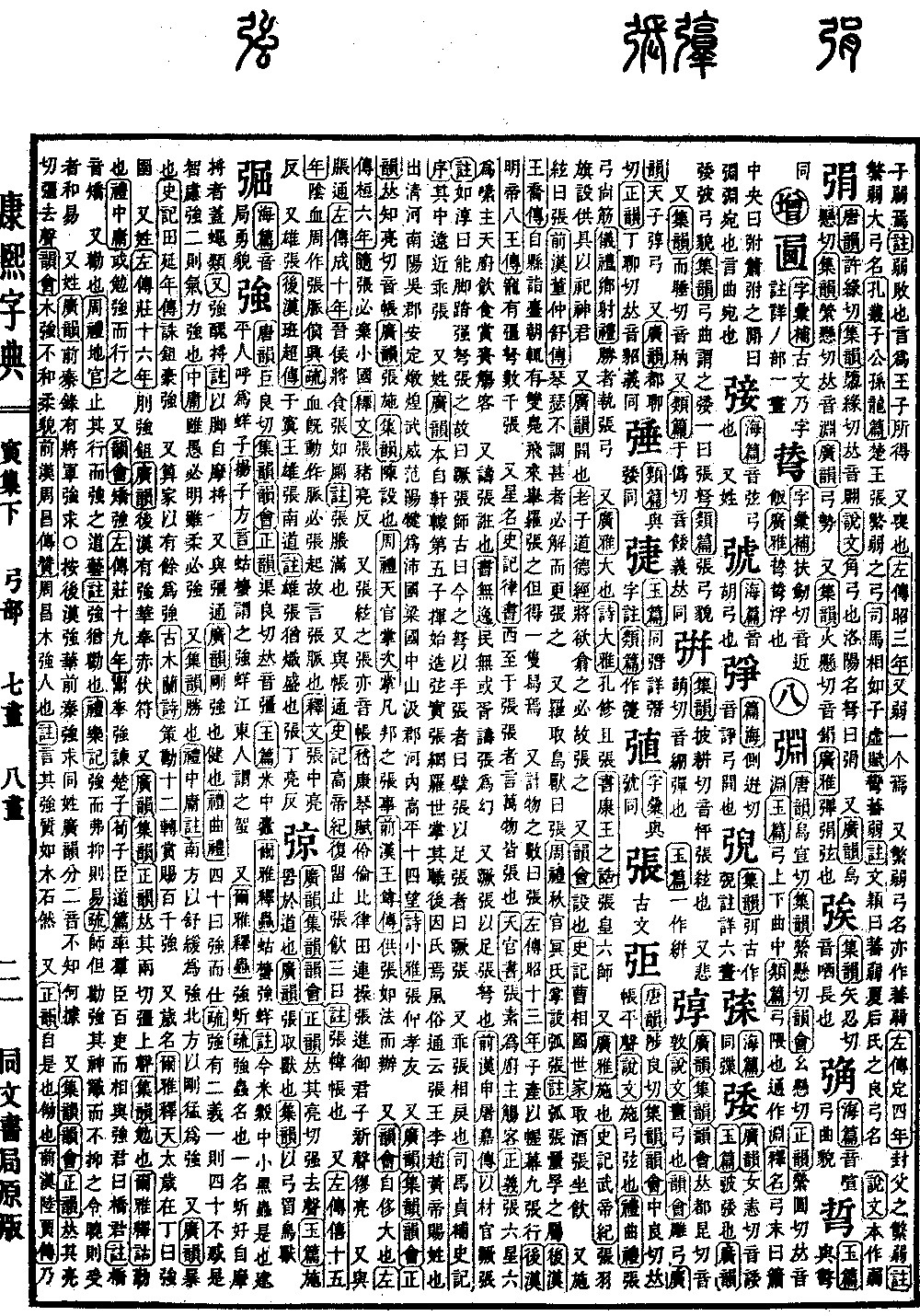
Yin Collection, Lower Volume
Radical: Bow (gōng)
Kangxi Strokes: 11
Page 359, Entry 19
Ancient form: 弡
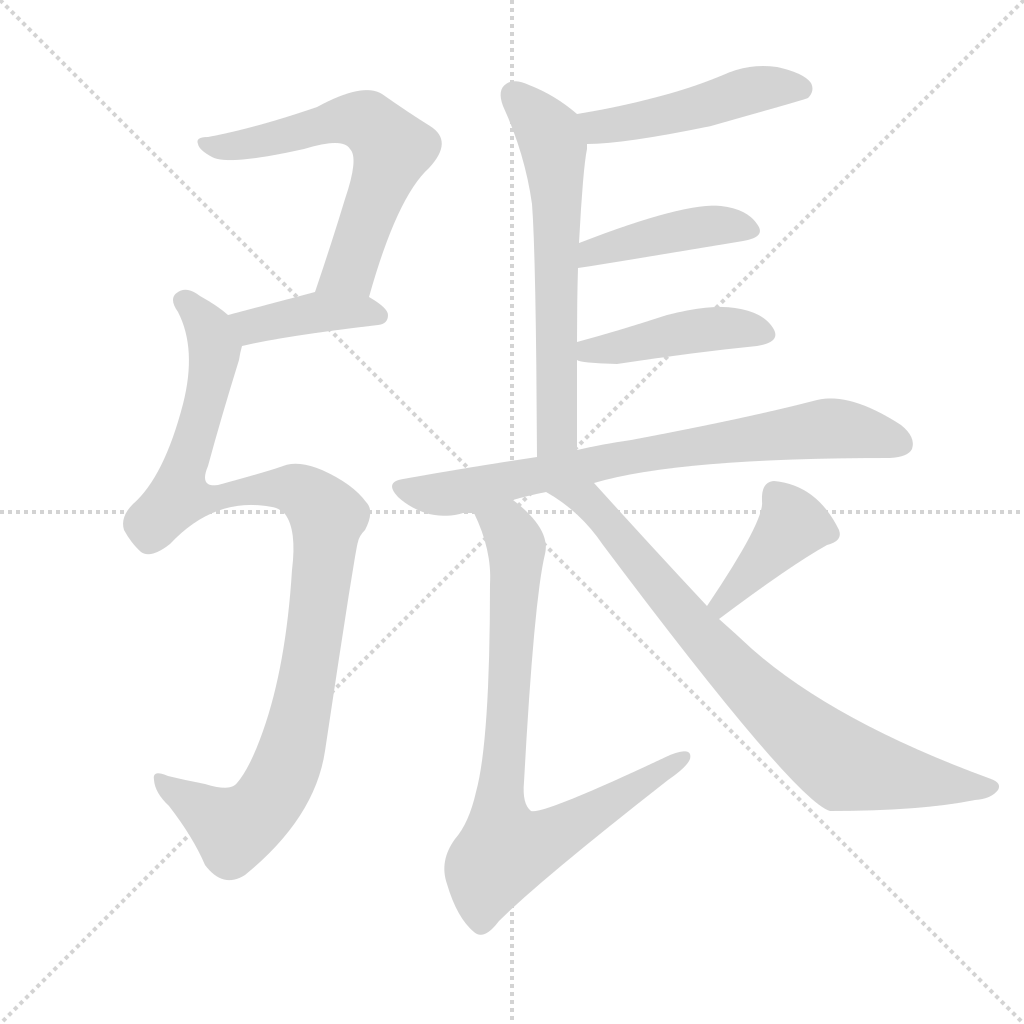
Pronounced zhang (level tone)
According to the Analytical Dictionary of Characters (Shuowen Jiezi), it refers to stringing a bow.
Book of Rites (Liji), Rules of Propriety (Quli): To string a bow, one uses the sinew.
Book of Etiquette and Ceremonial (Yili), Village Archery Rites (Xiangsheli): The winner holds the strung bow.
Also meaning large.
Book of Odes (Shijing), Great Odes (Daya): Very long and large.
Book of Documents (Shujing), Announcement of King Kang (Kangwang zhi gao): To make a show of force with the six armies.
Also meaning to apply or implement.
Records of the Grand Historian (Shiji), Annals of Emperor Wu (Wudi Ji): Arranged feather banners and prepared offerings to sacrifice to the divine lord.
Also meaning to open or expand.
Laozi, Tao Te Ching: If one wishes to contract something, one must first expand it.
Also meaning to set up.
Records of the Grand Historian (Shiji), House of Chancellor Cao (Cao Xiangguo Shijia): Took wine and set up seats to drink.
Also, applying strings is called zhang.
Book of Former Han (Qianhan), Biography of Dong Zhongshu: If the zither and flute are not in harmony, one must dismantle them and re-string them.
Also, using nets to trap birds and beasts is called zhang.
Rites of Zhou (Zhouli), Office of Autumn (Qiuguan), Officer of the Ming (Ming Shi): In charge of setting up arc-shaped traps.
Note: Arc-shaped traps are of the category of nets for birds.
Book of Later Han (Houhan), Biography of Wang Qiao: Whenever he traveled from the county to the tower to pay respects, a pair of wild ducks would fly over; he would set up a net to catch them, but would only obtain a single sandal.
Also, counting items is called zhang.
Zuo Commentary (Zuozhuan), 13th Year of Duke Zhao: Zichan traveled with nine curtains.
Book of Later Han (Houhan), Biographies of the Eight Princes of Emperor Ming: Chong had several thousand crossbows.
Also, the name of a star.
Records of the Grand Historian (Shiji), Book of the Musical Pitch (Lüshu): In the west, it reaches as far as Zhang. Zhang implies that all things are expanded.
Book of Celestial Offices (Tianguan Shu): The star Zhang acts as a kitchen, presiding over the hosting of guests.
Sub-commentary (Zhengyi): Zhang consists of six stars, forming the crop, presiding over the heavenly kitchen's food and the rewarding of guests.
Also, zhouzhang, meaning to deceive.
Book of Documents (Shujing), Against Luxurious Ease (Wuyi): Let the people not engage in mutual deception and chaotic fantasy.
Also, juezhang, meaning to draw a crossbow with the feet.
Book of Former Han (Qianhan), Biography of Shentu Jia: Used the crossbows of the talented guards.
Note: Ru Chun said: To be able to use the feet to step on a powerful crossbow to draw it is called juezhang. Shigu said: Modern crossbows drawn by hand are called bozhang, while those drawn by feet are called juezhang.
Also, guaizhang, meaning to be contrary or perverse.
Sima Zhen, Preface to the Supplemented Records of the Grand Historian: The distance between them is perverse.
Also, a surname.
Broad Rhymes (Guangyun): Originally descended from Hui, the fifth son of Xuanyuan, who first created strings and was the first to use nets; the family held this office for generations and later adopted it as their surname. Fengsu Tong says: Zhang, Wang, Li, and Zhao were surnames bestowed by the Yellow Emperor. They originate from fourteen prominent branches: Qinghe, Nanyang, Wujun, Anding, Dunhuang, Wuwei, Fanyang, Jianwei, Peiguo, Lianguo, Zhongshan, Jijun, Henei, Gaoping.
Book of Odes (Shijing), Lesser Odes (Xiaoya): Zhang Zhong is filial and friendly.
Pronounced zhang (falling tone)
Broad Rhymes (Guangyun): To spread out or apply.
Collection of Rhymes (Jiyun): To set up.
Rites of Zhou (Zhouli), Office of Heaven (Tianguan), Master of Ceremonies (Zhangci): In charge of all matters of setting up for the state.
Book of Former Han (Qianhan), Biography of Wang Zun: The provisions and settings were prepared according to the rules.
Also, to be self-aggrandizing.
Zuo Commentary (Zuozhuan), 6th Year of Duke Huan: If Sui is self-aggrandizing, it will surely abandon the small states.
Also, the zhang of stringing a bow is also pronounced zhang.
Ji Kang, Rhapsody on the Zither (Qinfu): Linglun compared the pitches, fields were joined and strings were taut, presenting to the gentleman, the new sounds are bright.
Also, interchangeable with the term for swelling.
Zuo Commentary (Zuozhuan), 10th Year of Duke Cheng: The Duke of Jin was about to eat when he felt a swelling and went to the restroom.
Note: Zhang means bloated and full.
Also, interchangeable with the term for curtains.
Records of the Grand Historian (Shiji), Annals of High Emperor (Gaodi Ji): Remained and stayed to set up curtains to drink for three days.
Note: Zhang means fabric curtains.
Also, Zuo Commentary (Zuozhuan), 15th Year of Duke Xi: Dark blood circulated, the vessels swelled and rose.
Sub-commentary: Once blood is in motion, the vessels must swell and rise, therefore it is called zhangmai.
Also, xiongzhang.
Book of Later Han (Houhan), Biography of Ban Chao: The King of Yutian was powerful and dominant in the Southern Region.
Note: Xiongzhang is similar to being fierce and flourishing.