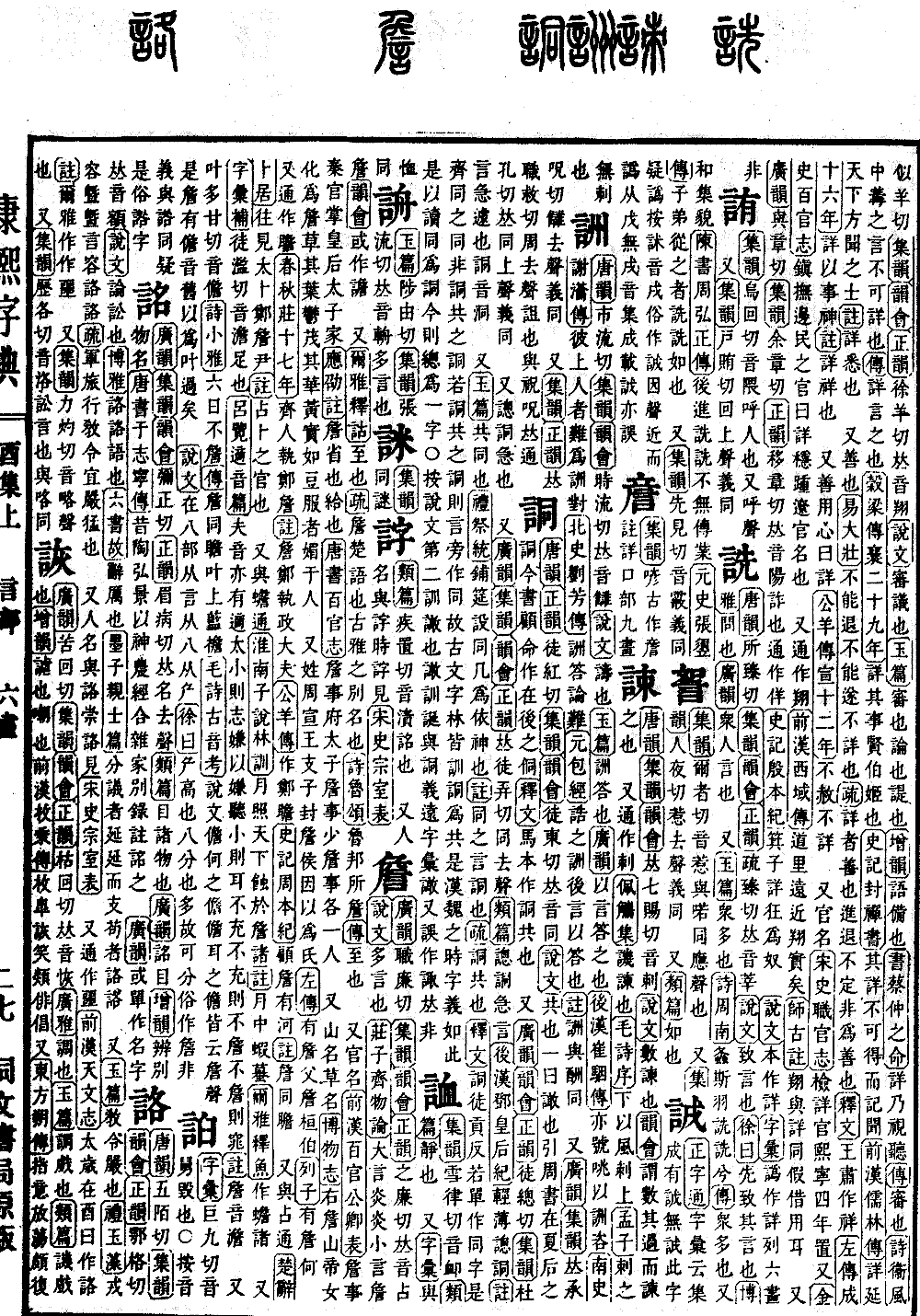
You Collection, Upper Volume
Radical: Speech (yán)
Kangxi Strokes: 13
Page 1159, Entry 13
Pronounced zhan.
According to the Explaining Graphs and Analyzing Characters (Shuowen Jiezi), it means to speak excessively. In the Zhuangzi, section on Discussion on Making All Things Equal (Qi Wu Lun), it refers to grand speeches having intense momentum, while trivial speech is incessant.
The Rhyme Collection (Yunhui) notes it is sometimes written in a variant form (zhan).
It also carries the meaning of to arrive or to reach, according to the Er Ya, section on Explaining Ancient Terms (Shi Gu). The Commentary (Shu) states that this is a dialect from the Chu region and is a variation of ancient elegant speech. In the Book of Odes (Shijing), section on Odes of Lu (Lu Song), it refers to the territory reached by the State of Lu. The Commentary (Zhuan) defines it as to reach.
It is also an official title. According to the Book of Han (Qian Han Shu), section on Table of Officials and Ministers, the Zhan Shi was an office established during the Qin dynasty, responsible for the affairs of the Empress and the Crown Prince. Ying Shao notes that the term implies examination and provision. The Book of Tang (Tang Shu), section on Treatise on Officials, states that the Palace of the Zhan Shi included one official of the rank of Zhan Shi and one of the rank of Shao Zhan Shi.
It refers to a mountain name and a plant name. The Record of Investigation of Things (Bowuzhi) mentions Mount Youzhan; the daughter of the Heavenly Emperor transformed into a zhan plant. Its leaves are lush, its flowers are yellow, and its fruits resemble beans. Those who consume it will be loved by others.
It is also a surname. A son of King Xuan of Zhou was enfeoffed as the Marquis of Zhan, and his descendants took this as their surname. The Zuo Tradition (Zuo Zhuan) mentions Zhan Fu and Zhan Huanbo; the Liezi mentions Zhan He.
It is also used as a loan character for zhan (to look upward/forward). The Spring and Autumn Annals (Chunqiu), seventeenth year of Duke Zhuang, notes the capture of Zheng Zhan by the people of Qi. The Commentary notes that Zhan was an administrative official of the State of Zheng. The Gongyang Tradition (Gongyang Zhuan) writes it as Zheng Zhan. The Records of the Grand Historian (Shiji), section on Basic Annals of Zhou, mentions looking back to see the Yellow River, with the note that Zhan is identical to zhan (to look).
It is also interchangeable with zhan (divination). In the Songs of Chu (Chu Ci), section on Divination (Bu Ju), it mentions visiting the chief diviner Zheng Zhanyin, with a note identifying the official as a diviner.
It is also interchangeable with chan (toad). The Huainanzi, section on Explanations of the Forest (Shuo Lin Xun), mentions the moonlight illuminating the world being consumed by a chanzhu, with a note identifying this as the toad within the moon. The Er Ya, section on Explaining Fish (Shi Yu), writes it as chanzhu.
According to the Supplement to the Collection of Characters (Zihui Bu), it is pronounced dan and means to satisfy. The Master Lu’s Spring and Autumn Annals (Lv Lan), section on Appropriate Sounds (Shi Yin Pian), states that music must be moderate; if too loud, it agitates the mind; if too quiet, the mind is not satisfied. With an unsatisfied mind listening to quiet sounds, the ears are not filled; if not filled, one is not satisfied; if not satisfied, one feels empty. The note indicates that here it is pronounced dan.
It is also used as a poetic rhyme, pronounced dan. In the Book of Odes (Shijing), section on Minor Odes (Xiao Ya), it mentions not seeing someone for six days. The Commentary notes that it is identical to zhan (to look), rhyming with the preceding characters lan and chan. The Examination of Ancient Sounds in the Mao Odes (Mao Shi Gu Yin Kao) states that in the Explaining Graphs and Analyzing Characters (Shuowen Jiezi), the characters dan in Danhe and dan in Dan’er are both derived phonetically from zhan, which indicates that zhan has the sound of dan; previous assertions that this was merely a poetic rhyme are incorrect.
The Explaining Graphs and Analyzing Characters (Shuowen Jiezi) places this character in the Radical: Eight (bā) section, composed of speech, eight, and gui (high). Xu says gui means high and eight means to divide. Because the speech is excessive, it can be separated. The common variant is incorrect.