Wu Collection, Upper Volume
Radical: Tile (wǎ)
Kangxi Strokes: 18
Page 752, Entry 18
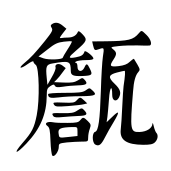
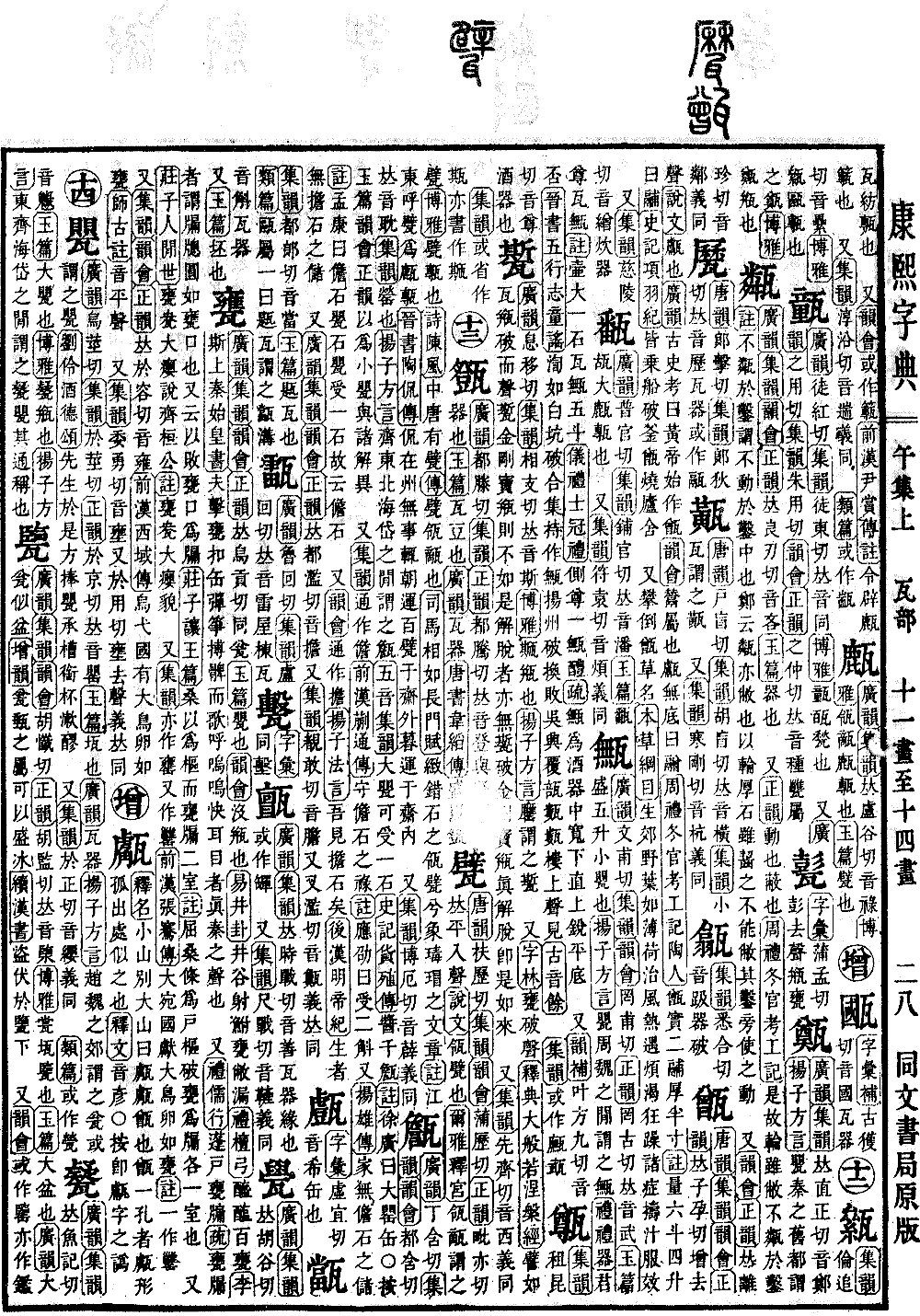
According to the Expanded Rhymes (Guangyun), pronounced dan. According to the Collected Rhymes (Jiyun) and the Rhyme Compendium (Yunhui), pronounced dan. According to the Collected Rhymes, it is a type of jar. According to the Book of Dialects (Fangyan) by Yang Xiong, in the region between the sea and Mount Tai in the northeast of the Qi state, this is called a dan. According to the Five Sounds Rhyme Compendium (Wuyin Jiyun), it is a large jar capable of holding one shi. In the Records of the Grand Historian (Shiji), Biographies of Money-makers, it mentions one thousand dan of bean paste. The commentary by Xu Guang states it is a large earthenware jar. Note: The Jade Chapters (Yupian), the Rhyme Compendium (Yunhui), and the Correct Rhymes (Zhengyun) consider it a small jar, which differs from other interpretations.
Furthermore, according to the Collected Rhymes, it is also written in a variant form (dan). In the History of the Former Han (Qianhanshu), Biography of Kuai Tong, it mentions holding a salary of a dan and a shi. The commentary by Ying Shao states that it holds two hu. In the Biography of Yang Xiong, it mentions the family had no reserve of a dan or a shi. The commentary by Meng Kang states that a dan and a shi refer to a jar and a shi; a jar holds one shi, hence the term dan and a shi.
Furthermore, according to the Rhyme Compendium, it is also written in a variant form (dan). In the Exemplary Sayings (Fayan) by Yang Xiong, it is written: I have seen a dan and a shi. In the History of the Later Han (Houhanshu), Annals of Emperor Ming, it mentions the living had no reserve of a dan or a shi.
According to the Expanded Rhymes (Guangyun), the Collected Rhymes (Jiyun), the Rhyme Compendium (Yunhui), and the Correct Rhymes (Zhengyun), pronounced dan. According to the Collected Rhymes, pronounced dan. According to the Collected Rhymes, pronounced zan. The meaning is the same.