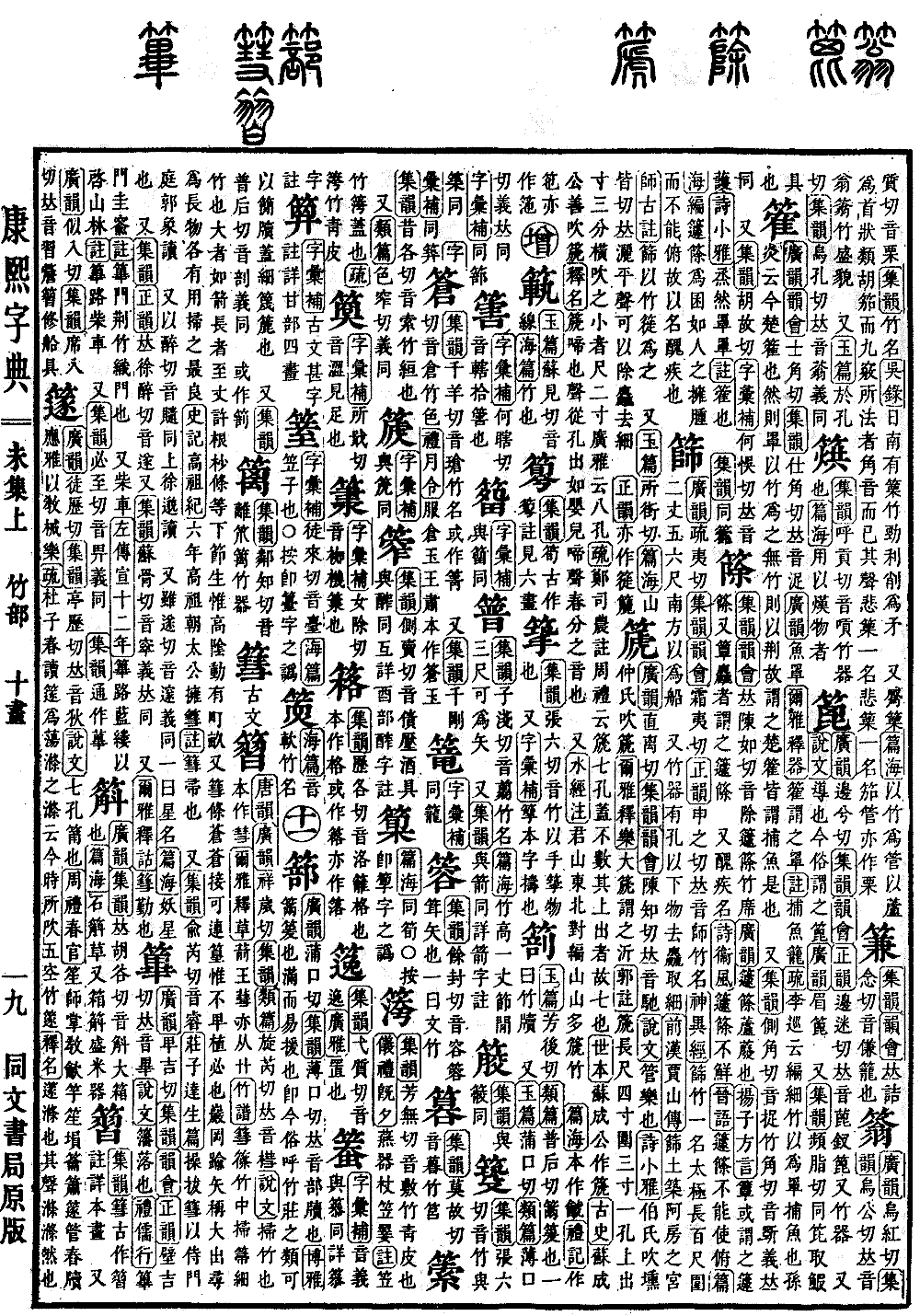
Wei Collection, Upper Volume
Radical: Bamboo (zhú)
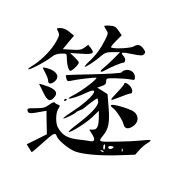
Character: di
Kangxi Stroke Count: 17
Page 895, Entry 42
According to the Extensive Rhymes (Guangyun), the pronunciation is di (rising tone). According to the Collection of Rhymes (Jiyun), the pronunciation is di (rising tone).
According to the Explanation of Words and Phrases (Shuowen), it is a bamboo instrument with seven holes.
According to the Rites of Zhou (Zhouli), the Master of Music is responsible for teaching the playing of the yu, sheng, xun, yue, xiao, chi, di, and guan, as well as the chun, du, ying, and ya instruments, in order to teach the gai music. The commentary by Du Zichun reads di as the di in the word for washing or purifying, stating that in current times, it refers to a five-holed bamboo di.
According to the Explanation of Names (Shiming), di signifies to cleanse, as its sound is clear and cleansing. It is commonly written as the character for flute.
Also, according to the Extensive Rhymes (Guangyun), the pronunciation is zhu (rising tone), which is the name of a type of bamboo.
Textual Verification: In the Rites of Zhou (Zhouli), under the section for the Master of Music, the original text for the list of instruments has been amended to include the character chi after xiao, and the term for music has been corrected to gai music based on the original source.