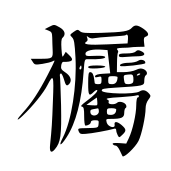
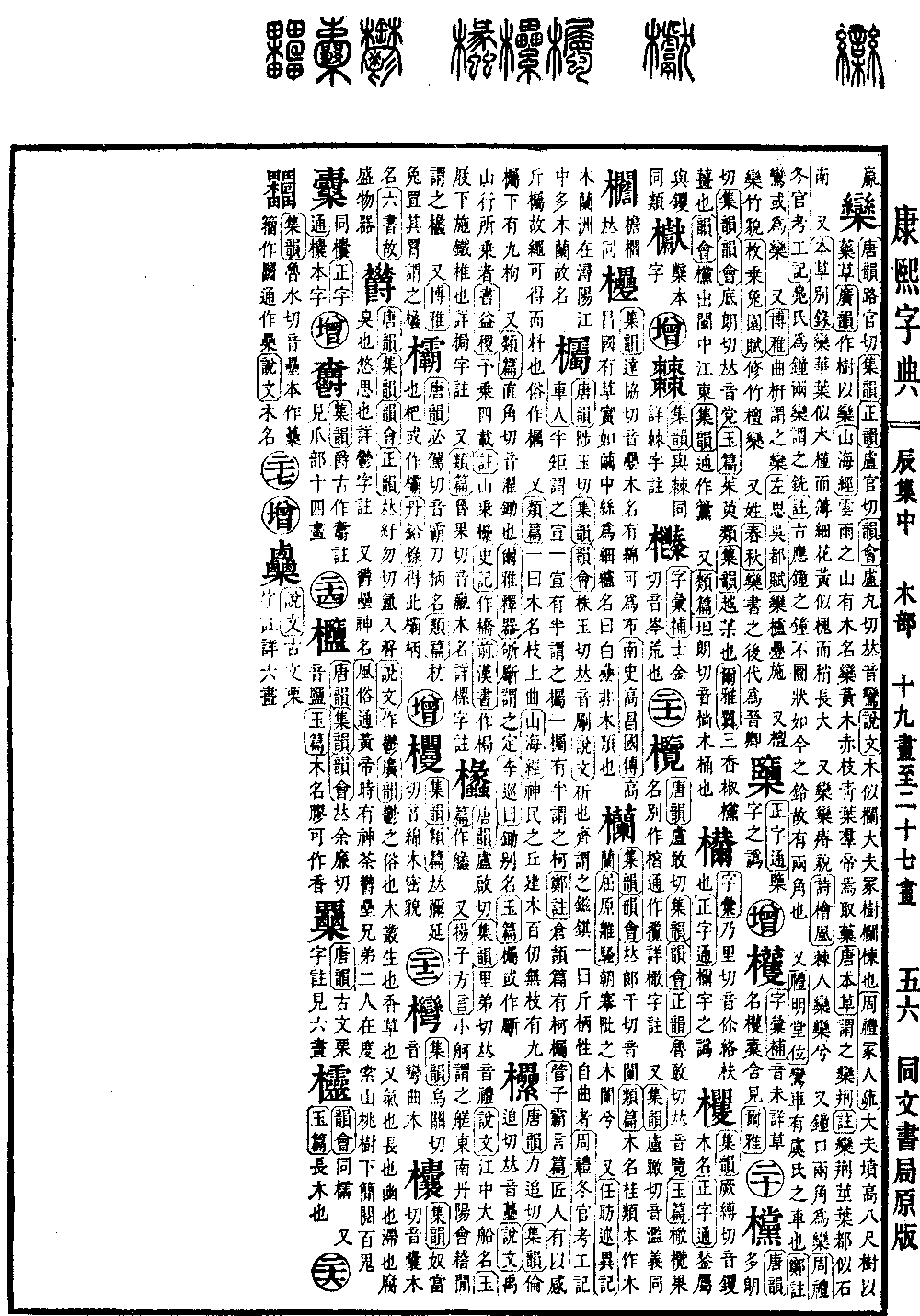
Chen Collection, Middle Volume. Radical: Tree (mù). 25 Kangxi strokes. Page 564, Entry 14. Pronounced zhu. According to the Tang Rhyme (Tangyun), Collected Rhymes (Jiyun), and Rhyme Compendium (Yunhui), it is pronounced the same as zhu. According to the Explanation of Graphs and Analysis of Characters (Shuowen), it means to chop or cut. In the region of Qi, it is called a ziqi. Another theory states it refers to the handle of an axe, specifically one that is naturally curved. In the Rites of Zhou (Zhouli), section Winter Officials, Artisans' Record (Kaogongji), chapter Carriage Maker, it is stated: A half-square is called a xuan, one and a half xuan is called a zhu, and one and a half zhu is called a ke. The commentary by Zheng notes that the Cangjie Pian contains the term ke-zhu. In the Guanzi, section Hegemonic Discourses, it is written: Because the craftsman has a feeling for the axe handle, the ink line can be used to measure the material. A common variant form is written as zhu. According to the Classified Dictionary (Leipian), another theory suggests it is a name for a type of tree. Its branches are curved upwards. In the Classic of Mountains and Seas (Shanhaijing), it is noted that on the Hill of the Divine People, there is a building tree (jianmu) that reaches a height of a hundred ren; it has no branches, but there are nine places where it is curved (zhu) and nine places where it is knotted (gou) below. According to the Classified Dictionary (Leipian), it is also pronounced zhi. It refers to a hoe. In the Literary Expositor (Erya), section Explanations of Implements, it is stated that a qizhu is called a ding. Li Xun explains that this is an alternative name for a hoe. According to the Jade Dictionary (Yupian), zhu is sometimes also written in a variant form (zhu).