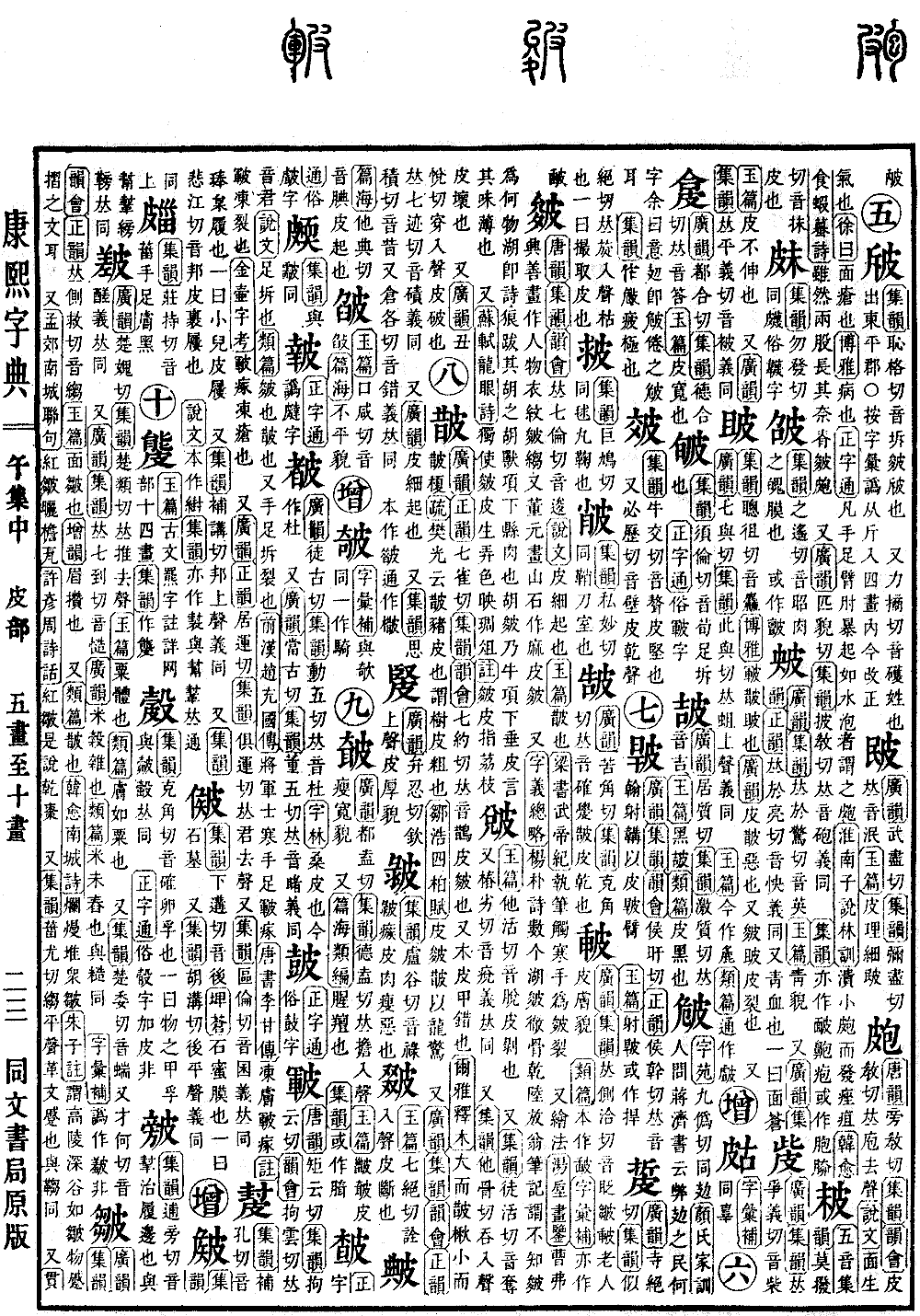
Wu Collection, Middle Volume
Radical: Skin (pí)
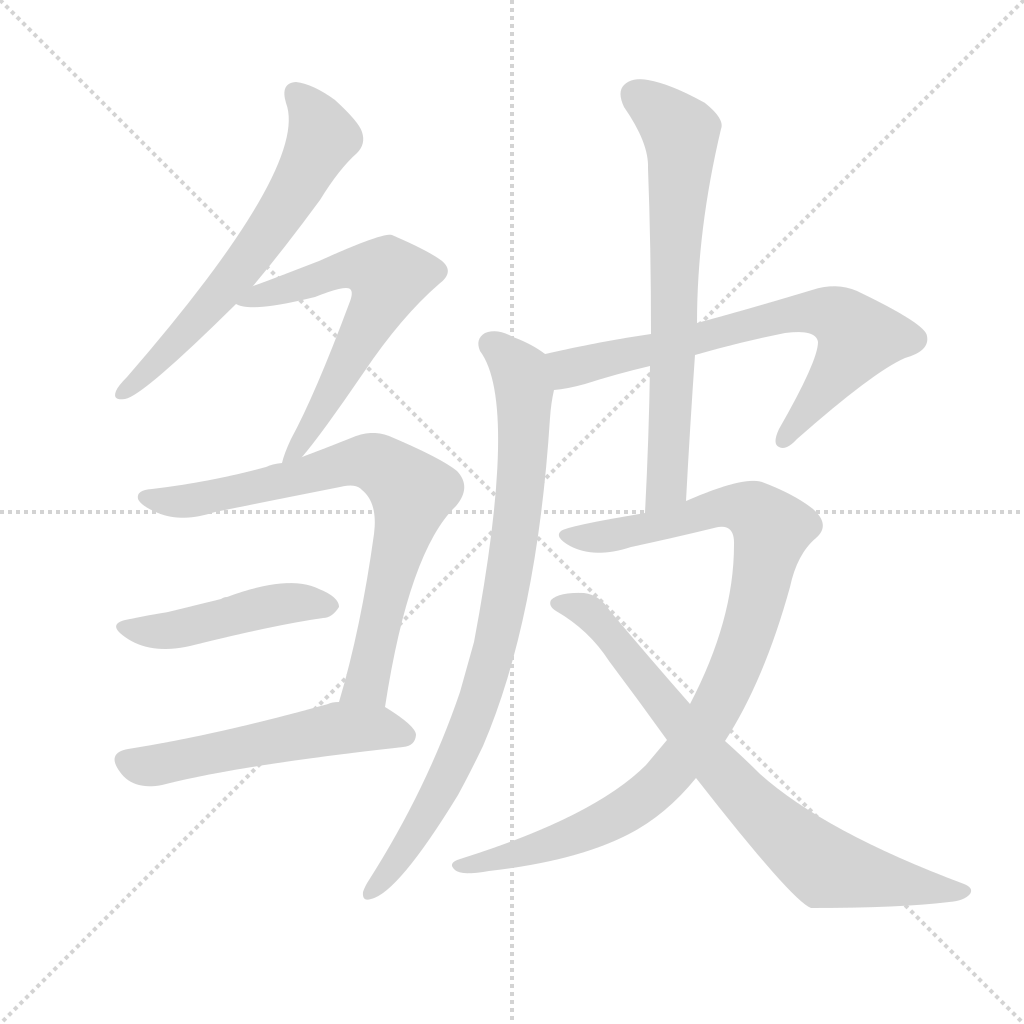
皺
Kangxi stroke count: 15
Page 791, Entry 10
Broad Rhymes (Guangyun), Collected Rhymes (Jiyun), Rhyme Meetings (Yunhui), and Orthodox Rhymes (Zhengyun): Pronounced zhou (falling tone).
Jade Chapters (Yupian): Skin on the face forming folds.
Increased Rhymes (Zengyun): Eyebrows knitted tightly.
Also, Classified Chapters (Leipian): Skin that is dry, cracked, and rough.
Han Yu, Southern City Poem (Nancheng shi): Scattered in piles are many wrinkles.
Zhu Xi Commentary (Zhuzi zhu): Refers to the textures of high mountains and deep valleys, resembling the surface of a wrinkled object squeezed together.
Also, Meng Jiao, Southern City Couplets (Nancheng lianju): Red wrinkles dried on the roof tiles.
Xu Yanzhou’s Poetic Remarks (Xu Yanzhou shihua): Red wrinkles refers to wind-dried jujubes.
Also, Collected Rhymes (Jiyun): Pronounced zhou (level tone). The texture formed by the contraction of a leather surface. Identical to the character (fou).
Also, Guanxiu, Villa at Hupou Poem (Hutou bieshu shi): Hungry, uncovering the water chestnut shell; new cicadas avoid the chestnut wrinkles.
Note: Chestnut wrinkles refers to the husk of a chestnut. The rhyme aligns with the character tou in the previous line and the character xiu in the following line.
Jade Chapters (Yupian): Also written as (fou).
Supplement to the Collection of Characters (Zihuibu): Also written as (variant form). Commonly written as (variant form).