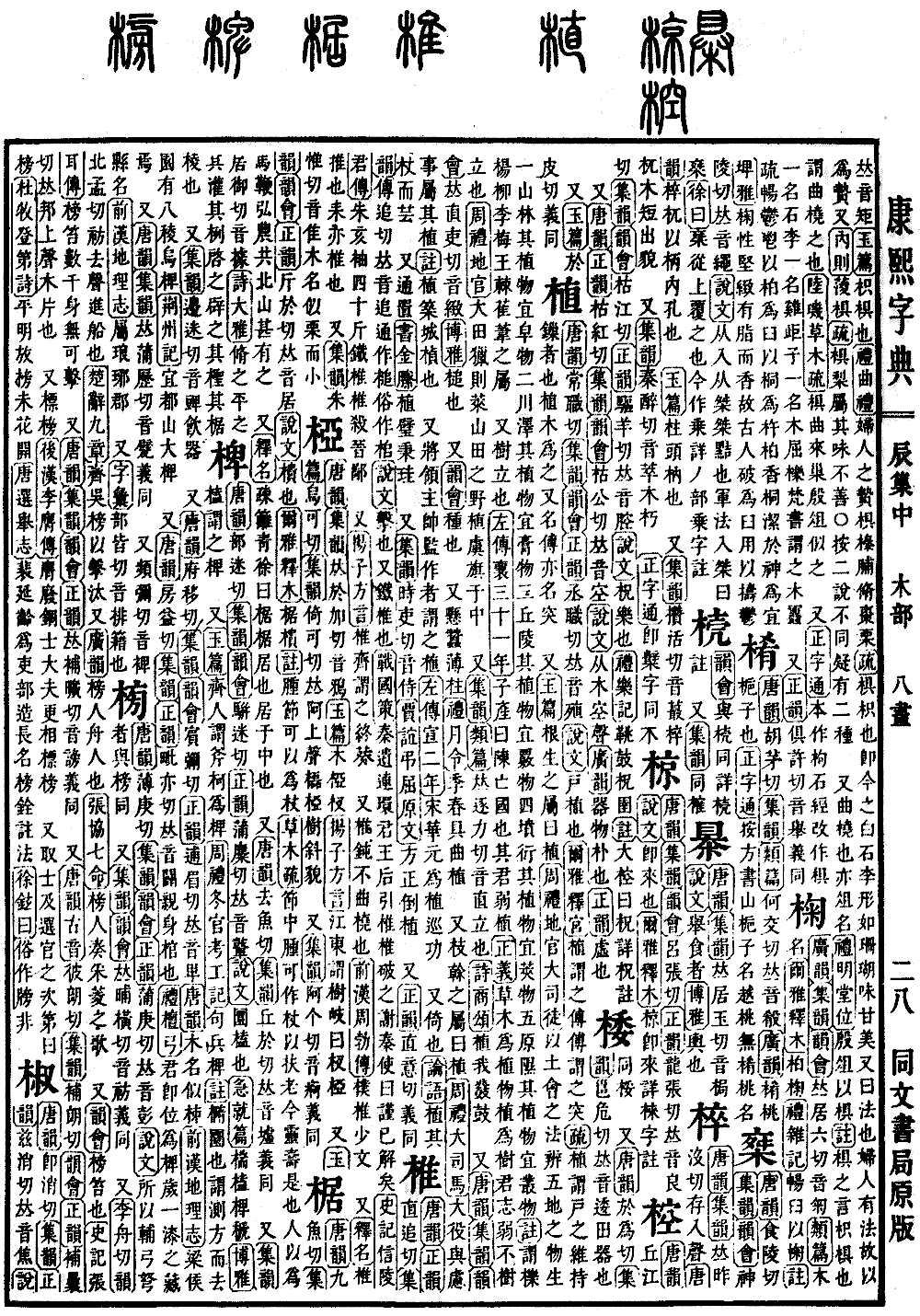
Chen Collection, Middle Volume
Radical: Tree (mù)
Kangxi Strokes: 12
Page 536, Entry 10
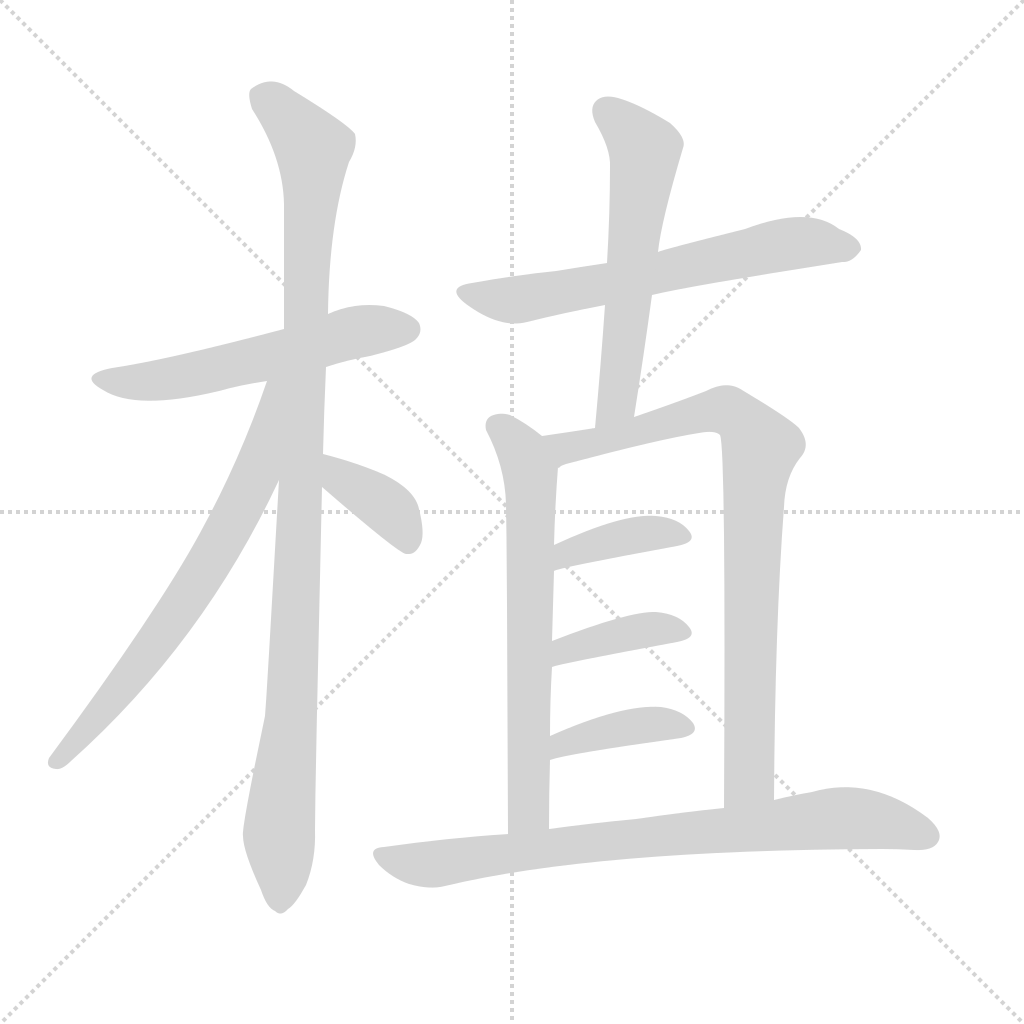
Pronounced zhi.
According to the Shuo Wen Jie Zi (Explaining Graphs and Analyzing Characters), it refers to the upright timber of a door.
According to the Erya (Approaching Elegance), the section on palaces: The upright timber is called a chuan, and the chuan is called a tu. The commentary states: The upright timber is a vertical wooden post on a door leaf used to secure the locking bolt, made of wood. It is also called a chuan, and also called a tu.
Also, according to the Yu Pian (Jade Chapters), living things with roots that can grow are called zhi.
According to the Book of Rites (Zhouli), section on the Ministry of Earth, Grand Minister of Instruction: Using land survey methods to distinguish the produce of five types of land. The first is mountain forests, suitable for tree-like crops such as oaks. The second is rivers and marshes, suitable for aquatic crops such as lotus and euryale. The third is hills, suitable for stone-fruited crops such as plums and prunes. The fourth is embankments and lowlands, suitable for legume crops. The fifth is plains and marshes, suitable for clustered crops such as reeds and rushes. The commentary states: This refers to plants such as oaks, poplars, willows, plums, prunes, king-thorns, and reeds.
Also refers to establishing or standing upright.
According to the Zuo Commentary (Zuo Zhuan), 30th Year of Duke Xiang: Zi Chan of Zheng said: This is a state on the verge of ruin; its ruler has a weak will and cannot stand upright. The commentary states: Plants are called zhi; planting them is called shu (tree/establish). A ruler with a weak will cannot establish prestige.
According to the Book of Rites (Zhouli), Ministry of Earth: During large-scale hunts, clear the weeds from the mountains and forests and erect the grand banner in the center of the hunting grounds.
Also, pronounced zhi. Means to stand.
According to the Book of Odes (Shijing), Eulogies of Shang: Erecting my bells and drums.
Also, pronounced zhi.
According to the Guang Ya (Expanded Elegance), it refers to a wooden mallet.
Also refers to planting. Also refers to the pillars used for suspending silkworm trays.
According to the Book of Rites (Liji), Monthly Ordinances: In the late spring, prepare the trays and pillars for silkworm rearing.
Also refers to items like branches or trunks.
According to the Book of Rites (Zhouli), Grand Marshal: For large projects, plan in advance and gather wooden pillars for building walls. The commentary states: These are the wooden pillars used when building walls.
Also refers to a commander, a chief, or a project supervisor.
According to the Zuo Commentary (Zuo Zhuan), 2nd Year of Duke Xuan: Hua Yuan of the State of Song, acting as the chief, inspected the construction.
Also refers to leaning.
According to the Analects (Lunyu): Leaning the staff aside to hoe the weeds.
Also interchangeable with zhi, meaning to place.
According to the Book of Documents (Shangshu), Metal Bound Coffer: Placing the jade bi-disk and holding the gui-scepter.
Also, pronounced shi.
According to the works of Jia Yi, Lament for Qu Yuan: An upright person is placed in an inverted position.
Also, pronounced zhi. Meaning is the same.
Textual Research:
According to the Erya, section on palaces: The upright timber is called a chuan, and the chuan is called a tu. The commentary states: The upright timber is a vertical wooden post on a door leaf used to secure the locking bolt, made of wood. It is also called a chuan, and also called a tu. Note: In the original text, three instances of the character chuan were corrected from the character fu.
According to the Zuo Commentary (Zuo Zhuan), 30th Year of Duke Xiang, Zi Chan said. Note: In the original text, the 31st year was corrected to the 30th year, and the word Zheng was added before Zi Chan.