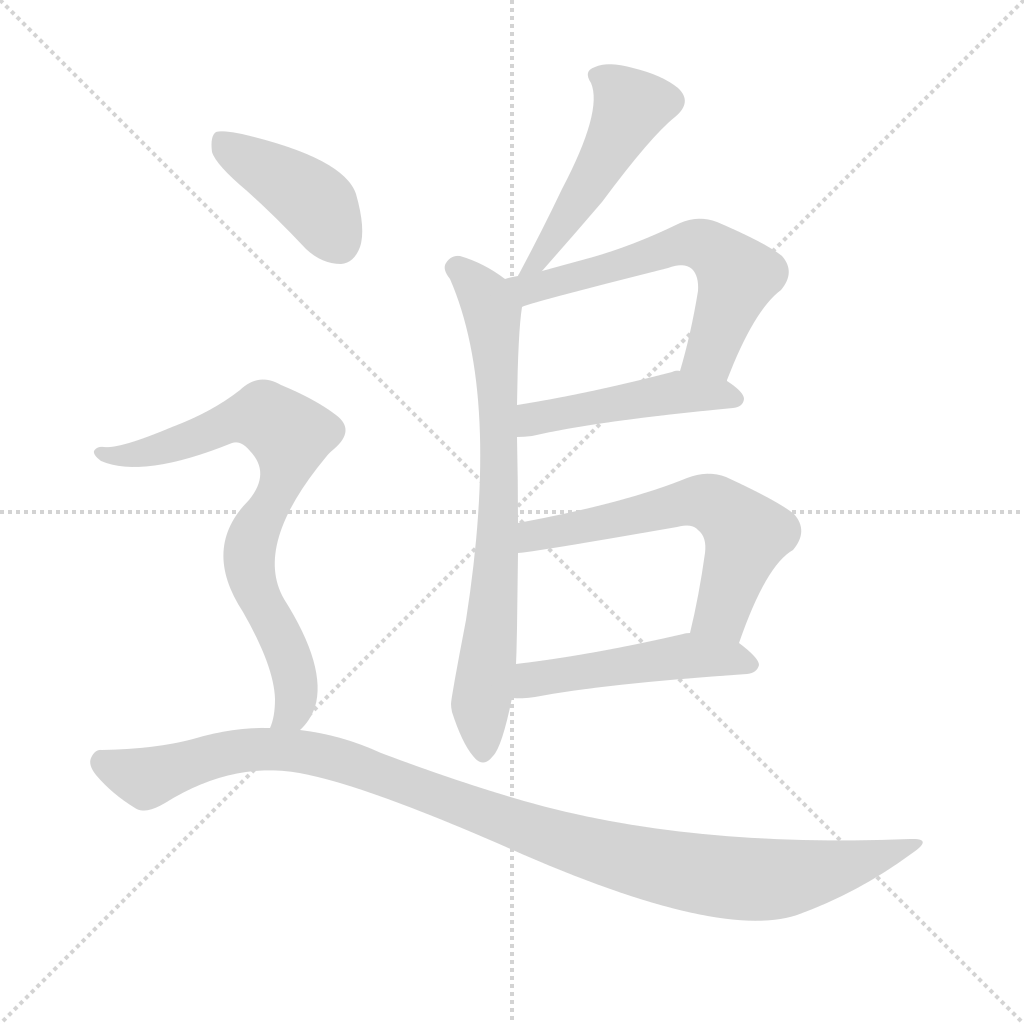
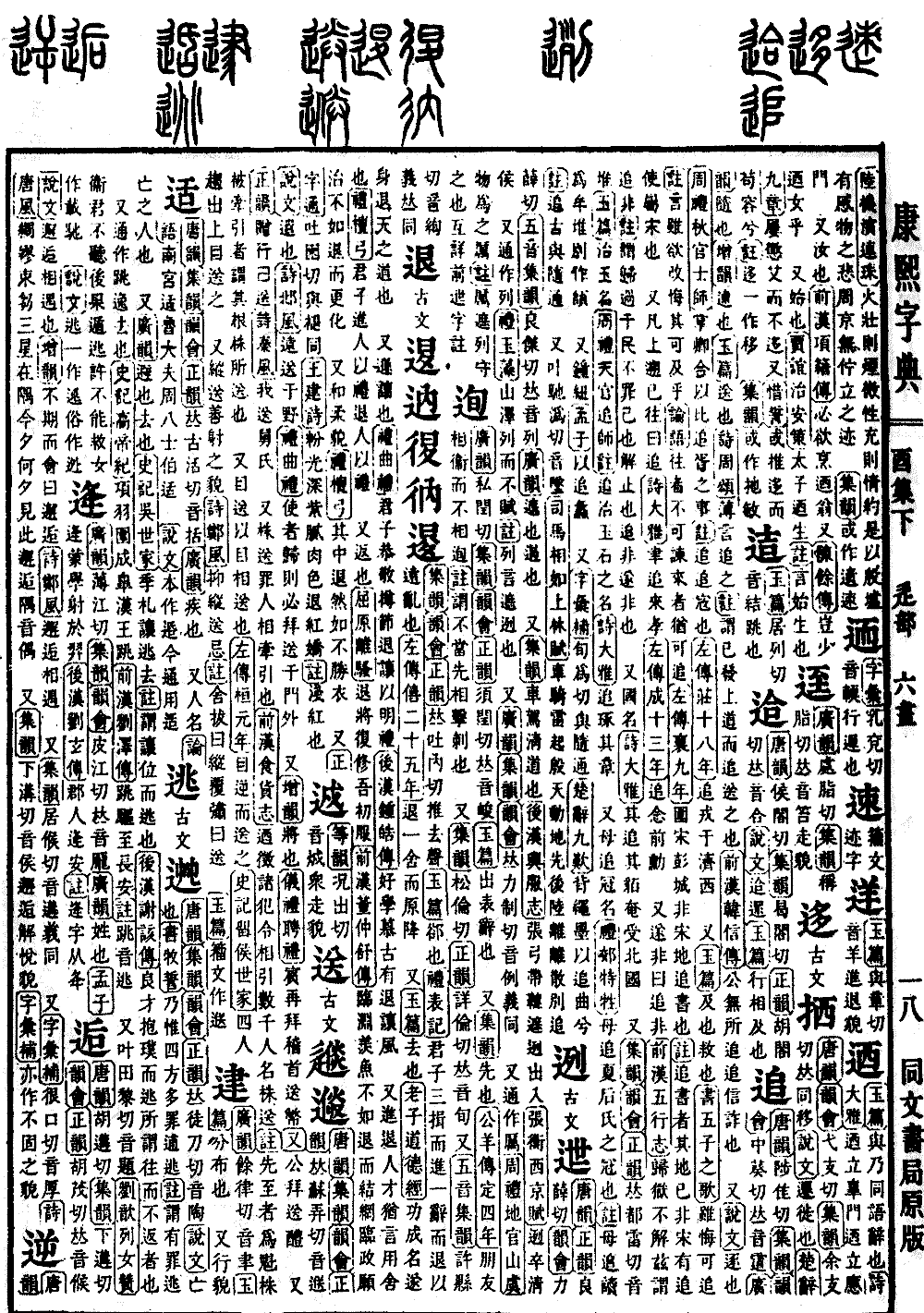
You Collection, Lower Volume
Radical: Walk (chuò)
Kangxi Strokes: 13
Page 1256, Entry 10
Tang Rhymes (Tangyun): Pronounced zhui
Collected Rhymes (Jiyun) and Rhymes Collection (Yunhui): Pronounced zhui
Broad Rhymes (Guangyun): To follow or accompany.
Increased Rhymes (Zengyun): To reach or arrive.
Jade Chapters (Yupian): To see off a traveler.
Book of Odes (Shijing), Odes of Zhou (Zhousong): To go forth and follow/see them off. Annotation: Refers to following someone who has already departed on a journey to see them off.
History of the Former Han (Qianhan Shu), Biography of Han Xin: Do not pursue. Here, pursue is a deceptive tactic used by Han Xin.
Also, Explaining Graphs (Shuowen): To pursue or chase.
Rites of Zhou (Zhouli), Ministry of Autumn (Qiuguan), Chief Justice (Shishi): In charge of village alliances to compare matters of pursuing thieves. Annotation: Pursue means to track and capture.
Zuo Commentary (Zuozhuan), 18th Year of Duke Zhuang: Pursued and attacked the Rong people as far as the west of the Ji River.
Also, Jade Chapters (Yupian): To catch up with; to remedy.
Book of Documents (Shujing), Song of the Five Brothers: Although one regrets, can it be remedied? Annotation: Asks whether one can still remedy the situation despite the regret.
Analects (Lunyu): Past events cannot be recovered, but future events can still be remedied.
Zuo Commentary (Zuozhuan), 9th Year of Duke Xiang: The siege of Pengcheng in the Song state was not a territory of Song; it is an example of retrospective recording. Annotation: Retrospective recording means the place no longer belonged to the state of Song, and it was recorded retrospectively as belonging to it.
Also, whenever one traces back to the past, it is called pursue.
Book of Odes (Shijing), Greater Odes (Daya): To recount the virtues of ancestors.
Zuo Commentary (Zuozhuan), 13th Year of Duke Cheng: To recall the achievements of predecessors.
Also, persisting in errors is called "pursue wrong."
History of the Former Han (Qianhan Shu), Treatise on the Five Elements: Shifting blame onto the common people without ceasing is called "pursue wrong." Annotation: Refers to blaming the people instead of reflecting on oneself. "Stop" is not the meaning here; "pursue wrong" means to persist in errors.
Also, a state name.
Book of Odes (Shijing), Greater Odes (Daya): That state of Zhui and the Mo people, all gathered the northern states.
Also, Collected Rhymes (Jiyun), Rhymes Collection (Yunhui), and Orthodox Rhymes (Zhengyun): Pronounced dui.
Jade Chapters (Yupian): A term for working jade.
Rites of Zhou (Zhouli), Ministry of Heaven (Tianguan), Master of Jade (Zhuishi) Annotation: Zhui is a term for the finishing of jade.
Book of Odes (Shijing), Greater Odes (Daya): Carving its patterns.
Also, Wuzhui: A type of cap.
Book of Rites (Liji), Suburban Sacrificial Rituals (Jiaotesheng): Wuzhui was the cap style of the Xia dynasty. Explanation of Texts (Shiwen): The first character is pronounced mou, the second is pronounced dui.
Also, a bell knob.
Mencius (Mengzi): Because the bell knob was worn down like a gourd.
Also, Supplementary Collection of Characters (Zihuibu): Pronounced sui. Interchangeable with the character for follow.
Songs of Chu (Chuci), Encountering Sorrow (Lisao): Departing from the plumb line to follow the crooked. Annotation: In ancient times, the character for pursue was interchangeable with the character for follow.
Also, rhymes with chui, pronounced zhui.
Sima Xiangru, Rhapsody on the Shanglin Park (Shanglin Fu): Chariots and cavalry sounded like thunder, shaking heaven and earth. Advancing and receding in disorder, scattering and pursuing each other.