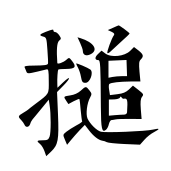
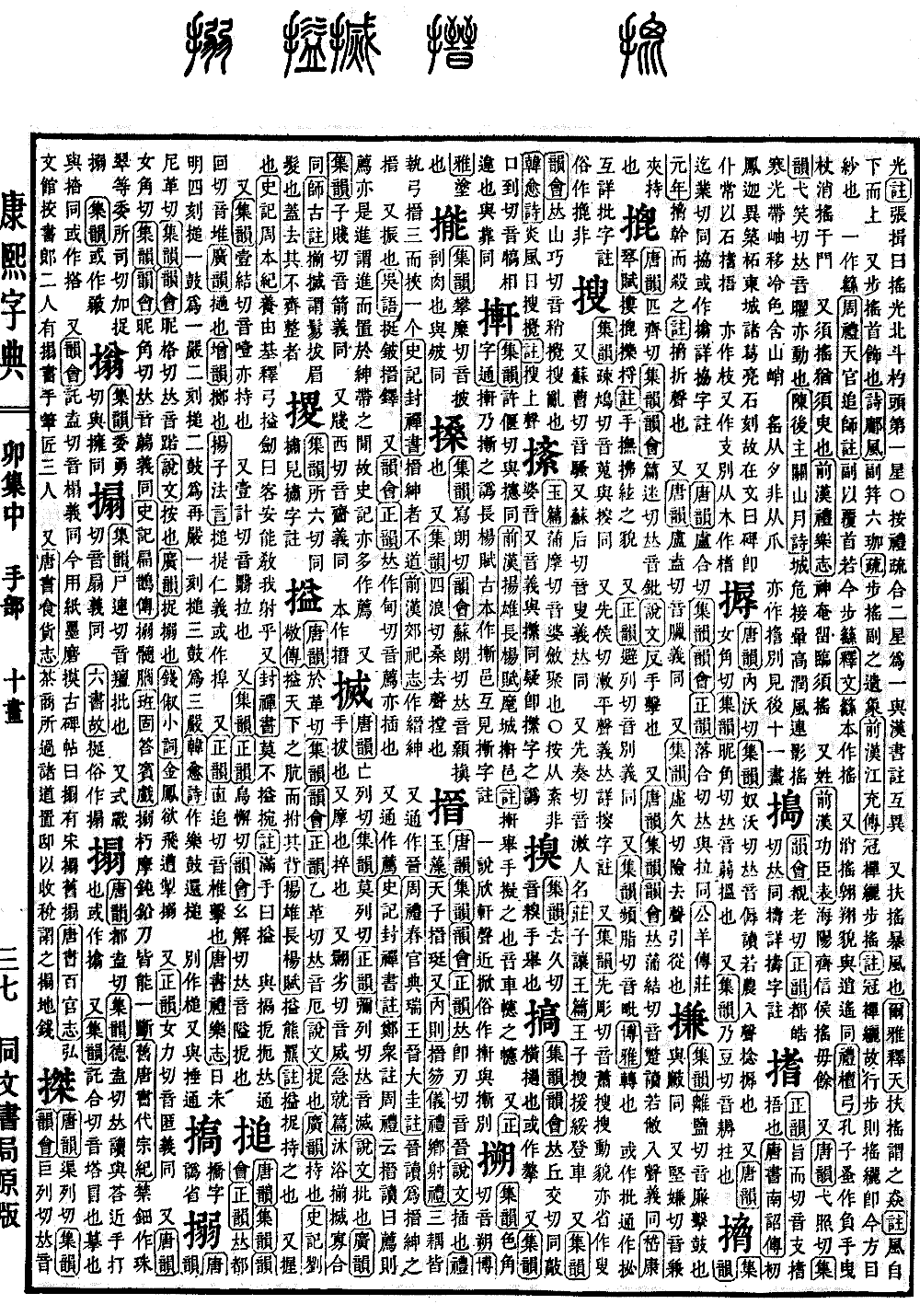
Mao Collection, Middle Volume. Radical: Hand (shǒu). Kangxi strokes: 14. Page 447, Entry 19.
Pronounced dui.
According to the Book of Tang (Tangyun), the Collection of Rhymes (Jiyun), the Dictionary of Rhymes (Yunhui), and the Correct Rhymes (Zhengyun), the character is pronounced dui.
According to the Broad Rhymes (Guangyun), it means to pluck, gather, or throw.
According to the Supplement to the Rhymes (Zengyun), it means to throw.
In the Model Sayings (Fayan) by Yangzi, it is used in the context of plucking or throwing away benevolence and righteousness. Sometimes written in a variant form.
Also, according to the Correct Rhymes (Zhengyun), it is pronounced zhui. It means to strike or beat.
In the Treatise on Ritual and Music in the Old Book of Tang (Tangshu), it is recorded that before dawn, a drum is struck once at four quarters of the hour to signal the first watch; struck twice at two quarters for the second watch; and struck three times at one quarter for the third watch.
In a poem by Han Yu, it describes the striking of drums during musical performances.
It is also written as a variant form.
It is also used interchangeably with the character meaning to beat or hammer (chui).