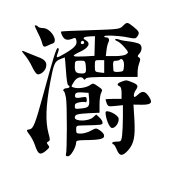
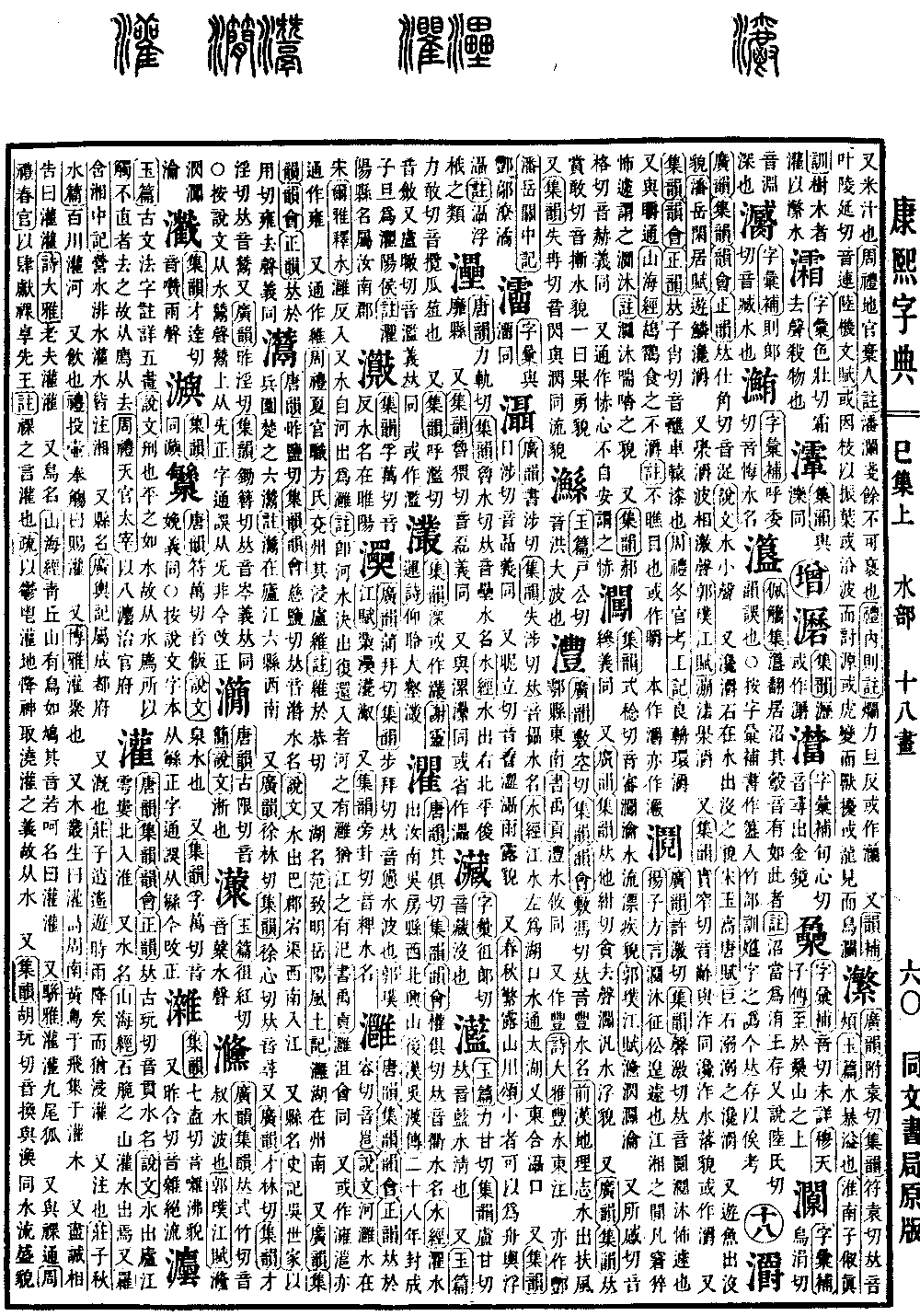
Si Collection, Upper Volume
Radical: Water (shuǐ)
Kangxi Strokes: 22
Page 662, Entry 11
Pronounced zhuó.
According to the Explaining Graphs and Analyzing Characters (Shuowen), it refers to the sound of flowing water. It also refers to the appearance of stones partially hidden and partially visible in water. As mentioned in the Gao Tang Fu by Song Yu: The massive stones are submerged, chán zhuó.
It also refers to the appearance of swimming fish emerging and disappearing. As mentioned in the Idle Living Rhapsody (Xianju fu) by Pan Yue: Swimming scales chán zhuó.
It also refers to the sound of waves crashing against each other. As mentioned in the Rhapsody on the Yangtze River (Jiang fu) by Guo Pu: The water crashes and splashes, péng bō xué zhuó.
Also pronounced zè (entering tone). The same as the character for water dropping. It refers to the appearance of water falling. Sometimes written as the character for splashing water.
Also pronounced jiào (falling tone). Refers to the lacquer on a carriage pole. As mentioned in the Rites of Zhou (Zhouli), section Winter Officials: A well-crafted pole is adorned with lacquer (zhuó).
Also used interchangeably with the character for blind. As mentioned in the Classic of Mountains and Seas (Shanhaijing): The gu bird, when eaten, prevents one from having poor eyesight (zhuó). Commentary: It means unable to see clearly. Sometimes written as the character for eye-related illness. Originally written as the current entry, also written as the character for eye-related illness.