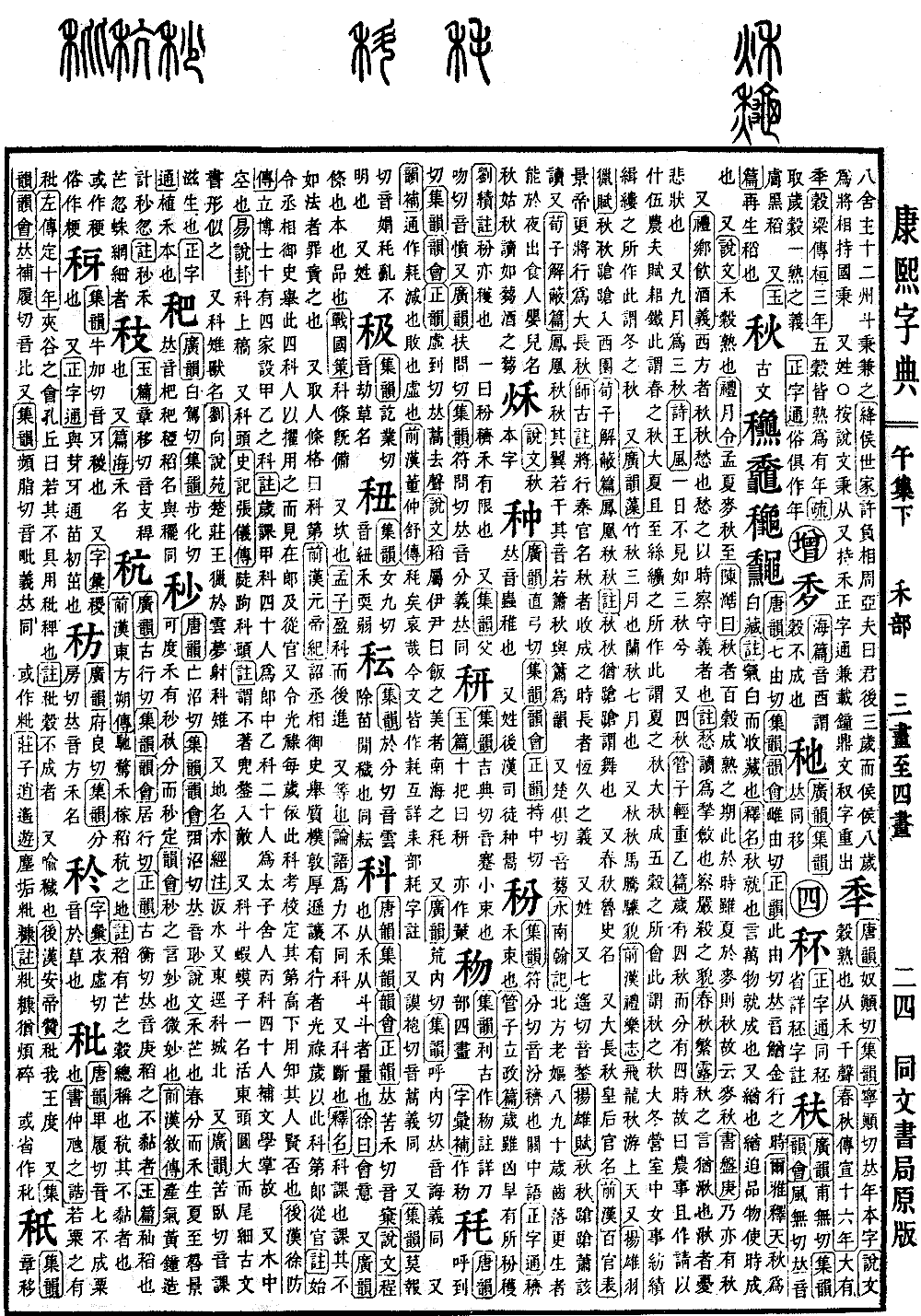
Wu Collection, Lower Volume
Radical: Grain (hé)
Kangxi Strokes: 14
Page 850, Entry 12
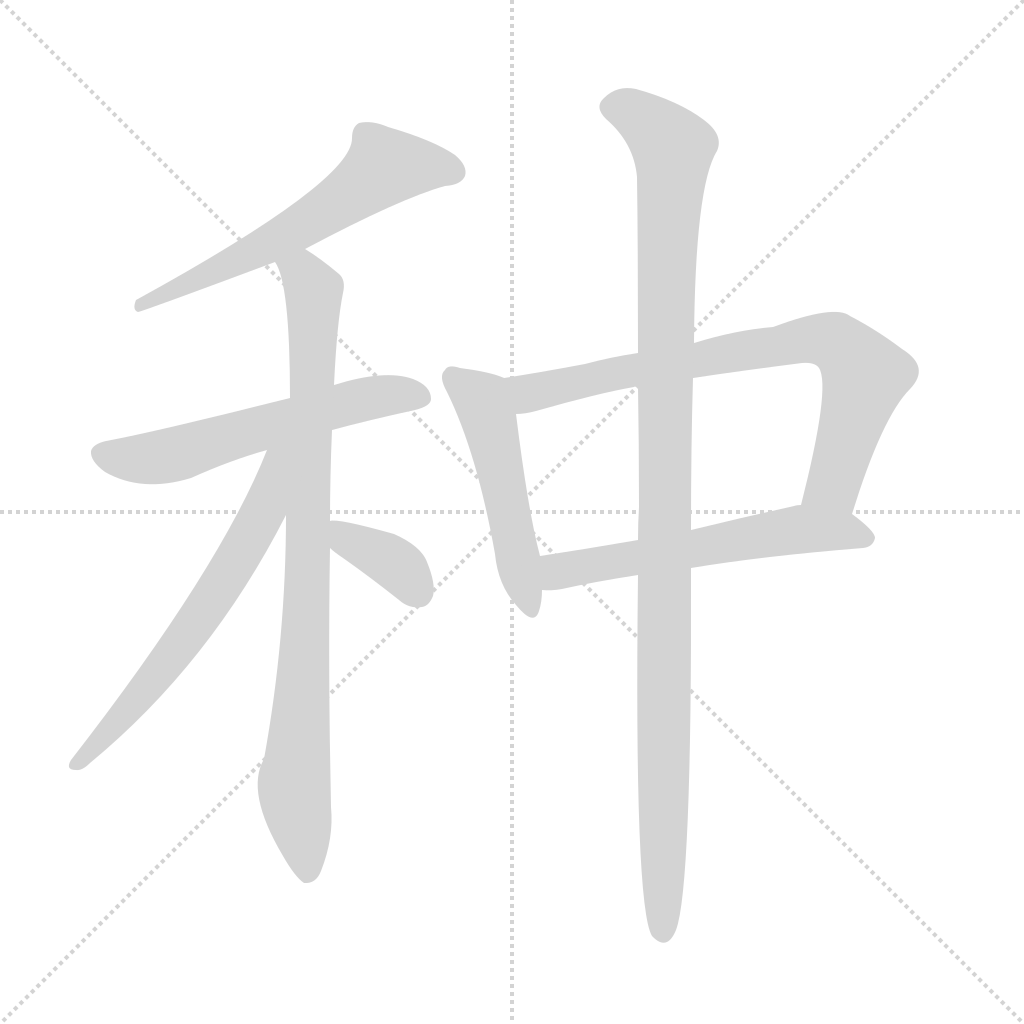
Pronounced chong. Small or young. Also a surname. Recorded in Later Han records as Situ Zhong Hao.
The ancient form of the character. Pronounced zhong (rising tone). The seed of a grain. Book of Odes (Shijing): Descend with superior seeds. Rites of Zhou (Zhouli): According to the nature of the land, select suitable crops and prepare their seeds. Also, from the Xia Official: In the region of Yu, it is suitable to plant the five grains. Note: These are millet, broomcorn millet, legumes, wheat, and rice. Also, a category or species. Book of Documents (Shangshu): Do not allow them to spread their kind in this new capital. Records of the Grand Historian (Shiji): Fearing that if the affair does not succeed, the Qin dynasty will exterminate his kin. Book of the Later Han (Hou Hanshu): This is the place where the remnant tribes dwell.
Also a place name. Records of the Grand Historian (Shiji): The people of Yang and Pingyang trade westward with the Qin and Di, and northward with Zhong and Dai. Note: Zhong is located in Shiyi County, Heng Prefecture; the north is likely Wei Prefecture.
Also the name of a foreign state. Book of the Later Han (Hou Hanshu): Wuwei Commandery faces the Xiongnu to the north and connects to the Qiang tribes to the south; the people feared raiding bandits and often abandoned their fields and property.
Also, Zhuangzi: Abandon that simple and cautious ingenuity. Note: Zhong-zhong, the appearance of being cautious and simple.
Also, Added Rhymes (Zengyun): Zhong-zhong, similar to saying "thing by thing."
Also, the appearance of short hair. Zuo Commentary (Zuozhuan): My hair is as short as this.
Pronounced zhong (falling tone). To plant or scatter. Book of Documents (Shangshu): Gao Yao widely disseminated virtue. Note: Zhong, to scatter. Sowing crops necessarily involves scattering them upon the land, hence the meaning of scattering. Records of the Grand Historian (Shiji): That which is not discarded includes books on medicine, divination, and the planting of trees. Book of the Former Han (Hanshu): The lunar mansion of Chunshou begins at sixteen degrees of the Well mansion, marking the solar term of Grain in Ear.
Correct Characters (Zhengzitong): The Explaining Graphs and Analyzing Characters (Shuowen Jiezi) states that the character is a grain that is planted first and matures later. It is formed from Grain (he) and the phonetic component Zhong (chong); the pronunciation is listed as zhi rong. The variant character is used for planting, formed from Grain (he) and the phonetic component Tong; the pronunciation is zhi yong. This divides the two characters. Note: In the Book of Odes (Shijing), the term for early and late ripening grains borrows the character for heavy; the Explaining Graphs and Analyzing Characters (Shuowen Jiezi) seems to differ from the Book of Odes (Shijing). Furthermore, the phonetic component Tong and the pronunciation zhi yong are opposite in sound. The character for planting is synonymous with the variant; in the Rites of Zhou (Zhouli), the character for planting is the same as that used in the classics and commentaries, and the usage in the classics and commentaries should be taken as the standard. The traditional pronunciation, which is the same as the sound for insect, is incorrect.