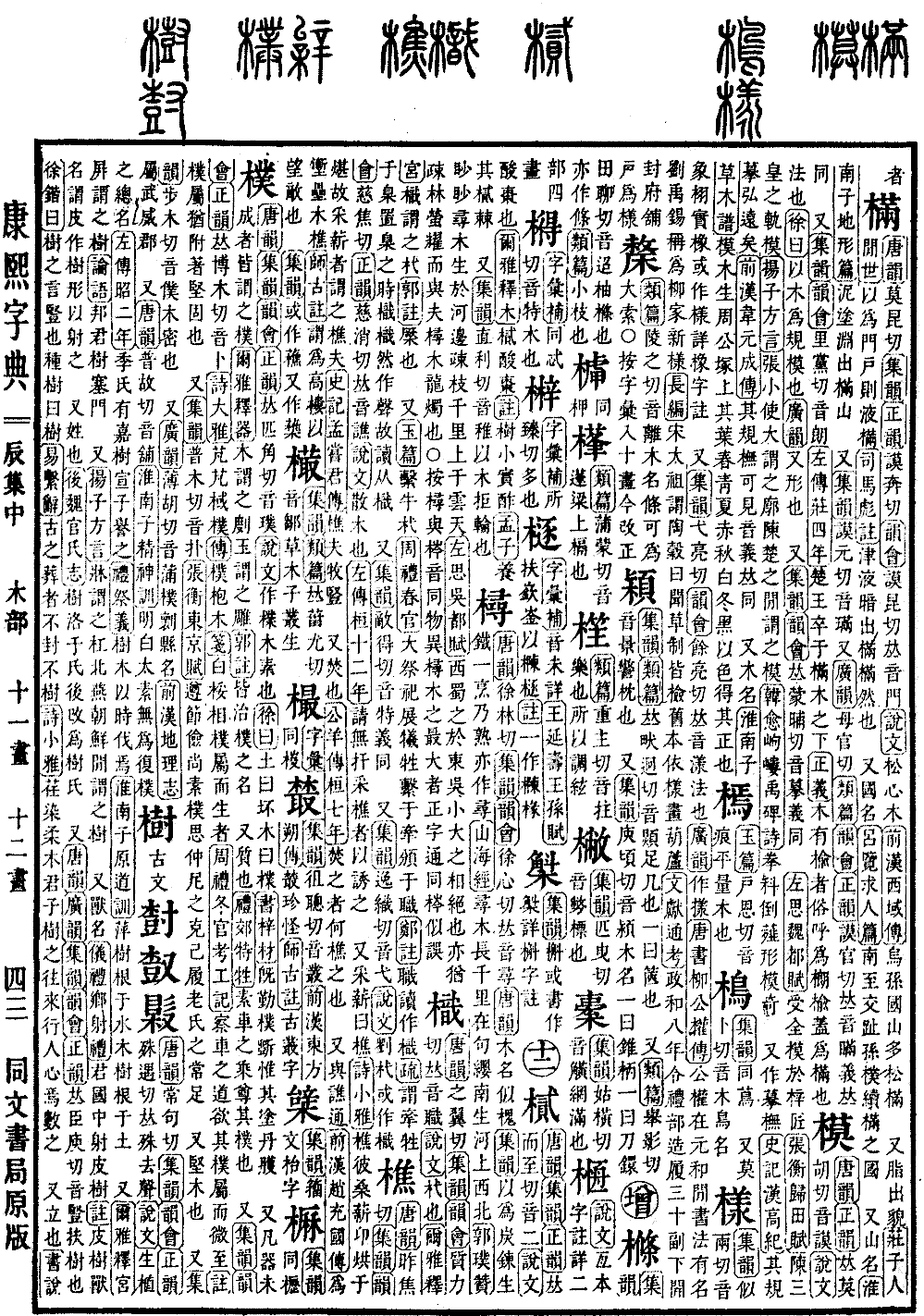
Chen Collection, Middle Volume
Radical: Wood (mù)
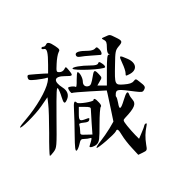
Zhi
Kangxi stroke count: 16
Page 551, Entry 21
Pronounced zhi.
According to Explaining Graphs and Analyzing Characters (Shuowen Jiezi), it refers to a wooden stake. The Erya, Explanation of Dwellings states that zhi is a wooden stake. Guo's commentary defines it as a peg.
Furthermore, in the Jade Chapters (Yupian), it refers to a wooden stake for tethering oxen.
The Rites of Zhou (Zhouli), Offices of the Supervisor of Sacrifices (Sishi) records that during major sacrificial rites, the sacrificial animals are inspected, tethered in the pens, and distributed to the responsible officials. Zheng's commentary notes that zhi is pronounced the same as this character. The sub-commentary explains that because of the sound made when driving a stake into the ground to tether an animal, the pronunciation is derived from zhi.
Also, according to the Collected Rhymes (Jiyun), it has a pronunciation of te, which is identical in sound to the word for specialty. The meaning is the same.
Additionally, according to the Collected Rhymes (Jiyun), it has a pronunciation of yi, which is identical in sound to the word for to shoot with a bow.
In some editions of Explaining Graphs and Analyzing Characters (Shuowen Jiezi), the character yi in the term Liu Yi is written as zhi.
Textual Research: In the Rites of Zhou (Zhouli), Spring Offices, it states that during major sacrifices, inspect the sacrificial animals, tether them in the pens, and distribute them to the responsible officials. The text has been corrected to refer to the Offices of the Supervisor of Sacrifices (Sishi) instead of the Spring Offices, pens instead of tethering ropes, and the word officials now includes the character for person.