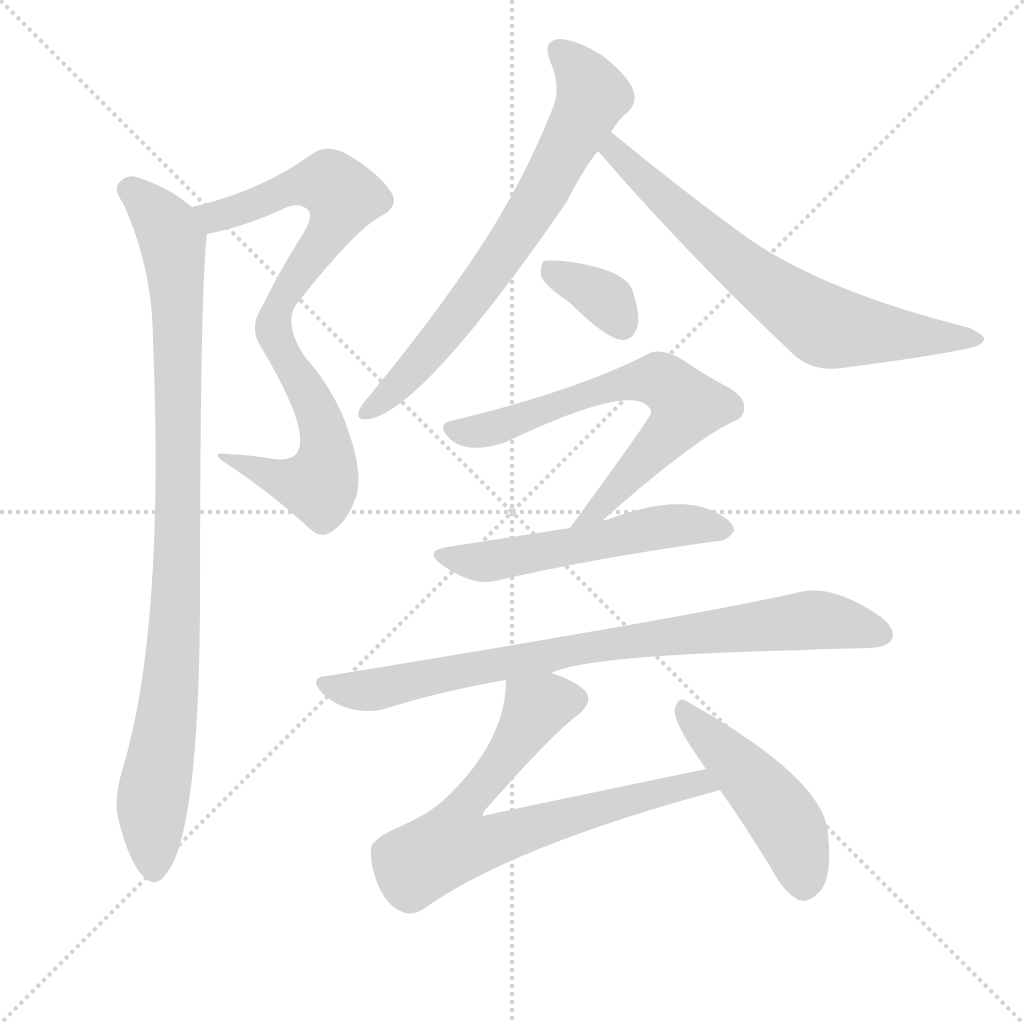
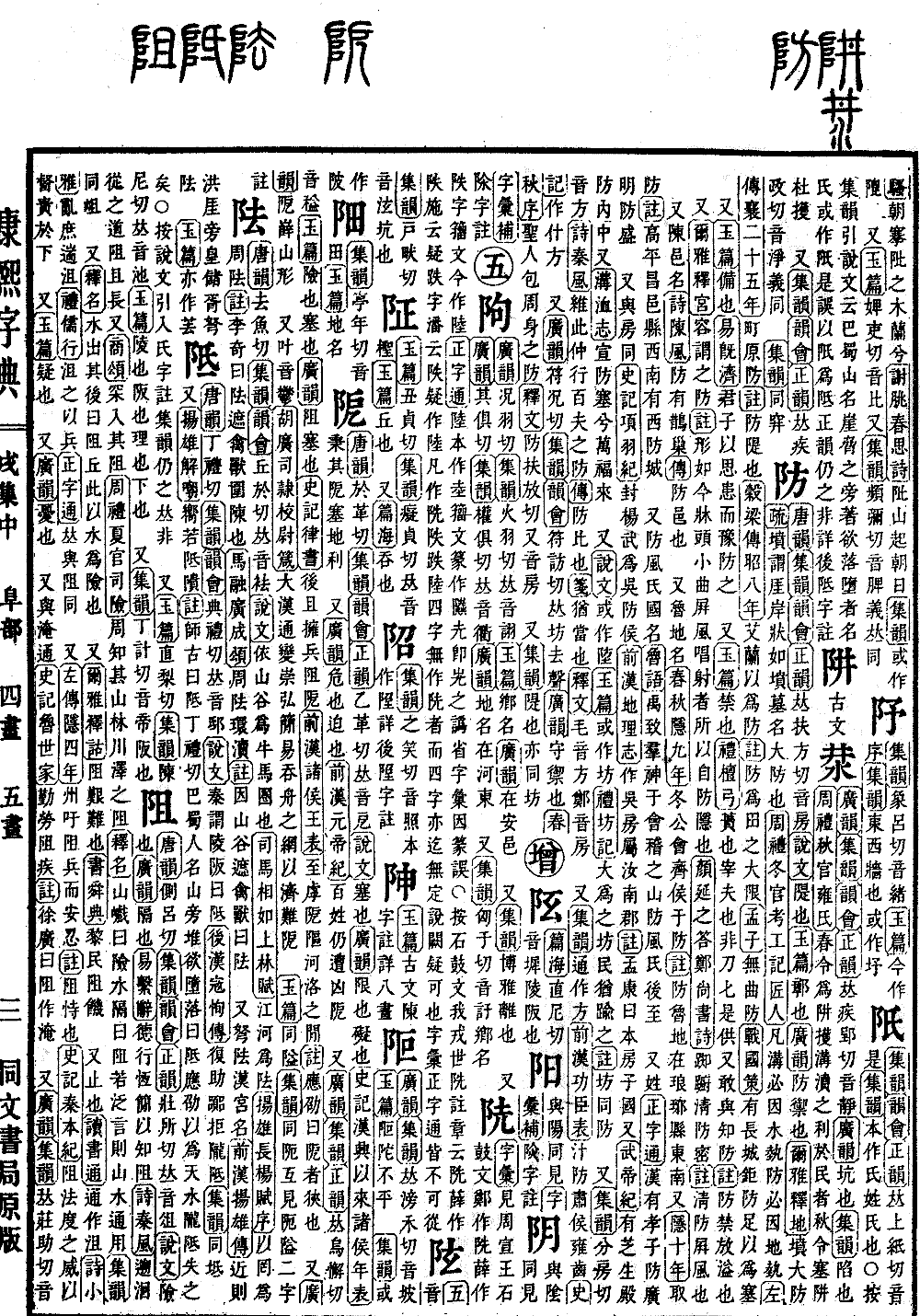
Xu Collection, Middle Volume. Radical: Mound (fù). Entry for yīn. Kangxi strokes: 16. Page 1347. Ancient forms include several variant characters.
Pronunciation: yīn.
Shuowen Jiezi (Shuowen): Dark.
Shimíng (Shimíng): Yīn means "shade"; the qi (vital energy) is hidden and shady within.
Yupian (Yupian): Mysterious and formless, deep and unfathomable is called yīn.
Book of Changes (Yijing), Kun Hexagram: Although the yīn has beauty, it contains it, following the king's affairs, not daring to complete them. It is the way of the earth, the way of the wife, the way of the minister.
Book of Rites (Liji), Monthly Ordinances: All officials quietly attend to their duties, so as to establish the achievements of the evening yīn.
Also, Rites of Zhou (Zhouli), Offices of Heaven, Inner Steward: Teaches the six palaces with yīn rites. Note: Yīn rites are women's rites.
Also, Inner Petty Official: Manages the king's private affairs and secret decrees.
Also, Offices of Earth, Grand Minister of Education: Teaches relatives with yīn rites, then the people will not resent. Note: Yīn rites refer to rites between men and women.
Also, overcast and clear weather.
Book of Odes (Shijing), Odes of Bei: Dark and cloudy. Also: With clouds and rain.
Also, Shuowen: The north side of a mountain.
Book of Documents (Shangshu), Tributes of Yu: South to Huayin.
Also, Shuowen: The south side of a body of water.
History of the Former Han (Qian Han Shu), Treatise on Geography: Fen yin County in Hedong Commandery. Note: Mount Jie is to the south.
Also, Yupian: Shadow.
Book of Jin (Jin Shu), Biography of Tao Kan: Yu the Great valued every inch of shadow (time), we should value every minute of shadow (time).
Also, Zhengzitong (Zhengzitong): The back is called yīn. Yang Xiu deciphered Cao E's eight characters on the back (of her stele).
Also, History of the Former Han (Qian Han Shu), Songs for Suburban Sacrifices: When the spirits arrive, blessings are abundant (yīn-yīn). Note: Shi Gu says, it means the blessings descend and cover everywhere below.
Also, Yupian: Silent.
Strategies of the Warring States (Zhanguo Ce): The alliance between Qi and Qin was secretly concluded.
Also, Book of Odes (Shijing), Odes of Qin: Yīn rein attachments of gilded bronze. Commentary: Yīn means to cover the huàn (crossbar). Shimíng: Yīn means "shade". It is placed horizontally in front of the carriage to shade the jìn (axle pin).
Also, a place name. Zuo Commentary (Zuozhuan), Duke Xiang, Ninth Year: Crossed Yinban to invade Zheng.
Also, Duke Zhao, Nineteenth Year: Chu official Yin Chi moved Yin to Xiayin.
Also, Twenty-second Year: Led an army to camp at Yin.
History of the Former Han (Qian Han Shu), Treatise on Geography: Yin County in Nanyang Commandery. Note: This is the Xiayin mentioned in the Zuo Commentary.
Also, during the Han dynasty, there were two Yinshan counties. Treatise on Geography: Yinshan in Xihe Commandery, and Yinshan in Guiyang Commandery.
Also, a mountain name. Records of the Grand Historian (Shiji), Annals of Qin Shi Huang: From the east of the Yuzhong River, it belongs to Yinshan. Note: Xu Guang says it is north of Wuyuan.
Also, a surname. Guangyun (Guangyun): Guan Xiu went from Qi to Chu and became the Grand Master of Yin; his descendants adopted it as their surname. According to Records of the Grand Historian (Shiji), Chu Shaosun's Turtle Divination Treatise: Yin Jing saved him and fled with him. Suoyin (Suoyin) says: Yin is the surname, Jing is the given name. Thus, the Yin surname already existed in the Shang dynasty. Also, Zuo Commentary (Zuozhuan), Duke Xi, Fifteenth Year: Jin's Yin Yisheng met the Count of Qin and made an alliance in Wangcheng. Note: Yisheng's fief was Yin. Strategies of the Warring States (Zhanguo Ce) mentions Yin Yinji, probably from this lineage. Also, Duke Zhao, Twenty-fourth Year: Yin Buning invaded the south with people from Wen. It is suspected that Yin was also a surname here.
Also, Zhengzitong: The male genitals are called yīn. Records of the Grand Historian (Shiji), Biography of Lu Buwei: Secretly sought the man with a large yīn, Lao Ai, to be a retainer.
Also, Lost Book of Zhou (Yi Zhou Shu): On the altar, a red canopy (chì yì) was spread, with yīn feathers. Note: Yīn refers to a crane.
Yupian: Currently written as a variant character pronounced yīn. Wuyin Jiyun (Wuyin Jiyun): Popularly written as a variant character pronounced yīn. Zihui (Zihui): Popularly written as a variant character pronounced yīn. Zihui Bu (Zihui Bu): Also written as the character yīn.
Also, Jiyun (Jiyun): Pronounced ām. Originally written as àn (dark, mourning hut), meaning a mourning hut. Analects (Lunyu): Gaozong observed a mourning period, and for three years did not speak.
Also, Jiyun, Yunhui (Yunhui): Pronounced yìn. Jiyun: To bury. Book of Rites (Liji), Meaning of Sacrifices: Bones and flesh perish below, yīn become wild earth. Note: Yīn is read as yìn, meaning "to shade" or "to cover".
Also, Book of Odes (Shijing), Greater Odes: You have already shaded the women, return to me and shine forth. Commentary: To cover and shade. Yunhui Xiaobu (Yunhui Xiaobu): The variant character yìn is interchangeable with yīn.
Also, Zhengzitong: Pronounced yìn. Ancient medical prescriptions mention the ailment of "pale yīn (dàn yīn)", popularly written as "pale drink (dàn yìn)".
Also, rhyming with yōng. Book of Odes (Shijing), Odes of Bin: On the second day, ice is chopped with thudding sounds; on the third day, it is put into the ice cellar (líng yīn). Commentary: Líng yīn is an ice house. Master Yang's Classic of the Supreme Mystery (Yangzi Taijing): The sun flies, hanging yīn (darkness), and all things flourish.
Also, rhyming with yān. Yellow Court Classic (Huangting Jing): Above are the spirits, below are the Guanyuan (dantian point), on the left is Shaoyang, on the right is Taiyīn.
Also, Yunhui Xiaobu: Originally written as Yīn (variant character). Shallow black color. Also written as yīn. Book of Odes (Shijing), Lesser Odes, My Horses are Dapple-Grey, Commentary: A horse with mixed black and white hair is called yīn (dapple-grey horse). Yīn is a shallow black color.
Correction: In Strategies of the Warring States (Zhanguo Ce), the original text's zhī chù (the place) should be changed to zhī jiāo (the alliance).
Correction: In Book of Odes (Shijing), Odes of Qin, the commentary states: "Yīn means to cover the guǐ (chariot track)." According to the original text, guǐ should be changed to huàn (crossbar).
Correction: In Lost Book of Zhou (Yi Zhou Shu), the phrase "a red yì (display)" (chì yì) should be changed to "a red yì (canopy)" (chì yì).