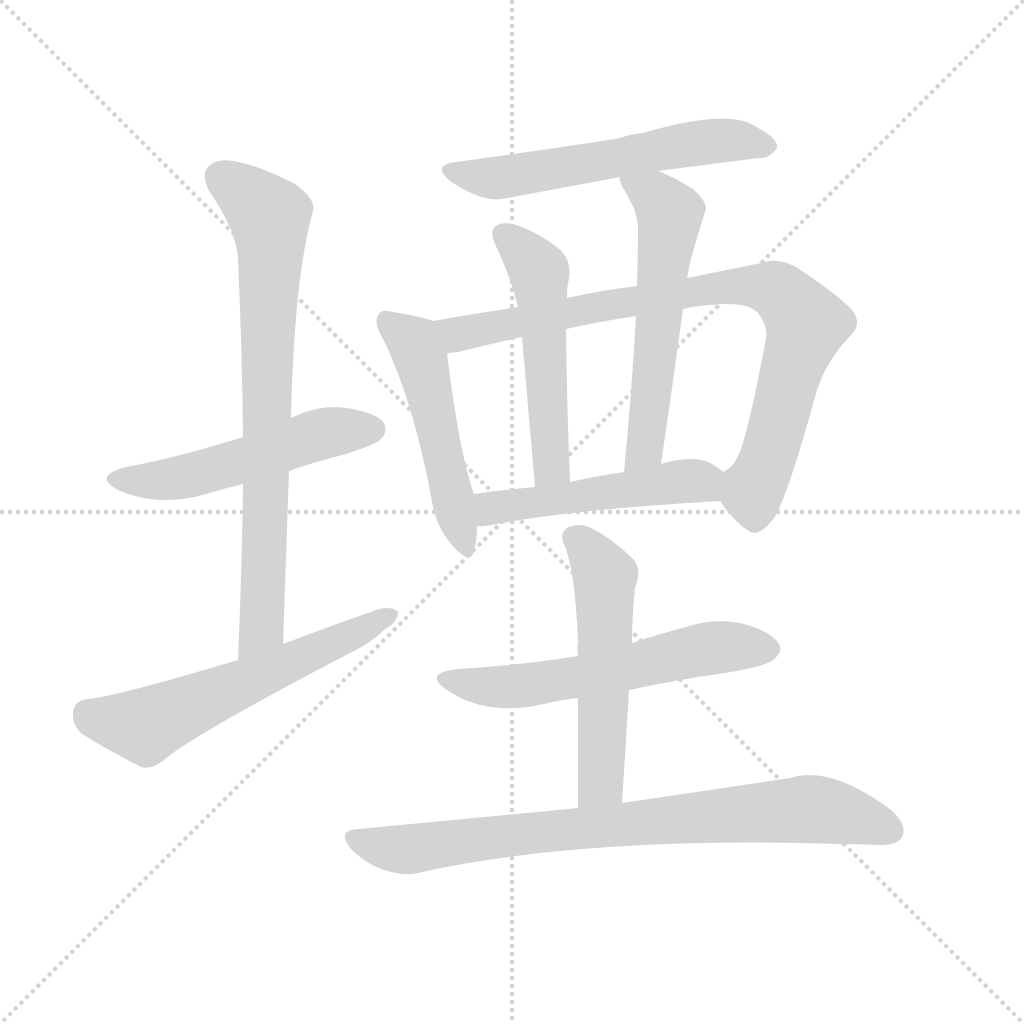
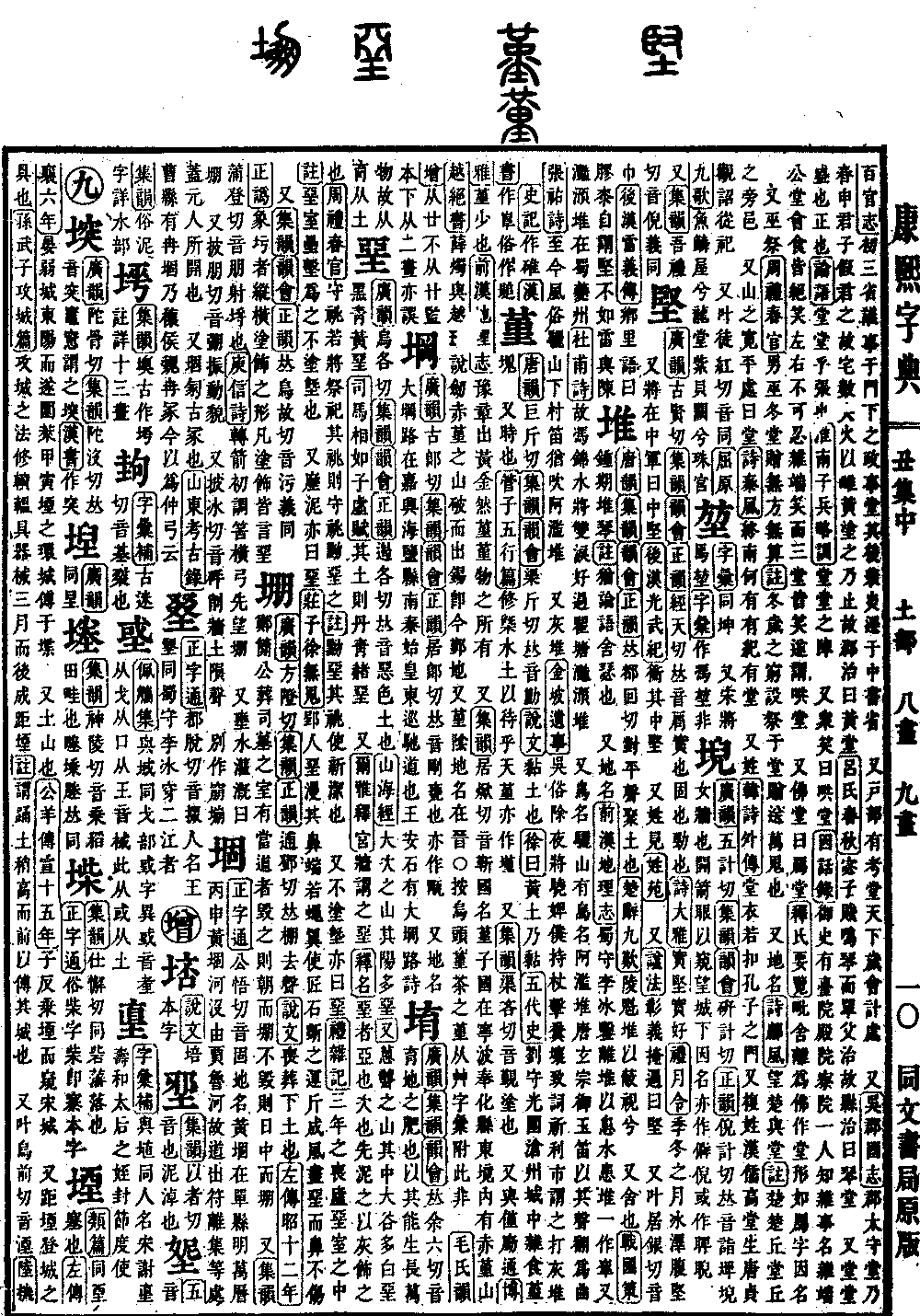
Chou Collection, Middle Volume. Radical: Earth (tǔ). Kangxi stroke count: 12. Page 232, Entry 23. According to the Classified Dictionary of Characters (Leipian), this is the same as the character for blocking. In the Commentary of Zuo (Zuozhuan), during the sixth year of Duke Xiang, Yan Ruo built a wall in Dongyang and subsequently besieged the state of Lai. On the day of Jiayin, they used earth to block the area surrounding the wall, approaching the low parapet on top of the wall. It also refers to an earthen mound. In the Gongyang Commentary (Gongyangzhuan), in the fifteenth year of Duke Xuan, the commander Zifan was sent to climb an earthen mound to peer into the capital city of Song. It further refers to an assault mound, which is a tool used for scaling city walls. In the Art of War (Sunwuzi), specifically the chapter on attacking cities, the method of attacking a city involves building shielded siege wagons and preparing equipment; only after three months can the assault mound be completed. The commentary notes that this refers to piling up earth to gradually increase the height, pushing forward in order to approach the city wall. It is also rhymed with the pronunciation of the character for buried, pronounced yan. In the work Lament for Cai Yong by Lu Ji, it is written: that vast river is being divided; how could it be blocked by a handful of earth. Thus, the wise teachings of Confucius suggest that wisdom must pass through dullness before virtue can be achieved. It is also interchangeable with the character for filling. For further details, see the entry for that character.