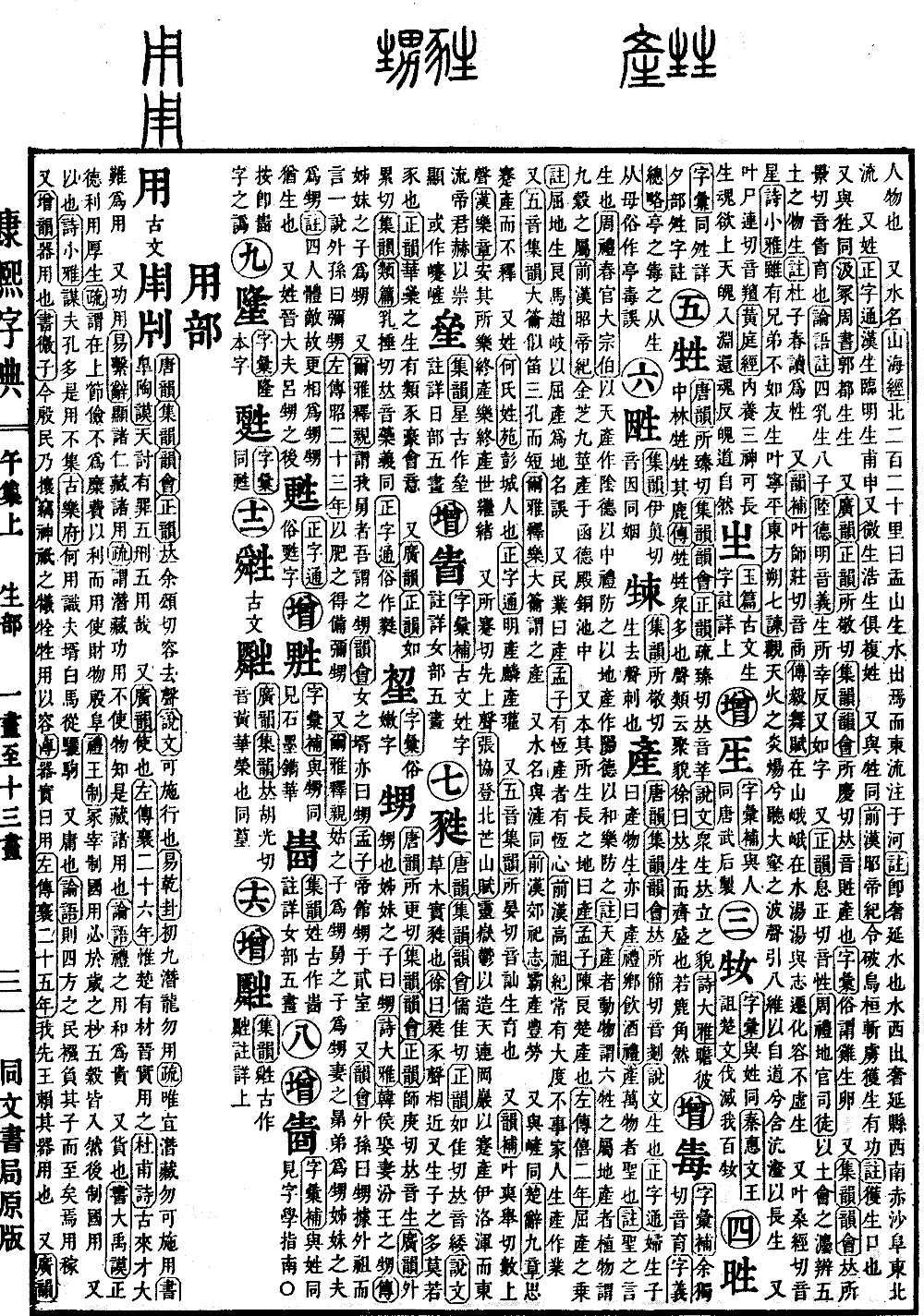
Wu Collection, Upper Volume
Radical: Use (yòng)
Kangxi Strokes: 5
Page 755, Entry 24
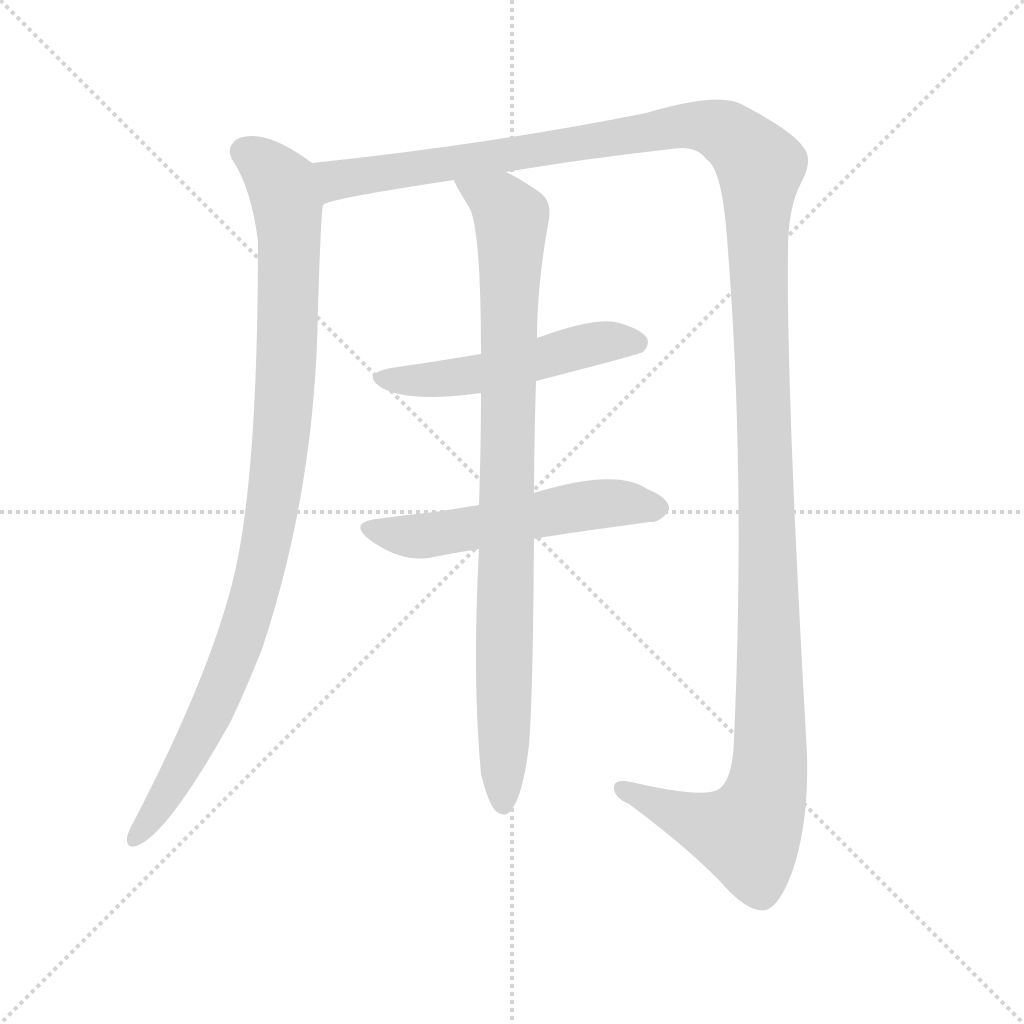
Ancient form. Pronounced yong (falling tone).
According to the Shuowen Jiezi, to be able to execute or implement.
In the Book of Changes (Yijing), Qian hexagram: "At the initial nine stage, the hidden dragon should not be made use of." Commentary: It is only appropriate to remain in hiding; it should not be implemented or made use of.
In the Book of Documents (Shujing), Counsels of Gao Yao: "Heaven punishes the guilty, use these five punishments accordingly."
Also, to employ or utilize.
In the Zuo Tradition (Zuo Zhuan), twenty-sixth year of Duke Xiang: "Only Chu has talent, and Jin actually employs it."
In the poetry of Du Fu: "Since ancient times, great talent has been difficult to utilize."
Also, utility or function.
In the Book of Changes (Yijing), Great Treatise: "Manifested in benevolence, hidden in its function." Commentary: This refers to hiding one's function so that external objects do not know of it; this is what is meant by "hidden in its function."
In the Analects (Lunyu): "In the practice (function) of ritual, harmony is to be prized."
Also, wealth and goods.
In the Book of Documents (Shujing), Counsels of the Great Yu: "Right conduct, the utilization of goods, and the enrichment of the people's lives." Commentary: This refers to those in high positions being frugal, not extravagant or wasteful, and using resources according to beneficial principles to ensure the abundance of goods.
In the Book of Rites (Liji), Royal Regulations: The prime minister determines state expenditures; this must be done at the end of the year, after the five grains have been harvested.
Also, indicating reliance or basis.
In the Book of Odes (Shijing), Minor Odes: "There are many who offer advice, and therefore the matter is difficult to accomplish."
In Ancient Music Bureau (Gulefu) poems: "By what is my husband to be identified? Riding a white horse followed by a black colt."
Also, indicating need.
In the Analects (Lunyu): "If so, then the people from the four quarters will carry their children on their backs to come to you; why would you need to farm yourself?"
Also, from the Zeng Yun: Implements or utensils.
In the Book of Documents (Shujing), Viscount of Wei: "Now the people of Yin-Shang are actually stealing the sacrificial animals and ritual implements of the gods to hide them." Commentary: Implements are referred to as use.
In the Zuo Tradition (Zuo Zhuan), twenty-fifth year of Duke Xiang: "Our former kings relied on these fine implements."
Also, from the Guangyun: To be thorough or reach.
Also, a surname. In the Han dynasty, there was a person named Yong Dou who served as the magistrate of Gaotang.
Also, according to the Yunbu, rhyming with the pronunciation rong.
In the Book of Odes (Shijing), Minor Odes: "Good plans are not listened to; bad plans are instead adopted."
In the New Discourses (Xinyu) by Lu Jia: "When the Great Way is severed and does not reach, morality is promoted but not adopted."
Also: "When standing, it is the root of the multitude of trees on Mount Tai; when fallen, it is material that can be used for ten thousand generations."
Also, from the Liushu Zheng'e: Zhou Boqi stated: The character for use is the ancient form of the character for a large bell. In ancient inscriptions, the character for bell on the Shang-dynasty Yin-Gui vessel is written as the character for use; later generations borrowed it to mean the "use" of implementation.
Textual research: In the Zuo Tradition, twenty-fifth year of Duke Xiang: "Our former kings relied on these fine implements." It is carefully noted that the character for profit has been added after the word relied upon, based on the original text.