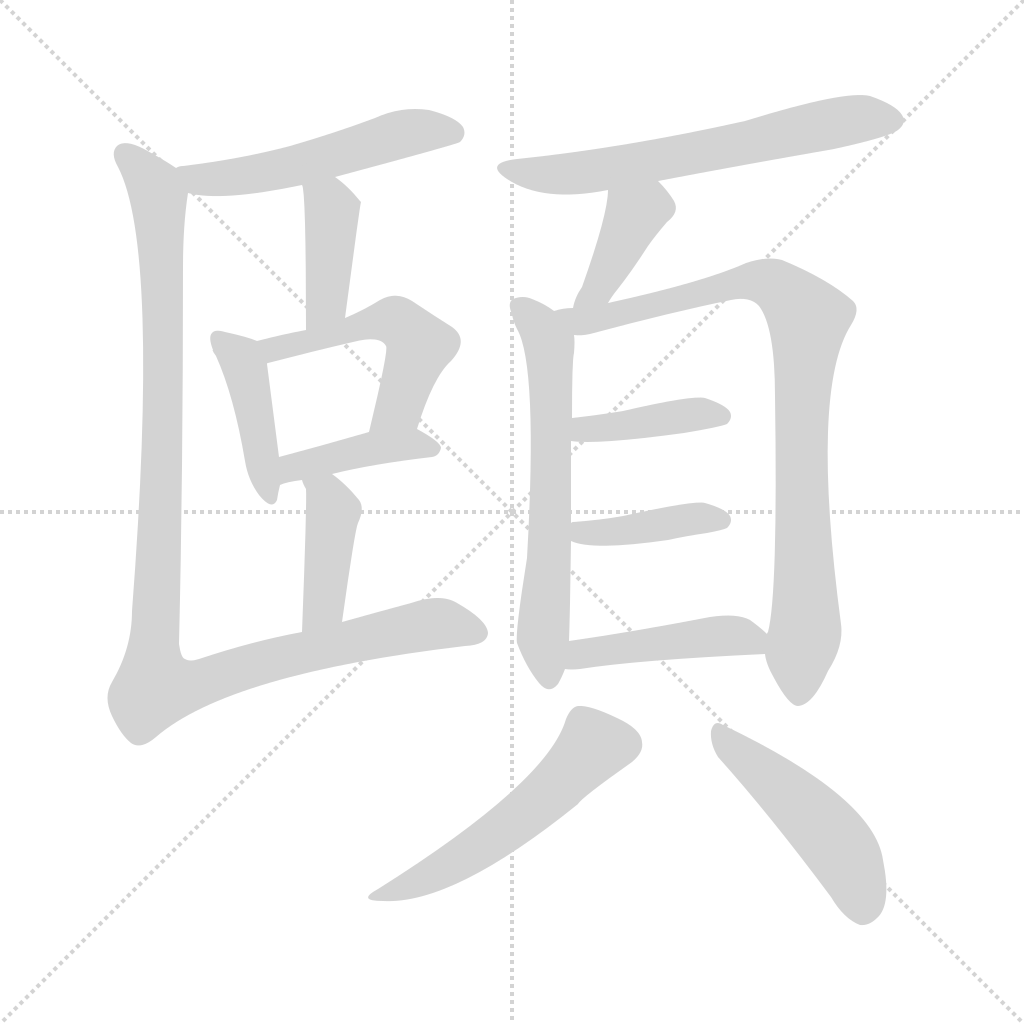
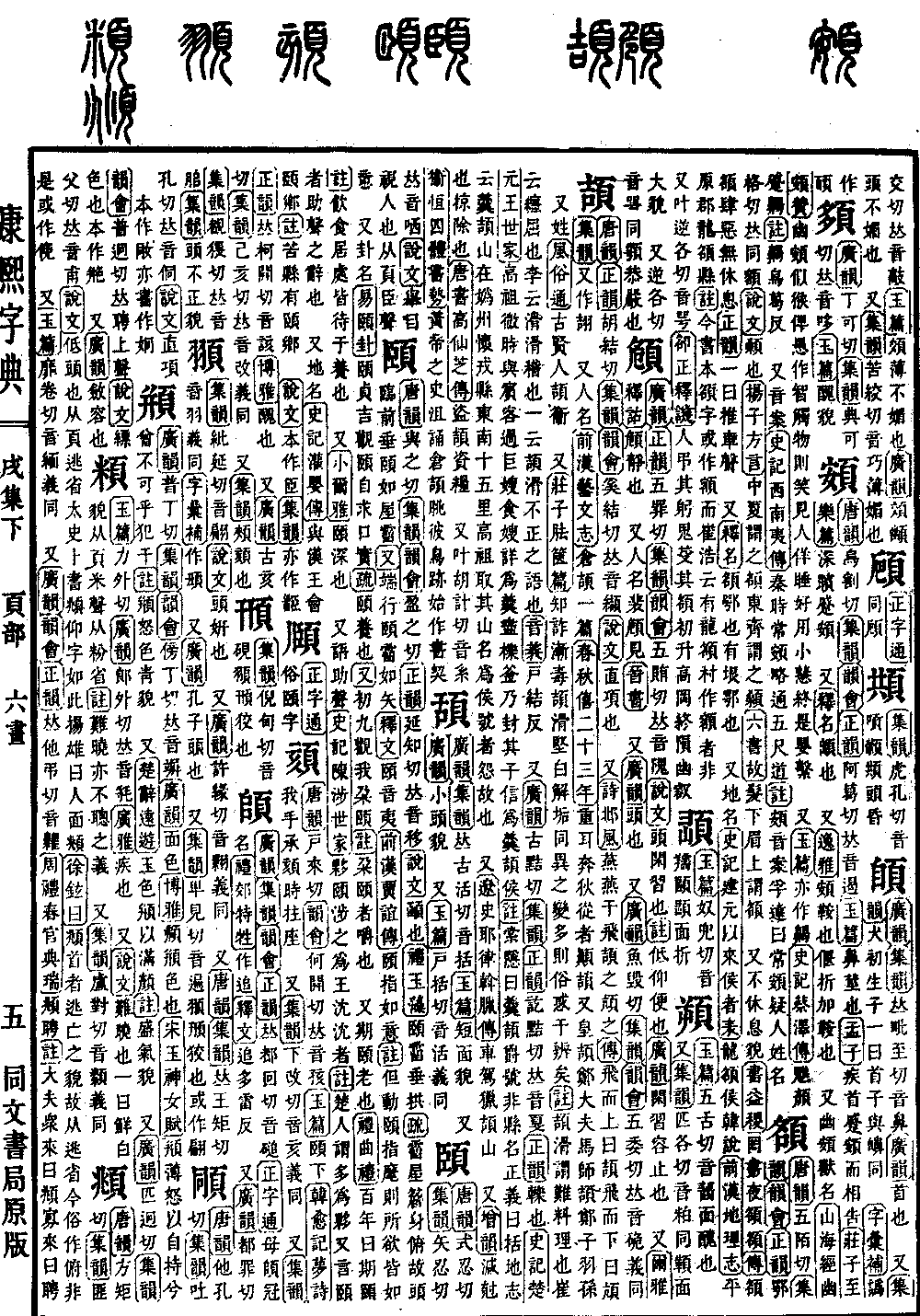
Xu Collection, Lower Volume
Radical: Leaf (yè)
Yi
Kangxi strokes: 15
Page 1403, Entry 13
Pronounced yi (rising tone).
As defined in the Shuowen Jiezi (Shuowen), the chin or jaw. In the Book of Rites (Liji), it says the chin hangs like eaves, referring to a bowing posture where the head leans forward and the chin hangs down like a roof eave. Also in the Book of Rites, it states to walk straight with the chin poised like an arrow. The Commentary on the Classics (Shiewen) notes the pronunciation is yi (level tone). In the History of the Former Han (Qianhan shu), the Biography of Jia Yi mentions moving the chin to point as one wishes, meaning that by merely moving the chin to gesture, one’s desires are fulfilled.
It is also the name of a hexagram. In the Book of Changes (Yijing), the Yi hexagram states that to be upright is auspicious, and to observe the Yi hexagram is to seek nourishment for oneself. The commentary explains that Yi means nourishment. The hexagram also states that the initial nine represents observing one’s own chewing, and the commentary explains that chewing is the act of mastication.
Also, the term Qiyi refers to old age. In the Book of Rites, it says that one hundred years of age is called Qiyi, which the commentary explains as a time when one relies on others for food, drink, and daily living.
Also, in the Minor Erya (Xiao Erya), Yi means deep.
It is also used as a modal particle. In the Records of the Grand Historian (Shiji), the Biography of Chen She states that the word huo-yi refers to the immense scale of Chen She’s kingship. The commentary notes that in the Chu region, people use huo to mean much, and yi is used as an auxiliary sound.
Also, a place name. In the Records of the Grand Historian, the Biography of Guan Ying mentions meeting the King of Han at Yixiang, and the commentary notes that there is a Yixiang in Ku County.
In the Shuowen Jiezi, the original form is written as a variant. In the Jiyun (Jiyun), it is also written in a variant form.