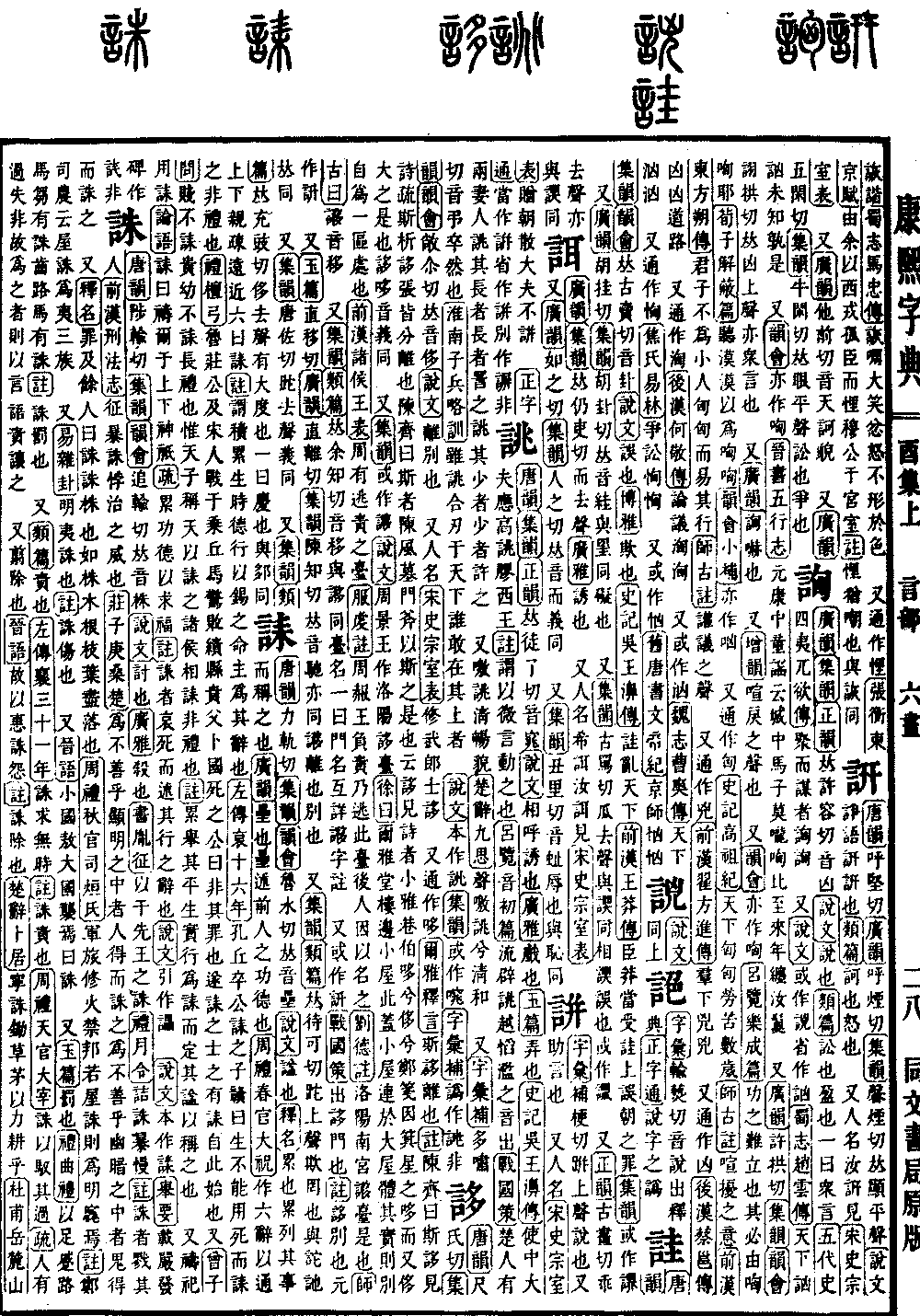
You Collection, Upper Volume
Radical: Speech (yán)
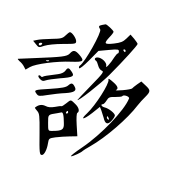
Character: Yi
Kangxi strokes: 13
Page 1160, Entry 09
Pronounced chi (rising tone).
Pronounced chi (rising tone).
Pronounced chi (rising tone).
According to the Explaining Graphs and Analyzing Characters (Shuowen Jiezi), it means to separate or depart. Also used as a personal name. In the History of Song (Songshi), Genealogy of the Imperial Clan, there is mention of the Gentleman of Xiuwu, Shi Yi. It is also used interchangeably with duo. According to the Er Ya, Explanation of Words, period yi means to separate. Commentary: In the Qi state, this is called si. Yi appears in the Commentary on the Book of Odes (Shijing). Si, xi, and yi all signify separation. The reference to the Qi state calling it si refers to the usage in the Odes of Wei, Grave Gate, where it says the axe is used to split them. The mention of yi in the Odes refers to the Lesser Odes of the Kingdom, Lane Uncle, which says: duo and chi. Zheng Xuan’s commentary: This refers to the vastness of the Winnowing Basket constellation, which is further expanded. Yi and duo share the same sound and meaning.
Alternatively written as yi (a variant form). According to the Explaining Graphs and Analyzing Characters (Shuowen Jiezi), King Jing of Zhou built the Yi Terrace in Luoyang. Xu comments: The Er Ya defines this as a small side room attached to the main hall. This is likely a small room connected to the main building, yet physically distinct as a separate area. In the History of the Former Han (Qian Hanshu), Table of Feudatory Princes, it mentions the Terrace of Escaping Debts. The commentary by Fu says: King Nan of Zhou was in debt and fled to this terrace, and later generations named it accordingly. Liu De’s commentary notes: This is the Yi Terrace in the South Palace of Luoyang. Shigu says: Yi is pronounced yi.
Also pronounced yi (rising tone). It is the same as yi. It is the name of a terrace. Another interpretation says it is the name of a gate. See the note for the character yi for further details.
Sometimes written as a variant form. In the Strategies of the Warring States (Zhanguo Ce), it mentions exiting through the Yi Gate. Commentary: Yi means to separate. The original text was written with a variant.
According to the Yu Pian, pronounced chi (rising tone). According to the Guang Yun, pronounced chi (rising tone). According to the Collection of Rhymes (Jiyun), pronounced chi (rising tone). It is synonymous with yi, meaning to separate or to depart.
According to the Collection of Rhymes (Jiyun) and the Classified Chapters (Leipian), pronounced tuo (rising tone). It means to deceive or defraud. It is synonymous with tuo and yi.
According to the Collection of Rhymes (Jiyun), pronounced tuo (departing tone). The meaning is the same.
According to the Collection of Rhymes (Jiyun) and the Classified Chapters (Leipian), pronounced chi (departing tone). It means to have a generous spirit. Another interpretation says it means to celebrate. It is synonymous with a variant form.