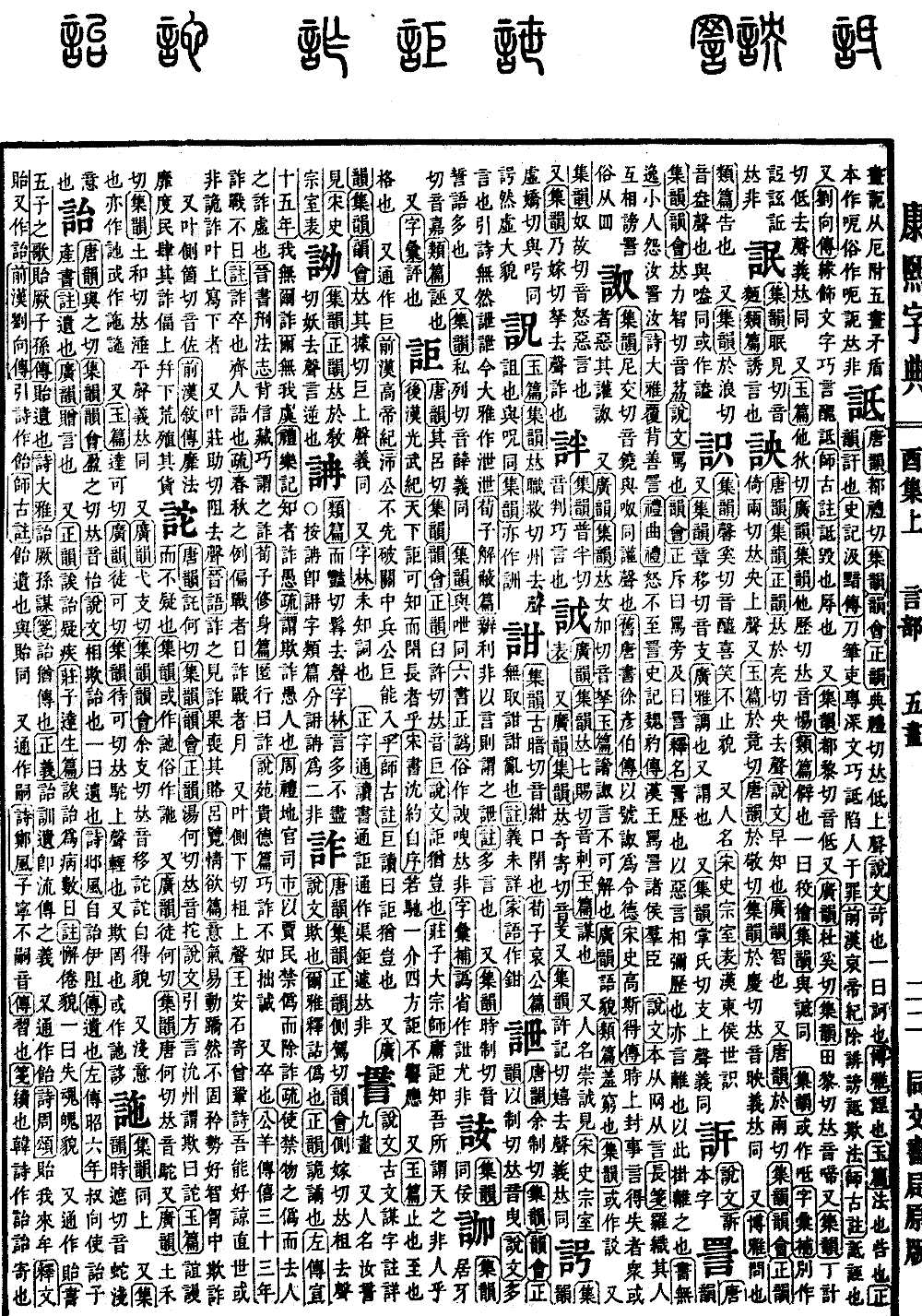
You Collection, Upper Volume
Radical: Speech (yán)
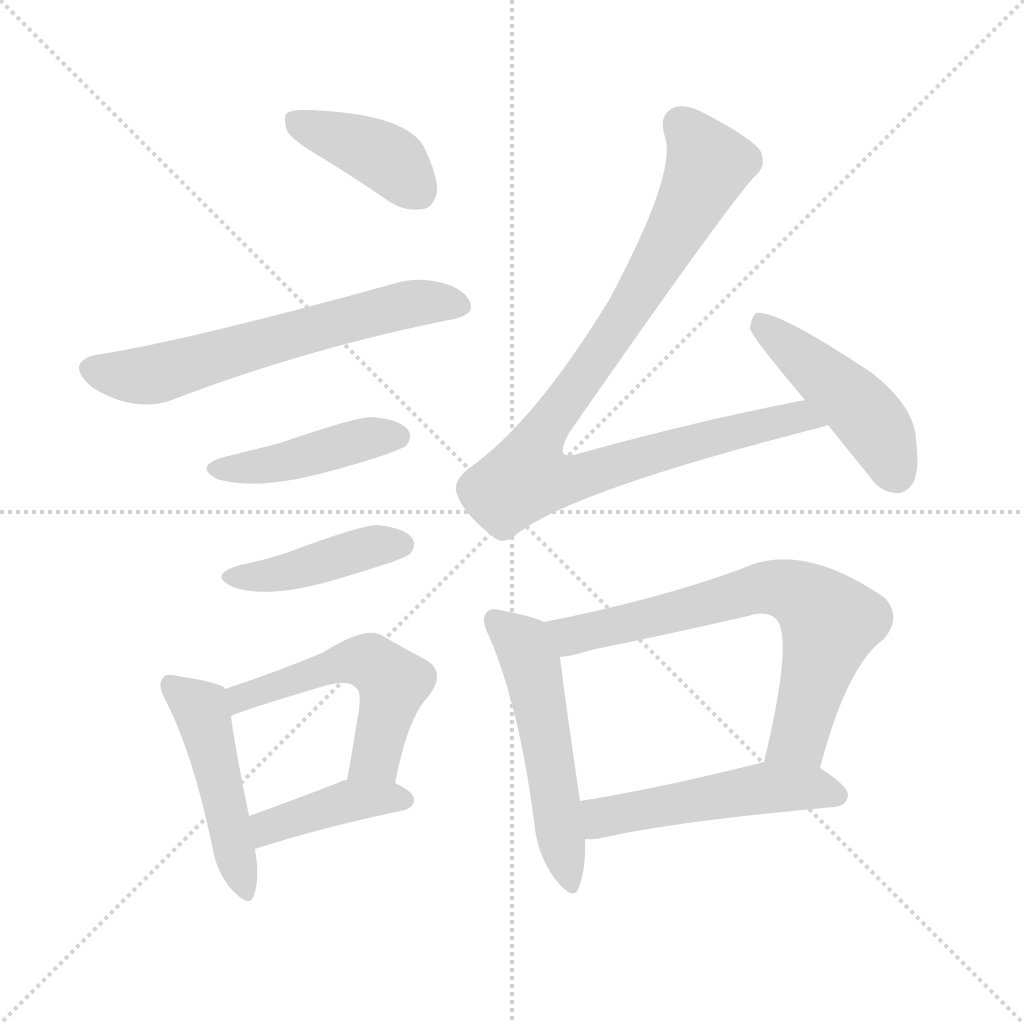
Yi
Kangxi Stroke Count: 12
Page 1154, Entry 23
Tang Rhyme (Tangyun): Pronounced zhi.
Collection of Rhymes (Jiyun), Collected Rhymes (Yunhui): Pronounced the same as the character yi.
Analytical Dictionary of Characters (Shuowen): Means to deceive one another. Another interpretation is to leave behind or to give as a gift.
Book of Odes (Shijing), Beifeng: Leaving this worry for myself.
Commentary (Zhuan): Means to leave behind.
Zuo Commentary (Zuozhuan), Year 6 of Zhao: Shuxiang sent a letter to Zichan.
Annotation (Zhu): Means to give to.
Broad Rhyme (Guangyun): Means parting words.
Also, Correct Rhymes (Zhengyun): Aiti, refers to an ailment of suspicion.
Zhuangzi, Dasheng Chapter: Became ill for several days due to aiti.
Annotation (Zhu): Describes a state of laxity and fatigue. Another explanation is the appearance of being distraught.
Also used interchangeably with the character yi (to bequeath).
Book of Documents (Shujing), Song of the Five Sons: To bequeath to their descendants.
Commentary (Zhuan): Yi means to leave behind.
Book of Odes (Shijing), Daya: To bequeath strategy to his descendants.
Note (Jian): Yi is the same as the meaning of passing down.
Rectification (Zhengyi): Yi is explained as leaving behind, which means to hand down.
Also used interchangeably with the character yi (maltose).
Book of Odes (Shijing), Zhousong: Bestowed upon us barley and wheat.
Explication of Texts (Shiwen): Yi is also written as yi.
Former Han History, Biography of Liu Xiang: Cites the Book of Odes (Shijing) written with the character yi (maltose).
Shigu Annotation (Shigu Zhu): Yi means to give as a gift. It is the same as the character yi (to bequeath).
Also used interchangeably with the character si (to continue).
Book of Odes (Shijing), Zhengfeng: Why do you not continue to send news?
Commentary (Zhuan): Means to practice.
Note (Jian): Means to continue. Han Poetry (Hanshi) is written as yi. Yi means to send. To unexpectedly not send a letter of inquiry.
Also, Collection of Rhymes (Jiyun), Collected Rhymes (Yunhui): Pronounced as yi (departing tone).
Categorized Compilation (Leipian): Also means to leave behind.
Collected Rhymes (Yunhui): Means to bestow.
Zuo Commentary (Zuozhuan), Year 16 of Wen: For those aged seventy and above, there are none who are not gifted items.
Sub-commentary (Shu): Both kui and yi are terms for giving items to people, synonymous with the character yi (to bequeath), having both level tone and departing tone pronunciations.
Also, Collection of Rhymes (Jiyun): Pronounced as tai.
Describes a state of laxity and fatigue. Cites the aiti from Zhuangzi. Li Gui reads it this way.
Also, Collection of Rhymes (Jiyun): Pronounced as tai.
Meaning is the same. Also has the meaning of to deceive.
Also, Broad Rhyme (Guangyun): Pronounced as tai (rising tone).
Categorized Compilation (Leipian): In the Jiangnan region, deception is called yi.
Supplemented Rhymes (Zengyun): Qiyi means to hoodwink and defraud.
Liezi, Yellow Emperor Chapter: To play tricks, insult, and deceive.
Xu Gan, Kao Wei Chapter: Relatives deceive one another, friends defraud one another.
Also, Collection of Rhymes (Jiyun): Used interchangeably with the character dai.
Guliang Commentary (Guliangzhuan), Year 1 of Xi: To hate the deception of the公子 (gongzi).
Annotation (Zhu): Means to deceive.
Records of the Grand Historian (Shiji), Annals of Xiang Yu: The King of Xiang lost his way, and a farmer deceived him saying: Go to the left, which resulted in his being trapped in a large swamp.
Shigu Annotation (Shigu Zhu): Dai means to hoodwink.
Categorized Compilation (Leipian): Sometimes written in a variant form.