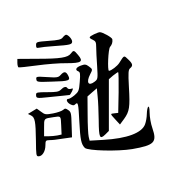
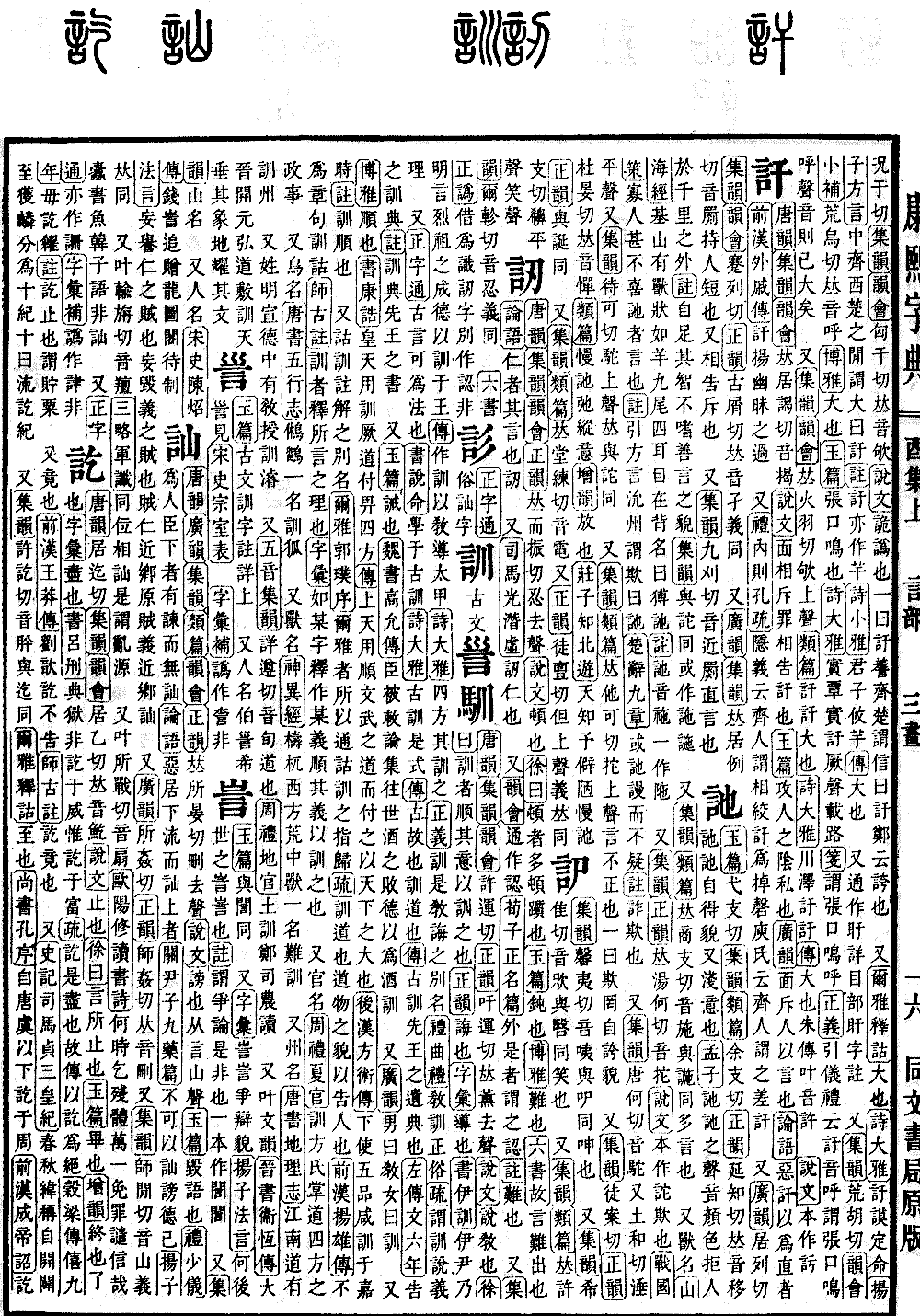
You Collection, Upper Volume
Radical: Speech (yán)
Page 1148, Entry 02
Pronounced yi. Describes a self-satisfied appearance. Also refers to shallowness. Mencius (Mengzi): The self-satisfied tone and expression reject others from a distance of a thousand miles. Commentary: Refers to someone content with their own wisdom who dislikes hearing good advice. Collected Rimes (Jiyun) notes it is the same as the character for being boastful. Sometimes written in a variant form.
Also, Collected Rimes (Jiyun) and Classified Dictionary (Leipian) note it is pronounced shi. It is the same as the character for being talkative. It also refers to a type of beast. Classic of Mountains and Seas (Shanhaijing): On Base Mountain there is a beast shaped like a sheep with nine tails and four ears, with eyes on its back; it is named bosi. Commentary: The pronunciation for the second syllable is as noted. Another version writes it as the character for slope.
Also, Collected Rimes (Jiyun) and Correct Rimes (Zhengyun) note it is pronounced tuo. According to Explaining Graphs and Analyzing Characters (Shuowen), it was originally written as the character for deceit. Refers to deception. Strategies of the Warring States (Zhanguoce): I truly dislike those who speak deceitful words. Commentary: Citing local dialects, the Yanzhou region refers to deception as this. Songs of Chu (Chu Ci), Nine Chapters (Jiuzhang): Some people deceive others without being suspected. Commentary: Refers to fraud.
Also, Collected Rimes (Jiyun) notes it is pronounced tuo. Also, it is pronounced as the level tone of the character for spit.
Also, Collected Rimes (Jiyun) notes it is pronounced tuo (rising tone). It is the same as the character for being boastful.
Also, Collected Rimes (Jiyun) and Classified Dictionary (Leipian) note it is pronounced tuo (rising tone). It refers to speech that is not upright. One source says it refers to an appearance of deception and self-aggrandizement.
Also, Collected Rimes (Jiyun) and Classified Dictionary (Leipian) note it is pronounced dan. Classified Dictionary (Leipian) defines it as slack and indulgent. Expanded Rimes (Zengyun) defines it as indulgent. Zhuangzi, Knowledge Wandering North (Zhi Beiyou): Heaven knows that I am ignorant and slack. Correct Rimes (Zhengyun) notes it is the same as the character for lying.
Also, Collected Rimes (Jiyun) and Classified Dictionary (Leipian) note it is pronounced dian.
Also, Correct Rimes (Zhengyun) notes it is pronounced dan (rising tone). The meaning is the same.