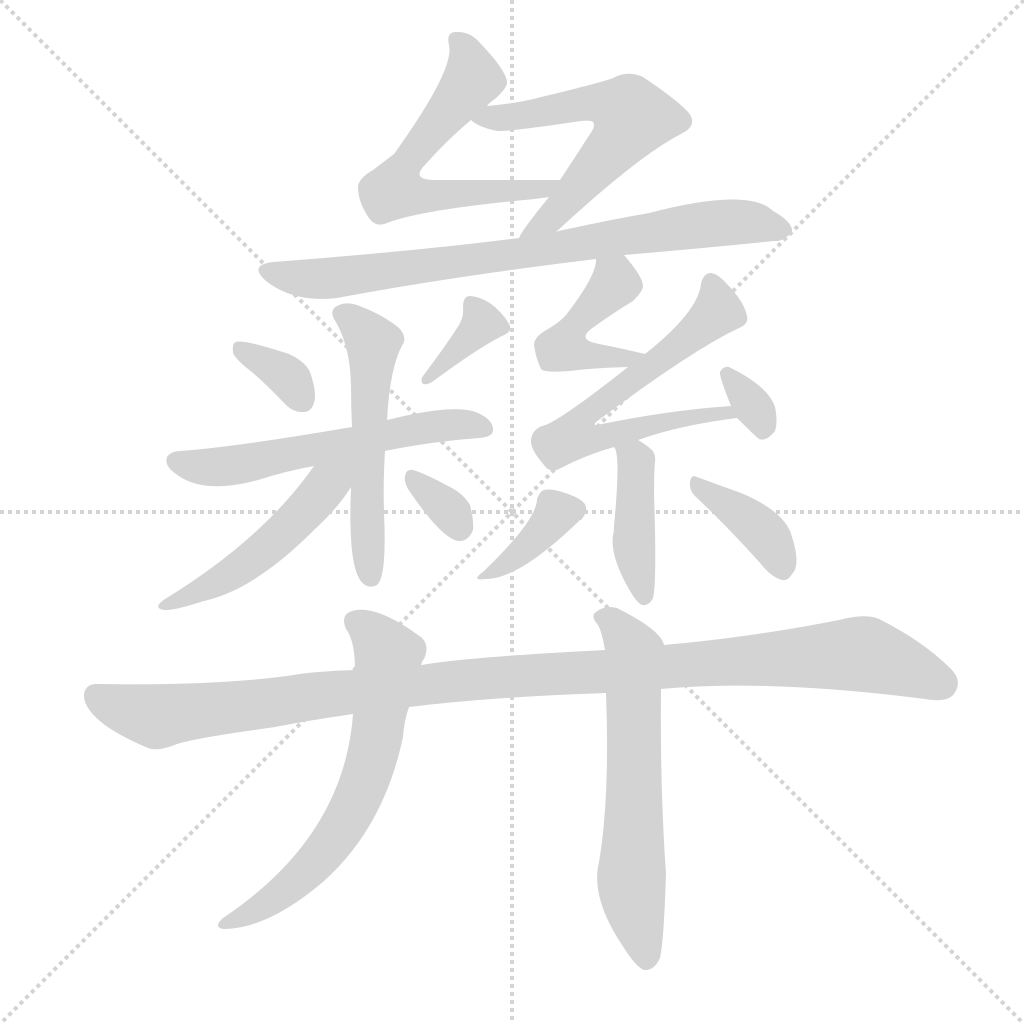
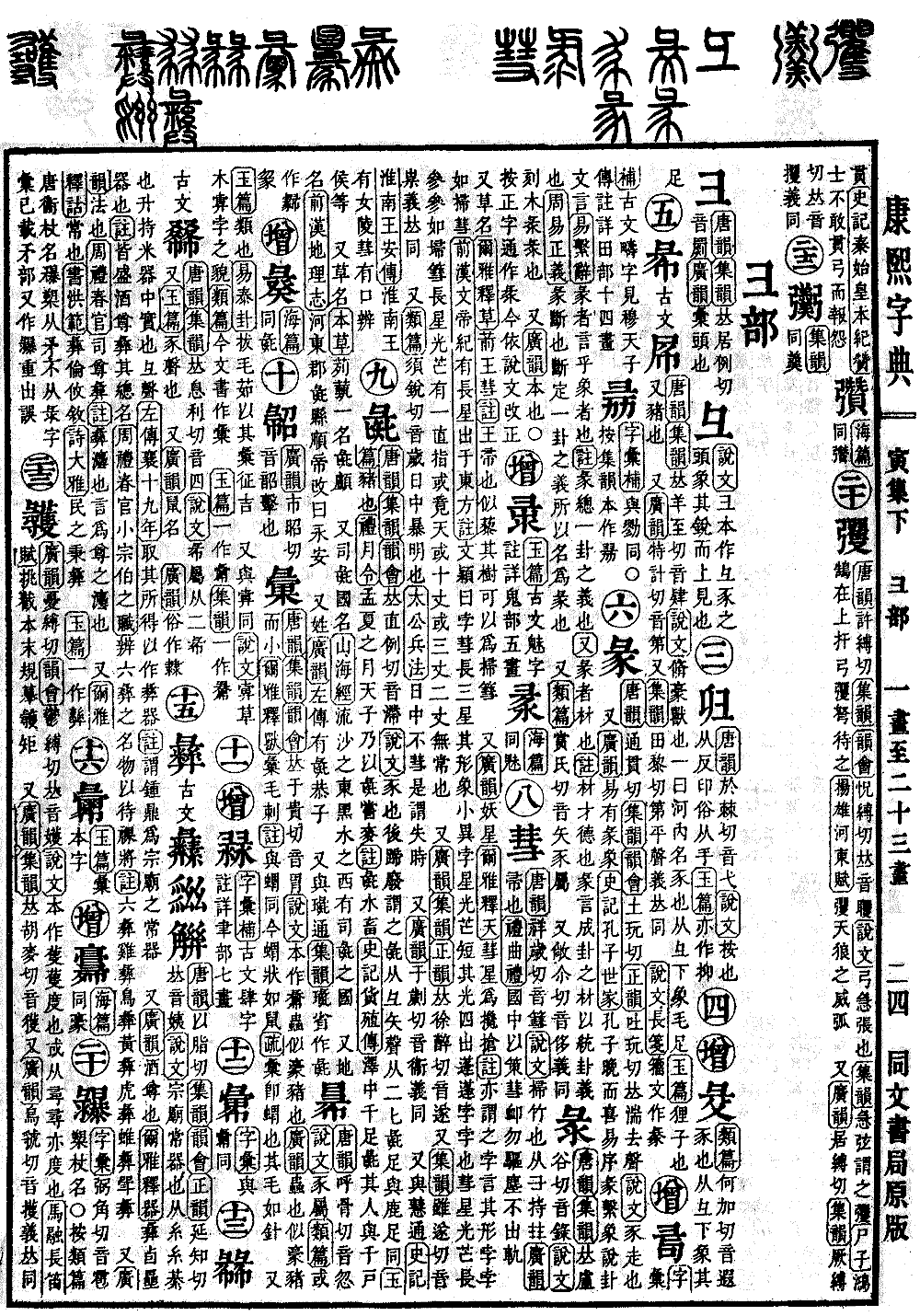
Yin Collection, Lower Volume
Radical: Snout (jì)
Kangxi Dictionary stroke count: 18
Page 362, Entry 26
Ancient literary records:
Tang Rhymes (Tangyun) states it is pronounced yi. Collected Rhymes (Jiyun), Rhyme Meetings (Yunhui), and Orthodox Rhymes (Zhengyun) state it is pronounced yi. The pronunciation is similar to yi.
Explication of Written Characters (Shuowen Jiezi) explains: A ritual vessel commonly used in ancestral temples. The character structure uses silk (mì) as the radical. Silk refers to the woven base cushion. Rising (shēng) represents the rice vessel held in the hand, with the center filled with objects. Snout (jì) is the phonetic component.
The Zuo Tradition (Zuo Zhuan), 19th year of Duke Xiang, records: Take the obtained materials to produce ritual vessels. Note: Refers to bells, tripods, and other ritual vessels commonly used in ancestral temples.
Furthermore, Broad Rhymes (Guangyun) explains: A vessel used for storing wine.
The Literary Expositor (Erya), Interpretation of Vessels, records: Yi, you, and lei are all containers. Note: These are all wine-storing vessels; yi is the collective term for them.
The Rites of Zhou (Zhouli), Spring Officials, Duties of the Minor Ancestral Recorder, records: Distinguish the names and forms of the six types of ritual vessels to prepare for the libation ritual. Note: The six yi refer to: chicken yi, bird yi, yellow yi, tiger yi, macaque yi, and jia yi.
Furthermore, Broad Rhymes (Guangyun) explains: Law or standard.
The Rites of Zhou (Zhouli), Spring Officials, includes the position of Official of Ritual Vessels. Note: Yi, that is, law. Refers to the laws governing the use of ritual vessels.
Furthermore, The Literary Expositor (Erya), Interpretation of Words, explains: Constant way or constant principle.
The Book of Documents (Shangshu), Great Plan, records: The constant principles and order are regulated.
The Book of Odes (Shijing), Greater Odes, records: The people uphold their constant nature.
The Jade Chapters (Yupian) records: A variant form of this character is written as.
Textual research: The original text of The Literary Expositor (Erya), Interpretation of Vessels, is written as "Yi, you, lei are vessels." It has now been corrected to "lei" in accordance with the original text.