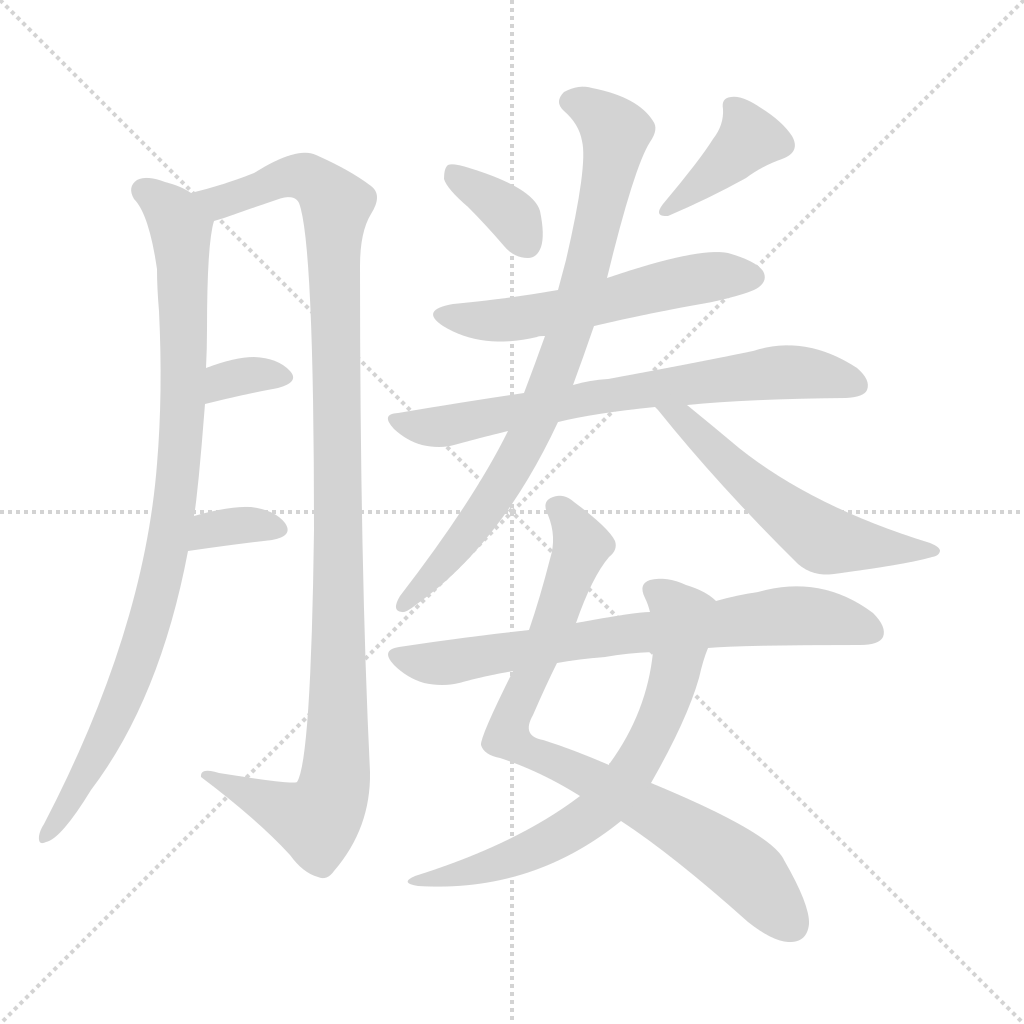
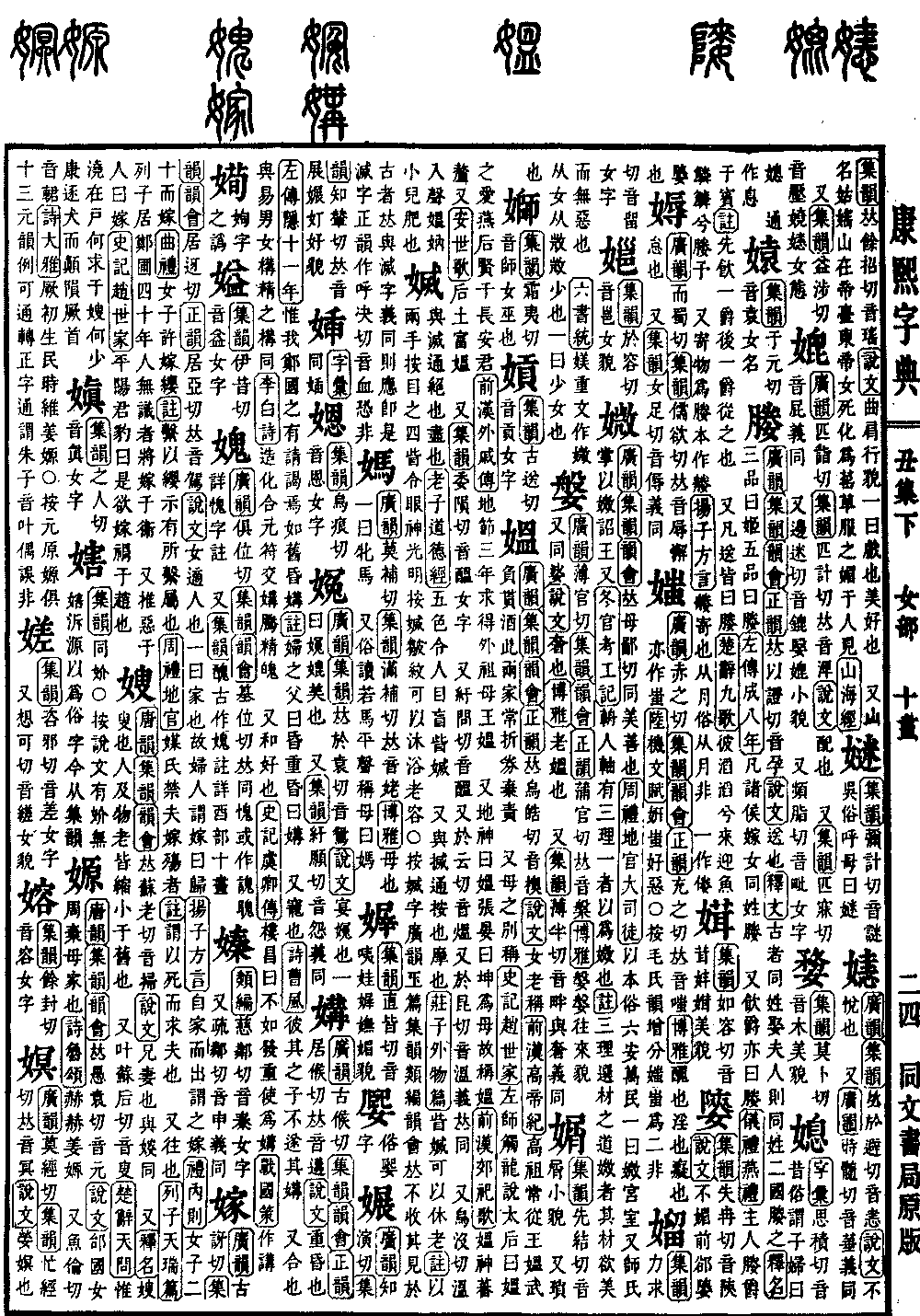
Chou Collection, Lower Volume
Radical: Woman (nǚ)
Ying
Kangxi stroke count: 13
Page 268, Entry 07
Pronounced ying (falling tone).
Shuowen Jiezi (Explanation of Graphs and Analysis of Characters) defines this as to send.
Classic of Rites Explanation (Shiwen) states: In ancient times, when feudal lords took a principal wife, two feudal states of the same surname would send women as part of the dowry.
Explanation of Names (Shiming) states: A woman of the third rank is called ji, and a woman of the fifth rank is called ying.
Zuo Tradition (Zuozhuan), Eighth Year of Duke Cheng: Whenever feudal lords marry off their daughters, states of the same surname must send women as dowry.
Also, offering a toast is called ying.
Ceremonial and Rituals (Yili), Banquet Rites: The host toasts the guests. Commentary: One drinks a cup first, and then a subsequent cup is offered in succession.
Furthermore, any act of sending someone off can be called ying.
Songs of Chu (Chucai), Nine Songs: The waves surge as if coming to welcome, the fish travel in schools to accompany me.
Also, sending items as a gift is called ying.
The original form of the character is written as [variant].
Yang Xiong's Dialects (Fangyan) states: The character means to send. The character is formed with the radical for moon (yùe). The common version using the moon radical is incorrect. It is also written as [variant]. Note that the moon radical here actually consists of an enclosure (jiōng) containing ice (bīng).
Textual verification: In the Songs of Chu (Chucai), Nine Songs, the original text reads waves (bō) surging to welcome; the character for that (bǐ) has been corrected to waves (bō) according to the original text.