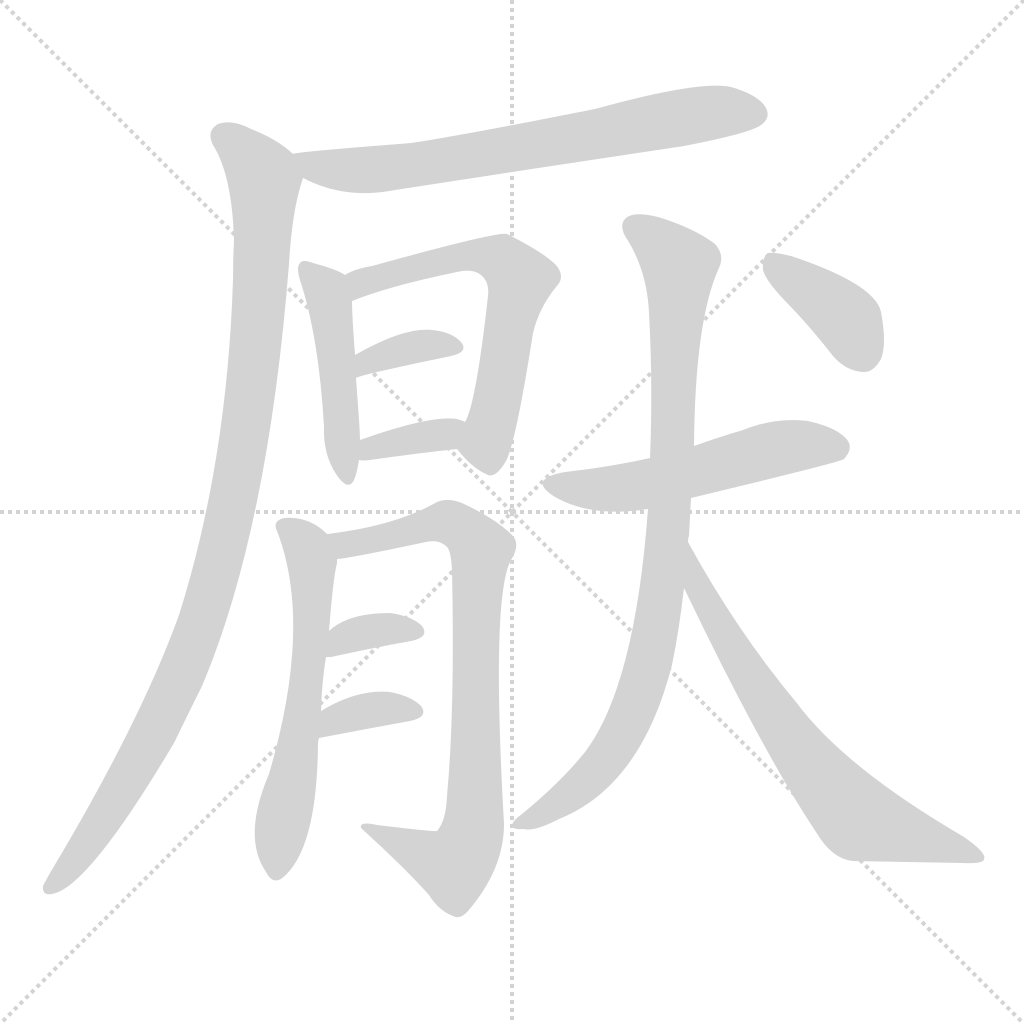
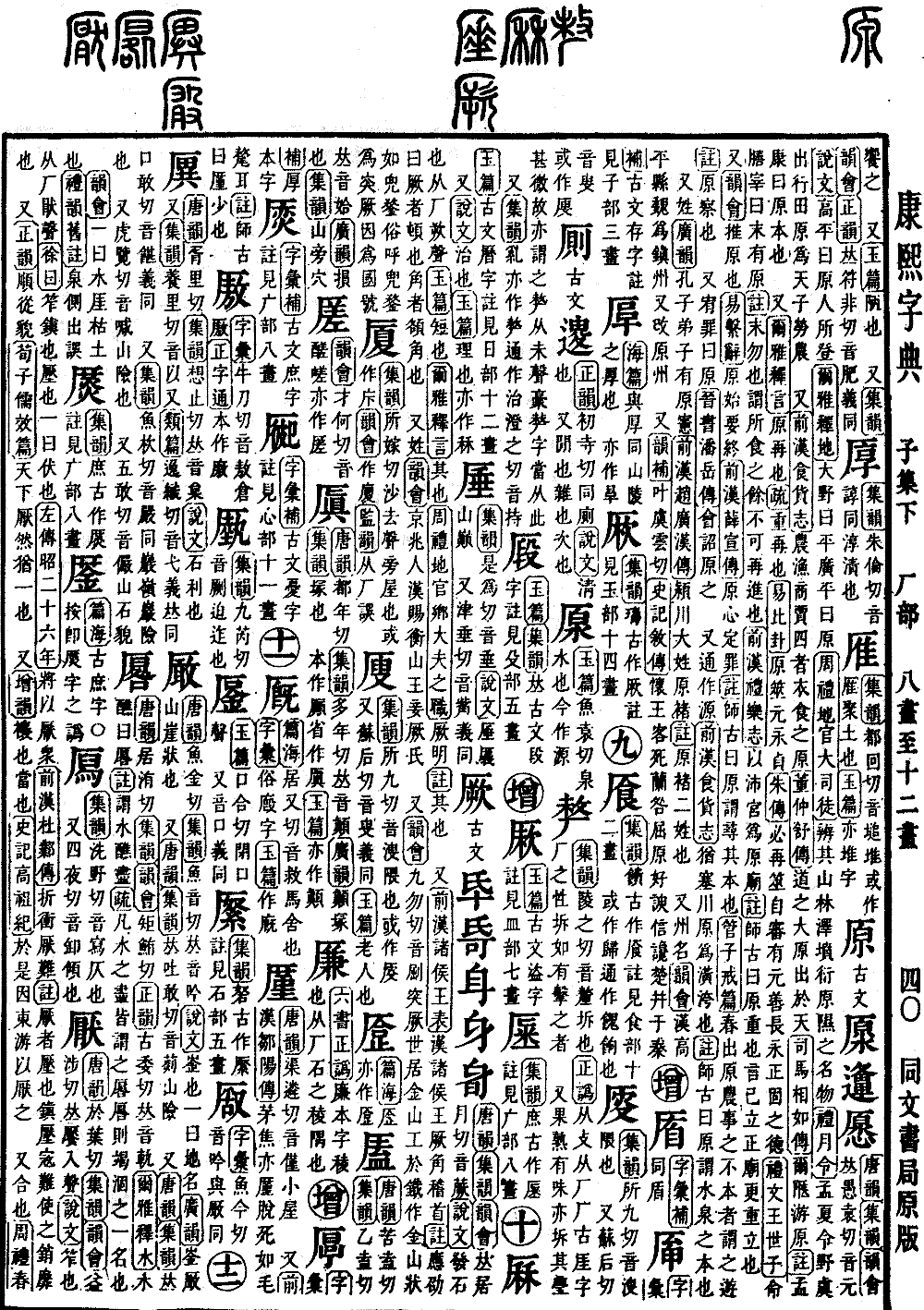
Zi Collection, Page Position: Lower
Radical: Cliff (hàn)
Yan
Kangxi Stroke Count: 14
Page 162, Number 51
Tang Dynasty Rhymes (Tangyun): yu-ye fanqie. Collected Rhymes (Jiyun) and Collected Rhyme Meetings (Yunhui): yi-she fanqie. Pronounced similarly to the entering tone of the character yàn.
Explaining Graphs and Analyzing Characters (Shuowen Jiezi) defines it as to press (zuó). The character structure follows the Cliff (hàn) radical and the phonetic component yàn.
Xu Xuan states that zuó means to suppress or restrain. Another interpretation is to lie prostrate.
Intending to use it to suppress the masses — Commentary of Zuo (Zuozhuan)
To break through the enemy's assault and suppress difficulties — Book of the Former Han (Qian Hanshu), Biography of Du Ye
Commentary: yàn means to press, referring to suppressing disasters and difficulties to make them dissipate.
Also, Correct Rhymes (Zhengyun): Expresses a state of obedience or submissiveness.
The whole world was submissive as if it were one — Xunzi (Xunzi), Chapter on the Effects of Confucianism (Ruxiao)
Also, Augmented Rhymes (Zengyun): Means to ward off or resist.
Thus he traveled east to ward it off — Records of the Grand Historian (Shiji), Annals of Gaozu
Also expresses the meaning of bringing together or approaching closely.
The Queen's carriage decorated with overlapping pheasant feathers — Rites of Zhou (Zhouli), Offices of Spring, Carriage Master
Commentary: Refers to arranging feathers so they are close to each other.
Also means to reduce or diminish.
And made a covenant with Chufu of Jin to diminish it — Commentary of Zuo
Commentary: yàn is like reducing.
Also from the Book of Etiquette and Ceremonial (Yili), Village Drinking Ceremony: The guest signaled with his hands to the assistant as they entered the left side of the gate.
Commentary: Pushing the hands forward in a bow is called yī; pulling the hands inward in a bow is called yàn.
Sub-commentary: Pulling the hands is called yàn refers to drawing the hands toward oneself.
Also, Broad Rhymes (Guangyun): Refers to a nightmare.
Also, Collected Rhymes: Yàncì is a place name.
Also, Collected Rhymes: Sometimes also written as yā.
Also, Tang Dynasty Rhymes, Collected Rhymes, Collected Rhyme Meetings, and Correct Rhymes: yu-yan fanqie. Pronounced similarly to the departing tone of the character yàn.
Collected Rhymes defines it as being satisfied.
Full of vital energy and outstanding — Book of Odes (Shijing), Eulogies of Zhou
Commentary: yàn refers to plants being filled with vital energy.
Capable of satisfying the heart of the Lord on High — Book of the Former Han, Biography of Wang Mang
Commentary: yàn means full or satisfied.
Also, Collected Rhyme Meetings: yàn is interchangeable with dù, referring to being weary of something.
I wore them without getting weary — Book of Odes. Note: dù means to be weary.
Also interchangeable with the character yàn meaning satisfied or full.
Confucius said: There is the satisfaction of yin and the satisfaction of yang — Book of Rites (Liji), Questions of Zengzi
Commentary: yàn means to be full or satiated.
Also, Tang Dynasty Rhymes and Collected Rhymes: yu-yan fanqie. Correct Rhymes: yu-jian fanqie. Pronounced as yǎn.
One who presses on their eyes and looks will see one thing as two — Xunzi, Chapter on Dispelling Obscurity (Jiebi)
Also, Correct Rhymes: Means to dislike or loathe.
Heaven will reject me! — Analects (Lunyu)
Also, Broad Rhymes: Refers to using sorcery to confuse people. Sometimes also written in a variant form pronounced yǎn.
Fear and trepidation turned the dream into a nightmare — Han Yu (Hán Yù), Poem on Visiting Xiangxi Temple (You Xiangxi Si Shi)
Also, Correct Rhymes: Same as the character yǎn meaning a dark spot or mole. Pronounced similarly to yǎn meaning to hide or conceal.
After seeing a superior man, he conceals himself — Book of Rites, The Great Learning
Commentary: yàn is read as yǎn. It describes a state of closing up or hiding.
Also, Collected Rhymes: yu-yan fanqie. Pronounced as yán.
Explaining Graphs and Analyzing Characters defines it as peaceful.
Tranquilly drinking through the night — Book of Odes, Minor Odes
My tranquil and gentle husband — Book of Odes, Odes of Qin
Commentary: Refers to a state of being quiet and peaceful.
Also, Correct Rhymes: Same as the character yìn meaning to be satiated.
He is merely satisfied — Commentary of Zuo
Du Yu's commentary states that when a base person's belly is full, he still knows to be satisfied.
Also, Collected Rhymes and Correct Rhymes: yi-jia fanqie. Pronounced as yā.
Suppressed and restrained, he then withdrew — Book of the Former Han, Biography of Liu Xiang
Commentary: Yan Shigu states that yàn is pronounced as yā, meaning to be suppressed so that one cannot expand.
Also from the Chapter on the Effects of Confucianism in Xunzi: Approaching dawn at the Wilds of Muye.
Commentary: yàn means approaching, referring to the time just before the sky brightens.
Also, Correct Rhymes: Interchangeable with the character yā.
Also, Collected Rhymes: yi-ji fanqie. Pronounced as yì. The term yàyì means damp or moist.
Also, Collected Rhymes: wu-gan fanqie. Pronounced as àn. Means to be deeply immersed in something.
His immersion is like being sealed up — Zhuangzi (Zhuangzi), Wandering at Ease (Xiaoyaoyou)